

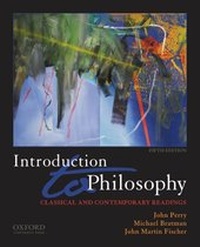
Introduction to Philosophy
Classical and Contemporary Readings
5th Edition
Published on 10. September 2009
Book
Paperback/Softback
880 pages
978-0-19-539036-0 (ISBN)
Description
Introduction to Philosophy: Classical and Contemporary Readings, Fifth Edition, is the most comprehensive topically organized collection of classical and contemporary philosophy available. Ideal for introductory philosophy courses, the text includes sections on God and evil, knowledge and reality, the philosophy of science, the mind/body problem, freedom of will, consciousness, ethics, political philosophy, existential issues, and philosophical puzzles and paradoxes. Insightful introductions to each part, study questions after each reading selection, and an extensive glossary of philosophical terms help make the readings more accessible to students. Revised and updated to make it more pedagogical, the fifth edition incorporates boldfaced key terms (listed after each reading and defined in the glossary); a guide to writing philosophy papers; and a "Logical Toolkit," which lists and explains common terminology used in philosophical reasoning. This edition also features five new readings and a separate section on existential issues. In addition, the book is accompanied by supplementary materials that enhance its utility.
An updated Instructor's Manual and Testbank on CD contains sample syllabi, sample exam questions, summaries of each reading, and additional pedagogical tools. A Companion Website at www.oup.com/us/perry offers multiple-choice self-quizzes; pedagogical material; and an interactive blog featuring recommended websites, news articles, helpful anecdotes, and interviews.
An updated Instructor's Manual and Testbank on CD contains sample syllabi, sample exam questions, summaries of each reading, and additional pedagogical tools. A Companion Website at www.oup.com/us/perry offers multiple-choice self-quizzes; pedagogical material; and an interactive blog featuring recommended websites, news articles, helpful anecdotes, and interviews.
More details
Edition
5th Revised edition
Language
English
Place of publication
New York
United States
Target group
College/higher education
Professional and scholarly
Edition type
Revised edition
Illustrations
Illustrations
Dimensions
Height: 235 mm
Width: 192 mm
Thickness: 32.5 mm
Weight
1361 gr
ISBN-13
978-0-19-539036-0 (9780195390360)
Copyright in bibliographic data and cover images is held by Nielsen Book Services Limited or by the publishers or by their respective licensors: all rights reserved.
Schweitzer Classification
Other editions
New editions
John Perry | Michael Bratman | John Martin Fischer
Introduction to Philosophy
Classical and Contemporary Readings
Book
07/2012
6th Edition
Oxford University Press Inc
€70.57
Article is exhausted; no reprint
Previous edition
Book
12/2007
4th Edition
Oxford University Press Inc
€184.45
Shipment within 15-20 days
Content
*=NEW TO THIS EDITION; Preface; PART I: PHILOSOPHY; Introduction: On the Study of Philosophy; Bertrand Russell, The Value of Philosophy; Plato, Apology: Defence of Socrates; PART II: GOD AND EVIL; Introduction; A. WHY BELIEVE?; Saint Anselm, The Ontological Argument; Saint Thomas Aquinas, The Existence of God; William Paley, Natural Theology; Blaise Pascal, The Wager; Bertrand Russell, Why I Am Not a Christian; B. THE PROBLEM OF EVIL; David Hume, Dialogues Concerning Natural Religion; Gottfried Leibniz, God, Evil and the Best of All Possible Worlds; John Perry, A Dialogue on Good, Evil, and the Existence of God; PART III: KNOWLEDGE AND REALITY; Introduction; A. PLATO AND THE CONCEPT OF KNOWLEDGE; Plato, Thaetetus; Edmund L. Gettier, Is Justified True Belief Knowledge?; B. DESCARTES AND THE PROBLEMS OF SKEPTICISM; Rene Descartes, Meditations on First Philosophy; Christopher Grau, Bad Dreams, Evil Demons, and the Experience Machine: Philosophy and The Matrix; Robert Nozick, Excerpt from Philosophical Explanations; C. HUME'S PROBLEMS AND SOME SOLUTIONS; David Hume, Of Scepticism with Regard to the Senses; David Hume, An Enquiry Concerning Human Understanding; W. C. Salmon, The Problem of Induction; PART IV: MINDS, BODIES, AND PERSONS; Introduction; A. THE TRADITIONAL PROBLEM OF MIND AND BODY; Bertrand Russell, The Argument from Analogy for Other Minds; Gilbert Ryle, Descartes's Myth; David M. Armstrong, The Nature of Mind; Daniel Dennett, Intentional Systems; Paul M. Churchland, Eliminative Materialism; B. MINDS, BRAINS, AND MACHINES; A. M. Turing, Computing Machinery and Intelligence; John R. Searle, Minds, Brains, and Programs; C. CONSCIOUSNESS; Thomas Nagel, What Is It Like to Be a Bat?; Frank Jackson, What Mary Didn't Know; David Lewis, Knowing What It's Like; D. PERSONAL IDENTITY; John Perry, A Dialogue on Personal Identity and Immortality; Bernard Williams, The Self and the Future; Derek Parfit, Personal Identity; * J. David Velleman, So It Goes; Daniel Dennett, Where Am I?; E. FREEDOM, DETERMINISM, AND RESPONSIBILITY; Roderick M. Chisholm, Human Freedom and the Self; Peter van Inwagen, The Powers of Rational Beings: Freedom of the Will; David Hume, Of Liberty and Necessity; Harry G. Frankfurt, Alternate Possibilities and Moral Responsibility; Harry G. Frankfurt, Freedom of the Will and the Concept of a Person; * Thomas Nagel, Moral Luck; PART V: ETHICS AND SOCIETY; Introduction; A. UTILITARIANISM; Jeremy Bentham, The Principle of Utility; John Stuart Mill, Utilitarianism; E. F. Carritt, Criticisms of Utilitarianism; J. J. C. Smart, Extreme and Restricted Utilitarianism; Bernard Williams, Utilitarianism and Integrity; Peter Singer, Famine, Affluence, and Morality; B. KANTIAN ETHICS; Immanuel Kant, Groundwork of the Metaphysic of Morals; * David Velleman, A Brief Introduction to Kantian Ethics; Onora O'Neill, Kantian Approaches to Some Famine Problems; Thomas Nagel, War and Massacre; C. ARISTOTELIAN ETHICS; Aristotle, Nicomachean Ethics; Thomas Nagel, Aristotle on Eudaimonia; D. JUSTICE AND EQUALITY; John Rawls, A Theory of Justice; Robert Nozick, Justice and Entitlement; G. A. Cohen, Where the Action Is: On the Site of Distributive Justice; John Stuart Mill, The Subjection of Women; Debra Satz, Markets in Women's Reproductive Labor; Kwame Anthony Appiah, Racisms; E. CHALLENGES TO MORALITY; 1. MORALITY AND SELF-INTEREST; Plato, The Republic; David Hume, An Enquiry Concerning the Principles of Morals; David Gauthier, Morality and Advantage; J. L. Mackie, The Law of the Jungle: Moral Alternatives and Principles of Evolution; 2. SUBJECTIVISM, RELATIVISM, AND SKEPTICISM; J. L. Mackie, The Subjectivity of Values; Gilbert Harman, Ethics and Observation; Nicholas L. Sturgeon, Moral Explanations; PART VI: EXISTENTIAL ISSUES; * Susan Wolf, Moral Saints; Thomas Nagel, The Absurd; Albert Camus, The Myth of Sisyphus; Richard Taylor, The Meaning of Human Existence; Susan Wolf, The Meanings of Lives; * Thomas Nagel, Death; PART VII: PUZZLES AND PARADOXES; Introduction; A. ZENO'S PARADOXES; Achilles and the Tortoise; The Racecourse; The Argument Against Plurality; B. METAPHYSICAL AND EPISTEMOLOGICAL PUZZLES AND PARADOXES; The Paradox of Identity; The Paradox of the Heap; The Surprise Examination; Goodman's New Riddle of Induction; C. PUZZLES OF RATIONAL CHOICE; The Prisoner's Dilemma; Newcomb's Problem; Kavka's Toxin Puzzle; Quinn's Puzzle of the Self-Torturer; D. PARADOXES OF LOGIC, SET THEORY, AND SEMANTICS; The Paradox of the Liar; Other Versions of the Liar; Russell's Paradox; Grelling's Paradox; E. PUZZLES OF ETHICS; The Trolley Problem; Ducking Harm and Sacrificing Others; Glossary