

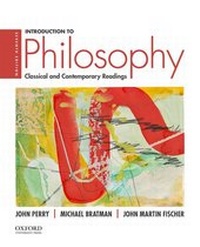
Introduction to Philosophy
Classical and Contemporary Readings
7th Edition
Published on 30. July 2015
Book
Paperback/Softback
928 pages
978-0-19-020023-7 (ISBN)
Description
Introduce your students to philosophy with the most widely used, trusted, and comprehensive topically organized collection of classical and contemporary readings available.
Easy to use for both students and instructors, Introduction to Philosophy: Classical and Contemporary Readings incorporates boldfaced key terms (listed after each reading and defined in the glossary), a "Logical Toolkit," and a guide to writing philosophy papers.
The seventh edition features eleven new readings, including eight by contemporary women philosophers, bringing the total number of essays by women to twelve. It is also accompanied by a robust support package that includes a more extensive test bank, available on the new online Ancillary Resource Center, and expanded self-quizzes for students on the Companion Website.
Easy to use for both students and instructors, Introduction to Philosophy: Classical and Contemporary Readings incorporates boldfaced key terms (listed after each reading and defined in the glossary), a "Logical Toolkit," and a guide to writing philosophy papers.
The seventh edition features eleven new readings, including eight by contemporary women philosophers, bringing the total number of essays by women to twelve. It is also accompanied by a robust support package that includes a more extensive test bank, available on the new online Ancillary Resource Center, and expanded self-quizzes for students on the Companion Website.
Reviews / Votes
Introduction to Philosophy is the best introductory philosophy text of its kind. It is well organized and the readings are thoughtfully selected and edited for the audience. Furthermore, the book's editors do an excellent job of providing commentary and questions for students. I find the introductions to be exceptionally clear and very helpful for my students when they are trying to figure out how to approach the readings. * Tracie Mahaffey, Florida State University * This is my first choice in introductory anthologies; it's better than the Feinberg/Shafer-Landau. This edition is one of the best introductory textbooks on the market. It has coverage of important topics and positions and a clear and helpful structure. * Eugene Marshall, Wellesley College * I am pleased to see the addition of several works by female authors. That is certainly a positive change. In addition, the organization is excellent and one of the book's great strengths. * Shane Gronholz, University of Colorado Boulder * This introduction to philosophy provides instructors with unparalleled latitude in designing their courses. The book includes both historical and contemporary readings in all areas of philosophy including metaphysics, epistemology, logic, ethics, and political philosophy. It also includes important readings by female philosophers, something that is sadly lacking in most other introductory texts. * Aleksandar Pjevalica, The University of Texas at El Paso * Introduction to Philosophy has sections on most of the central topics in philosophy, making it adaptable to almost any topical introduction to the field. It has a good selection of classical texts on each topic, and, for some topics, a nice sampling of more contemporary literature. * Louise Antony, University of Massachusetts Amherst *More details
Edition
7th Revised edition
Language
English
Place of publication
New York
United States
Target group
College/higher education
Edition type
Revised edition
Dimensions
Height: 236 mm
Width: 190 mm
Thickness: 30 mm
Weight
1420 gr
ISBN-13
978-0-19-020023-7 (9780190200237)
Copyright in bibliographic data and cover images is held by Nielsen Book Services Limited or by the publishers or by their respective licensors: all rights reserved.
Schweitzer Classification
Other editions
Additional editions
John Perry | Michael Bratman | John Martin Fischer
Introduction to Philosophy
Classical and Contemporary Readings
Book
07/2015
7th Edition
Oxford University Press Inc
€73.04
Article exhausted; check different version
Persons
John Perry is Henry Waldgrave Stuart Professor of Philosophy Emeritus at Stanford University and Distinguished Professor of Philosophy Emeritus at the University of California, Riverside.
Michael Bratman is U.G. and Abbie Birch Durfee Professor in the School of Humanities and Sciences and Professor of Philosophy at Stanford University.
John Martin Fischer is Distinguished Professor of Philosophy at the University of California, Riverside.
Michael Bratman is U.G. and Abbie Birch Durfee Professor in the School of Humanities and Sciences and Professor of Philosophy at Stanford University.
John Martin Fischer is Distinguished Professor of Philosophy at the University of California, Riverside.
Author
Henry Walgrave Stuart Professor Emeritus and Distinguished Professor of Philosophy EmeritusHenry Walgrave Stuart Professor Emeritus and Distinguished Professor of Philosophy Emeritus, Stanford University and the University of California, Riverside
U.G. and Abbie Birch Durfee Professor in the School of Humanities and Science and Professor of PhilosophyU.G. and Abbie Birch Durfee Professor in the School of Humanities and Science and Professor of Philosophy, Stanford University
Chair and Distinguished Professor of PhilosophyChair and Distinguished Professor of Philosophy, the University of California, Riverside
Content
*=NEW TO THIS EDITION; PART I: PHILOSOPHY; PART II: GOD AND EVIL; A. WHY BELIEVE?; B. THE PROBLEM OF EVIL; PART III: KNOWLEDGE AND REALITY; A. DESCARTES AND THE PROBLEMS OF SKEPTICISM; B. HUME'S PROBLEMS AND SOME SOLUTIONS; PART IV: MINDS, BODIES, AND PERSONS; A. THE TRADITIONAL PROBLEM OF MIND AND BODY; B. MINDS, BRAINS, AND MACHINES; C. PERSONAL IDENTITY; D. FREEDOM, DETERMINISM, AND RESPONSIBILITY; PART V: ETHICS AND SOCIETY; A. UTILITARIANISM; B. KANTIAN ETHICS; C. ARISTOTELIAN ETHICS; D. JUSTICE AND EQUALITY; E. CONTEMPORARY MORAL PROBLEMS; F. CHALLENGES TO MORALITY; PART VI: EXISTENTIAL ISSUES; PART VII: PUZZLES AND PARADOXES; A. ZENO'S PARADOXES; B. METAPHYSICAL AND EPISTEMOLOGICAL PUZZLES AND PARADOXES; C. PUZZLES OF RATIONAL CHOICE; D. PARADOXES OF LOGIC, SET THEORY, AND SEMANTICS; E. PUZZLES OF ETHICS