

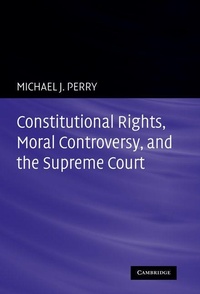
Constitutional Rights, Moral Controversy, and the Supreme Court
Published on 10. November 2008
Book
Hardback
266 pages
978-0-521-75595-5 (ISBN)
Description
In this important book, Michael J. Perry examines three of the most disputed constitutional issues of our time: capital punishment, state laws banning abortion, and state policies denying the benefit of law to same-sex unions. The author, a leading constitutional scholar, explains that if a majority of the justices of the Supreme Court believes that a law violates the Constitution, it does not necessarily follow that the Court should rule that the law is unconstitutional. In cases in which it is argued that a law violates the Constitution, the Supreme Court must decide which of two importantly different questions it should address: is the challenged law unconstitutional? Is the lawmakers' judgment that the challenged law is constitutional a reasonable judgment? Perry not only illuminates moral controversies that implicate one or more constitutionally entrenched human rights, but also the fundamental question of the Supreme Court's proper role in adjudicating such controversies.
Reviews / Votes
Review of the hardback: 'Perry's book presents an elegant, comprehensive, but remarkably concise exposition of how human rights claims should be treated in constitutional adjudication. On the way, it offers a compelling recapitulation of the moral and legal arguments associated with three of the most contentious issues in American politics: capital punishment, abortion and same-sex marriage. Perry's discussions of these difficult questions are clear, smart, and painstakingly fair.' Richard S. Kay, University of Connecticut School of Law Review of the hardback: 'Michael Perry lights a blazing path out of today's deepest political gulfs. Nobody who reads this book will think about the death penalty, abortion, gay rights, indeed about democracy, in the same way again. Elegantly simple, powerful, and practical, Perry's book belongs on every citizen's nightstand.' Jason Mazzone, Brooklyn Law School Review of the hardback: 'Should a court presume to strike down a democratically enacted law as 'unconstitutional' even though scholars, judges, and citizens emphatically disagree about what the Constitution means? Michael Perry addresses this question with passion and insight and with respect to 'hot button' issues like abortion and same-sex marriage. His answers will persuade some and provoke others, but either way they force us to think hard about a question of crucial importance to a diverse and democratic nation.' Steven Smith, University of San DiegoMore details
Language
English
Place of publication
Cambridge
United Kingdom
Target group
College/higher education
Dimensions
Height: 222 mm
Width: 145 mm
Thickness: 19 mm
Weight
510 gr
ISBN-13
978-0-521-75595-5 (9780521755955)
Copyright in bibliographic data and cover images is held by Nielsen Book Services Limited or by the publishers or by their respective licensors: all rights reserved.
Schweitzer Classification
Other editions
Additional editions
Michael J. Perry
Constitutional Rights, Moral Controversy, and the Supreme Court
Book
12/2010
Cambridge University Press
€48.50
Shipment within 15-20 days
Michael J. Perry
Constitutional Rights, Moral Controversy, and the Supreme Court
E-Book
02/2009
1st Edition
Cambridge University Press
€30.99
Available for download
Person
Michael J. Perry holds a Robert W. Woodruff Chair at Emory University, where he teaches in the law school. Previously, Perry held the Howard J. Trienens Chair in Law at Northwestern University, where he taught for fifteen years, and the University Distinguished Chair in Law at Wake Forest University. He has written on American constitutional law and theory; law, morality and religion; and human rights theory in more than sixty articles and ten books, most recently Under God? Religious Faith and Liberal Democracy (Cambridge, 2003) and Toward a Theory of Human Rights: Religion, Law, Courts (Cambridge, 2007).
Content
Introduction: a partial theory of judicial review; 1. Human rights: from morality to constitutional law; 2. Constitutionally entrenched human rights, the Supreme Court, and Thayerian deference; 3. Capital punishment; 4. Same-sex unions; 5. Abortion; 6. Thayerian deference revisited; Postscript: religion as a basis of lawmaking?