

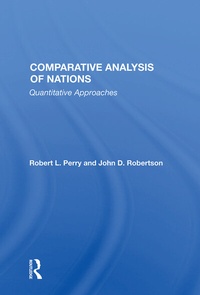
Comparative Analysis Of Nations
Quantitative Approaches
1st Edition
Published on 30. June 2020
Book
Hardback
556 pages
978-0-367-01529-9 (ISBN)
Description
This text integrates traditional textbook, philosophy of science, statistical cookbook, and advanced conceptual approaches, with focus on applying basic and specific statistical tools to the cross-national analysis of data. It exposes the cross-national analysis to comparative politics students.
More details
Language
English
Place of publication
London
United Kingdom
Publishing group
Taylor & Francis Ltd
Target group
College/higher education
Dimensions
Height: 254 mm
Width: 173 mm
Weight
1240 gr
ISBN-13
978-0-367-01529-9 (9780367015299)
Copyright in bibliographic data and cover images is held by Nielsen Book Services Limited or by the publishers or by their respective licensors: all rights reserved.
Schweitzer Classification
Other editions
Additional editions
Book
10/2022
1st Edition
Routledge
€51.98
Shipment within 15-20 days
E-Book
03/2019
1st Edition
Routledge
€55.49
Available for download
E-Book
03/2019
1st Edition
Routledge
€55.49
Available for download
Person
Robert L. Perry is an assistant professor in the Department of Behavioral Science at the University of Texas, Permian Basin. John D. Robertson is a professor in the Department of Political Science at Texas A & M University. Robert L. Perry is an assistant professor in the Department of Behavioral Science at the University of Texas, Permian Basin. John D. Robertson is a professor in the Department of Political Science at Texas A & M University.
Content
1. The Elements of the Science of Comparing Nations 2. Strategies of Comparative Political Inquiry 3. The Role of Univariate Analysis in the Science of Comparing Nations 4. The Role of the Normal Distribution in Cross-National Research 5. The Role of lnferential Measures and Confidence Intervals in Cross-National Research 6. The Role of Measurement Validity in Cross-National Analysis 7. Specifying the Primary Properties of Democracy 8. The Role of Hypothesis Testing in Cross-National Analysis 9. The Role of Tabular Analysis in Cross-National Analysis 10. The Utility of the Difference of Means Test and the Study of Civic Culture 11. The Political-Economic System 12. The Role of One-Way Analysis of Variance and Cross-National Analysis 13. The Role of Linear Analysis and the Conceptualization of Political Empowerment 14. Factor Analysis as a Tool of Data Reduction With in Cross-National Analysis 15. The Role of Scatterplot Analysis and the Conceptualization of Modernity 16. The Role of Basic Regression in Cross-National Analysis 17. The Role of Residual Analysis in Cross-National Research