

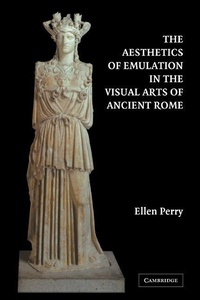
The Aesthetics of Emulation in the Visual Arts of Ancient Rome
1st Edition
Published on 16. June 2011
Book
Paperback/Softback
226 pages
978-0-521-28397-7 (ISBN)
Description
Originally published in 2005, this book examines Roman strategies for the appropriation of the Greek visual culture and argues that the scholarship on this topic, dominated by copy criticism (Kopienkritik), has not appreciated Roman values in the visual arts. Ellen Perry analyzes the Roman aesthetics that lie at the core of the visual conservatism - and innovation - in the art of that civilization. These attitudes help to explain the preponderance of copies, exact or free, after the sculpture of great Greek masters in Roman art. A knowledge of Roman values, Perry demonstrates, explains the entire range of visual appropriation in Roman art, which includes not only the phenomenon of copying, but also such manifestations as allusion, parody, and most importantly aemulatio, successful rivalry with one's models.
Reviews / Votes
"Perry's book offers an extensive critique of previous scholarship and a thoroughgoing investigation of the implications of more modern approaches. In so doing, Perry's book challenges art historians on both sides of the issue to re-examine their beliefs, and it should stimulate further, more nuanced consideration of this important topic." CAA Review Rachel KousserMore details
Language
English
Place of publication
Cambridge
United Kingdom
Target group
Professional and scholarly
Product notice
Paperback (trade)
Illustrations
Worked examples or Exercises
Dimensions
Height: 229 mm
Width: 152 mm
Thickness: 14 mm
Weight
374 gr
ISBN-13
978-0-521-28397-7 (9780521283977)
Copyright in bibliographic data and cover images is held by Nielsen Book Services Limited or by the publishers or by their respective licensors: all rights reserved.
Schweitzer Classification
Other editions
Additional editions
Book
01/2005
Cambridge University Press
€122.50
Shipment within 15-20 days
Person
Content
Introduction: a critical time in the study of Roman artistic imitation; 1. Decorum and tradition: the beginnings of a theoretical apparatus; 2. Decorum and patron: the functions of art; 3. The marginalization of innovation: Kopienkritik and the construct of the free copy; 4. The strategy of eclecticism; 5. Phantasia: the artist's vision as model.