

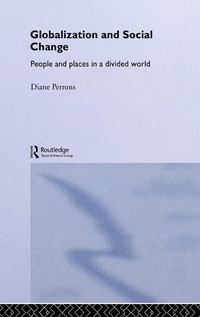
Globalization and Social Change
People and Places in a Divided World
1st Edition
Published on 1. April 2004
Book
Hardback
376 pages
978-0-415-26695-6 (ISBN)
Description
Globalization and Social Change takes a refreshing new perspective on globalization and widening social and spatial inequalities. Diane Perrons draws on ideas about the new economy, risk society, welfare regimes and political economy to explain the growing social and spatial divisions characteristic of our increasingly divided world.
Combining original argument with a clear exposition of the underlying processes, Perrons illustrates her points through a series of case studies linking people in rich and poor countries. She places strong emphasis on the socio-economic aspects of change, particularly changes in working patterns and living arrangements, and makes reference to the new global division of labour, declining industrial regions and widening social divisions within what she terms 'superstar regions'. Wide in scope, this new study also focuses on changing family structures, the feminization of employment, migration, work life balance and new conceptions of gender identity and gender roles.
Diane Perrons' enlightening book concludes that divisions by social class and gender are in some ways becoming more significant than divisions between nations, and suggests that new systems of social and economic organization are necessary for social peace in the new millennium.
Combining original argument with a clear exposition of the underlying processes, Perrons illustrates her points through a series of case studies linking people in rich and poor countries. She places strong emphasis on the socio-economic aspects of change, particularly changes in working patterns and living arrangements, and makes reference to the new global division of labour, declining industrial regions and widening social divisions within what she terms 'superstar regions'. Wide in scope, this new study also focuses on changing family structures, the feminization of employment, migration, work life balance and new conceptions of gender identity and gender roles.
Diane Perrons' enlightening book concludes that divisions by social class and gender are in some ways becoming more significant than divisions between nations, and suggests that new systems of social and economic organization are necessary for social peace in the new millennium.
Reviews / Votes
'a fresh, new approach... overall, the book offers a welcome addition to the existing literature on globalization.' - Journal of Economic & Social GeographyMore details
Language
English
Place of publication
London
United Kingdom
Publishing group
Taylor & Francis Ltd
Target group
College/higher education
Illustrations
16 s/w Tabellen
16 Tables, black and white
Dimensions
Height: 240 mm
Width: 161 mm
Thickness: 25 mm
Weight
731 gr
ISBN-13
978-0-415-26695-6 (9780415266956)
Copyright in bibliographic data and cover images is held by Nielsen Book Services Limited or by the publishers or by their respective licensors: all rights reserved.
Schweitzer Classification
Other editions
Additional editions
E-Book
07/2004
Routledge
€100.99
Available for download
E-Book
07/2004
Routledge
€100.99
Available for download
Book
04/2004
1st Edition
Routledge
€109.09
Shipment within 15-20 days
Person
Diane Perrons is Senior Lecturer in the Department of Geography and Environment and a Fellow of the Gender Institute at the London School of Economics.
Content
1. Analyzing Globalization and Social Change Part 1: Measuring and Theorizing Inequality and Uneven Development 2. Uneven Geographical Development within the Global Economy 3. Theorizing Uneven Development Part 2: Economic Integration, New Divisions of Labour and Gender Relations 4. The Global Division of Labour and the Feminization of Employment 5. The New Global Division of Labour and the Old Industrial Regions: Uneven Regional Development in the UK Part 3: The New Economy, Globalization and Geography 6. The New Economy and the Digital Divide: Global and Social Divisions 7. Living and Working in Superstar Regions Part 4: Shaping Development 8. Social Reproduction and the State 9. Globalization, Participation and Empowerment 10. Conclusion: Challenging the Divided World