

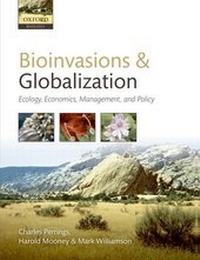
Bioinvasions and Globalization
Ecology, Economics, Management, and Policy
Published on 24. December 2009
Book
Paperback/Softback
288 pages
978-0-19-956016-5 (ISBN)
Description
Bioinvasions and Globalization synthesises our current knowledge of the ecology and economics of biological invasions, providing an in-depth evaluation of the science and its implications for managing the causes and consequences of one of the most pressing environmental issues facing humanity today.
Emergent zoonotic diseases such as HIV and SARS have already imposed major costs in terms of human health, whilst plant and animal pathogens have had similar effects on agriculture, forestry, fisheries. The introduction of pests, predators and competitors into many ecosystems has disrupted the benefits they provide to people, in many cases leading to the extirpation or even extinction of native species. This timely book analyzes the main drivers of bioinvasions - the growth of world trade, global transport and travel, habitat conversion and land use intensification, and climate change - and their consequences for ecosystem functioning. It shows how bioinvasions impose disproportionately high costs on countries where a large proportion of people depend heavily on the exploitation of natural resources. It considers the options for improving assessment and management of invasive species risks, and especially for achieving the international cooperation needed to address bioinvasions as a negative externality of international trade.
Emergent zoonotic diseases such as HIV and SARS have already imposed major costs in terms of human health, whilst plant and animal pathogens have had similar effects on agriculture, forestry, fisheries. The introduction of pests, predators and competitors into many ecosystems has disrupted the benefits they provide to people, in many cases leading to the extirpation or even extinction of native species. This timely book analyzes the main drivers of bioinvasions - the growth of world trade, global transport and travel, habitat conversion and land use intensification, and climate change - and their consequences for ecosystem functioning. It shows how bioinvasions impose disproportionately high costs on countries where a large proportion of people depend heavily on the exploitation of natural resources. It considers the options for improving assessment and management of invasive species risks, and especially for achieving the international cooperation needed to address bioinvasions as a negative externality of international trade.
Reviews / Votes
Bioinvasions and Globalization provide the foundation and fodder to help drive new innovative strategies to manage invasive species in a globalized world. * Trends in Ecology and Evolution *More details
Language
English
Place of publication
Oxford
United Kingdom
Target group
College/higher education
Professional and scholarly
Illustrations
40 illustrations
Dimensions
Height: 246 mm
Width: 189 mm
Thickness: 15 mm
Weight
637 gr
ISBN-13
978-0-19-956016-5 (9780199560165)
Copyright in bibliographic data and cover images is held by Nielsen Book Services Limited or by the publishers or by their respective licensors: all rights reserved.
Schweitzer Classification
Other editions
Additional editions
Charles Perrings | Harold Mooney | Mark Williamson
Bioinvasions and Globalization
Ecology, Economics, Management, and Policy
Book
12/2009
Oxford University Press
€92.85
Shipment within 15-20 days
Persons
Charles Perrings is Professor of Environmental Economics at Arizona State University, where he directs the ecoSERVICES Group within the College of Liberal Arts and Sciences. He co-chairs (with Shahid Naeem) the ecoSERVICES core project of DIVERSITAS, the international program of biodiversity science. He is the author of numerous books and scientific papers on the economics of biodiversity change.
Harold Mooney is Professor of Biology at Stanford University. His main research area is in global change biology. He has published widely on invasive species and was the founding chair of the Global Invasive Species Programme. He currently chairs the scientific committee for DIVERSITAS, the international program for research in biological diversity.
Mark Williamson is Professor of Biology (Emeritus) at the University of York. He is a population biologist who founded the department of biology at York in 1963 and who has been involved with biological invasion research since the first SCOPE programme (1982-89).
Harold Mooney is Professor of Biology at Stanford University. His main research area is in global change biology. He has published widely on invasive species and was the founding chair of the Global Invasive Species Programme. He currently chairs the scientific committee for DIVERSITAS, the international program for research in biological diversity.
Mark Williamson is Professor of Biology (Emeritus) at the University of York. He is a population biologist who founded the department of biology at York in 1963 and who has been involved with biological invasion research since the first SCOPE programme (1982-89).
Content
PART I - THE DRIVERS OF BIOLOGICAL INVASIONS ; PART II - ECONOMICS ; PART III - MANAGEMENT AND POLICY