

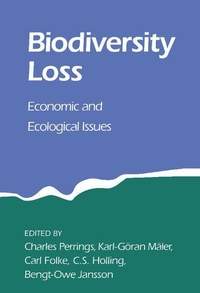
Biodiversity Loss
Economic and Ecological Issues
Published on 28. July 1995
Book
Hardback
350 pages
978-0-521-47178-7 (ISBN)
Description
This volume reports key findings of the Biodiversity Program of the Royal Swedish Academy of Sciences' Beijer Institute. The program brought together a number of eminent ecologists and economists to consider the nature and significance of the biodiversity problem. In encouraging collaborative work between these closely related disciplines it sought to shed new light on the concept of diversity; the implications of biological diversity for the functioning of ecosystems; the driving forces behind biodiversity loss; and the options for promoting biodiversity conservation. The results of the program are surprising. It is shown that the core of the biodiversity problem is a loss of ecosystem resilience and the insurance it provides against the uncertain environmental effects of economic and population growth. This is as much a local as a global problem, implying that biodiversity conservation offers benefits that are as much local as global. The solutions as well as the causes of biodiversity loss lie in incentives to local users.
Reviews / Votes
"[The chapters] are solid contributions to the literature. They illuminate many of the core questions of biodiversity and its conservation. They have much to say to conservation biologists, resource economists, environmental strategists, and those concerned with the role of biodiversity in national land-use planning....would make excellent assignments for graduate classes." Norman Myers, BioScience "This book may be the most significant contribution to the interdisciplinary literature on biodiversity....Well-coordinated group discussions and sharing of draft research papers, joint research projects and chapter co-authorship by ecologists and economists, and strong and thoughtful editing have resulted in a coherent volume of original and strong contributions." Richard B. Norgaard, Journal of Wildlife Management "[The chapters] are solid contributions to the literature. They illuminate many of the core questions of biodiversity and its conservation. They have much to say to conservation biologists, resource economists, environmental strategists, and those concerned with the role of biodiversity in national land-use planning....would make excellent assignments for graduate classes." Norman Myers, BioScience "This book may be the most significant contribution to the interdisciplinary literature on biodiversity....Well-coordinated group discussions and sharing of draft research papers, joint research projects and chapter co-authorship by ecologists and economists, and strong and thoughtful editing have resulted in a coherent volume of original and strong contributions." Richard B. Norgaard, Journal of Wildlife ManagementMore details
Language
English
Place of publication
Cambridge
United Kingdom
Target group
Professional and scholarly
Illustrations
57 Line drawings, unspecified
Dimensions
Height: 235 mm
Width: 157 mm
Thickness: 25 mm
Weight
719 gr
ISBN-13
978-0-521-47178-7 (9780521471787)
Copyright in bibliographic data and cover images is held by Nielsen Book Services Limited or by the publishers or by their respective licensors: all rights reserved.
Schweitzer Classification
Other editions
Additional editions
Book
01/1997
Cambridge University Press
€62.80
Shipment within 15-20 days
Persons
Content
Introduction: Framing the problem of biodiversity loss C. Perrings, K.-G. Maler, C. Folke, C. S. Holling and B. O. Jansson; Part I. Conceptualising Diversity and Ecosystem Functions: 1.1. Diversity functions M.Weitzman; 1.2. Biodiversity in the functioning of ecosystems C. S. Holling, D. W. Schindler, B. W. Walker and J. Roughgarden; 1.3. Scale and biodiversity in coastal and estuarine ecosystems R. Constanza, M. Kemp and W. Boynton; Part II. Integrating Ecology and Economics in the Analysis of Biodiversity Loss: 2.1. Wetland valuation: three case studies R. K. Turner, C. Folke, I. M. Gren and I. Bateman; 2.2. An ecological economy: notes on harvest and growth G. Brown and J. Roughgarden; 2.3. Biodiversity loss and the economics of discontinuous change in semi-arid rangelands C. Perrings and B. W. Walker; Part III. The Economic Issues: 3.1. Economic growth and the environment K.-G. Maler; 3.2. The international regulation of biodiversity decline T. Swanson; 3.3. Policies to control tropical deforestation E. B. Barbier and M. Rauscher; 3.4. On biodiversity conservation S. Barrett; Part IV. Conclusions: 4.1. Unanswered questions C. Perrings, K.-G. Maler, C. Folke, C. S. Holling and B. O. Jansson; References.