

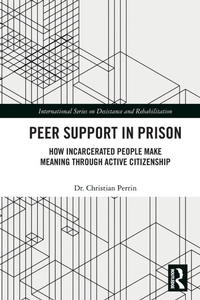
Peer Support in Prison
How Incarcerated People make Meaning through Active Citizenship
1st Edition
Published on 30. January 2026
Book
Paperback/Softback
166 pages
978-1-032-88888-0 (ISBN)
Description
This book explores the profound impact of peer support within the bleak landscape of incarceration. In a system bereft of opportunities for personal growth, the narratives within these pages reveal how individuals who have committed offences rebuild their lives by 'giving back' and establishing meaningful connections with their fellow inmates.
Peer Support in Prison draws on rich phenomenological interviews conducted with prisoners who assumed altruistic social roles while serving time. In doing so, it highlights the value of peer support in fostering hope, making meaning, and cultivating prosocial identities. By adopting empathic and mutually supportive roles within the prison community, individuals forge a pathway to a more meaningful future, defying unfavourable odds. The text unfolds to demonstrate that, even for those denigrated and rejected as 'evil', change is possible when motivated by principles of compassion, reciprocity, and connectedness.
This book attests to the adaptability of humans, offering a unique perspective on how incarcerated individuals can find redemption, build trust, and reconstruct their lives through the transformative power of generativity and active citizenship. This has great implications for a stagnant carceral system which does not work as a restorative mechanism. Within the frame of 'generative justice', the findings from this book offer hopeful alternatives to the cruel hegemony of prison.
Peer Support in Prison draws on rich phenomenological interviews conducted with prisoners who assumed altruistic social roles while serving time. In doing so, it highlights the value of peer support in fostering hope, making meaning, and cultivating prosocial identities. By adopting empathic and mutually supportive roles within the prison community, individuals forge a pathway to a more meaningful future, defying unfavourable odds. The text unfolds to demonstrate that, even for those denigrated and rejected as 'evil', change is possible when motivated by principles of compassion, reciprocity, and connectedness.
This book attests to the adaptability of humans, offering a unique perspective on how incarcerated individuals can find redemption, build trust, and reconstruct their lives through the transformative power of generativity and active citizenship. This has great implications for a stagnant carceral system which does not work as a restorative mechanism. Within the frame of 'generative justice', the findings from this book offer hopeful alternatives to the cruel hegemony of prison.
More details
Other editions
Additional editions
Christian Perrin
Peer Support in Prison
How Incarcerated People make Meaning through Active Citizenship
E-Book
09/2024
1st Edition
Routledge
€60.49
Available for download
Christian Perrin
Peer Support in Prison
How Incarcerated People make Meaning through Active Citizenship
E-Book
09/2024
1st Edition
Routledge
€60.49
Available for download
Christian Perrin
Peer Support in Prison
How Incarcerated People make Meaning through Active Citizenship
Book
09/2024
1st Edition
Routledge
€231.20
Shipment within 15-20 days
Person
Christian Perrin is an Assistant Professor of Forensic Psychology at the University of Birmingham. He maintains active research interests spanning the UK, US, and UAE. He primarily teaches forensic and social psychology modules and conducts research in the areas of incarceration, restorative justice, social work, and community reintegration. He has worked in several prisons internationally and has cultivated a wealth of experience in forensic and clinical settings. He holds other interests in individual and organisational wellbeing and enjoys collaborating with organisations to make meaningful improvements in 'psychological flexibility' - a construct he connects with closely as an Acceptance and Commitment Therapist.
Content
Acknowledgements
Foreword by Dr William McGowan
Introduction - Sisyphus Behind Bars
Part I: Humanity and Interdependency in the Bleakness of Prison
Chapter 1 - "It's Nice to Be Nice". A History of and Theoretical Basis for Peer Support
Chapter 2 - Peer Support in Prisons: A Magnified Effect?
Part II: Narrativising Redemption and Recovery From Offending Behaviour
Chapter 3 - Cultivating an Internal Narrative of Desistance, 'Drip-by-Drip'
Chapter 4 - The Irredeemable? How Incarcerated Peer Supporters Negotiate the 'Sex Offender' Label
Part III: Obstacles and Implications for Life After Prison
Chapter 5 - Peer Support in Carceral Settings: Roadblocks in the Journey Ahead
Chapter 6 - "There's No Promised Land, Just Hope": Future Selves in Punitive Landscapes
Conclusion - Towards a Generative Justice
Appendices
Index
Foreword by Dr William McGowan
Introduction - Sisyphus Behind Bars
Part I: Humanity and Interdependency in the Bleakness of Prison
Chapter 1 - "It's Nice to Be Nice". A History of and Theoretical Basis for Peer Support
Chapter 2 - Peer Support in Prisons: A Magnified Effect?
Part II: Narrativising Redemption and Recovery From Offending Behaviour
Chapter 3 - Cultivating an Internal Narrative of Desistance, 'Drip-by-Drip'
Chapter 4 - The Irredeemable? How Incarcerated Peer Supporters Negotiate the 'Sex Offender' Label
Part III: Obstacles and Implications for Life After Prison
Chapter 5 - Peer Support in Carceral Settings: Roadblocks in the Journey Ahead
Chapter 6 - "There's No Promised Land, Just Hope": Future Selves in Punitive Landscapes
Conclusion - Towards a Generative Justice
Appendices
Index