

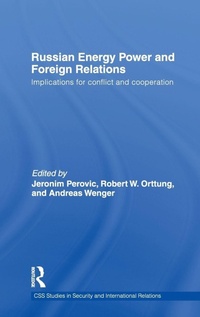
Russian Energy Power and Foreign Relations
Implications for Conflict and Cooperation
1st Edition
Published on 4. February 2009
Book
Hardback
254 pages
978-0-415-48438-1 (ISBN)
Description
This book examines Russia's new assertiveness and the role of energy as a key factor in shaping the country's behavior in international relations, and in building political and economic power domestically, since the 1990s.
Energy transformed Russia's fortunes after its decline during the 1990s. The wealth generated from energy exports sparked economic recovery and political stabilization, and has significantly contributed to Russia's assertiveness as a great power. Energy has been a key factor in shaping Russia's foreign relations in both the Eurasian and global context. This development raises a host of questions for both Russia and the West about the stability of the Russian economy, how Russia will use the power it gains from its energy wealth, and how the West should react to Russia's new-found political weight.
Given that energy is likely to remain at the top of the global political agenda for some time to come, and Russia's role as a key energy supplier to Europe is unlikely to diminish soon, this book sheds light on one of the key security concerns of the 21st century: where is Russia headed and how does energy affect the changing dynamics of Russia's relations with Europe, the US and the Asia-Pacific region.
This book will be of interest to students of Russian politics, energy security, international relations and foreign policy in general.
Jeronim Perovic is a senior researcher at the Center for Security Studies at ETH Zurich. Robert Orttung is a visiting scholar at the Center for Security Studies at the Swiss Federal Institute of Technology (ETH) in Zurich and a senior fellow at the Jefferson Institute. Andreas Wenger is professor of international security policy and director of the Center for Security Studies at ETH Zurich.
Energy transformed Russia's fortunes after its decline during the 1990s. The wealth generated from energy exports sparked economic recovery and political stabilization, and has significantly contributed to Russia's assertiveness as a great power. Energy has been a key factor in shaping Russia's foreign relations in both the Eurasian and global context. This development raises a host of questions for both Russia and the West about the stability of the Russian economy, how Russia will use the power it gains from its energy wealth, and how the West should react to Russia's new-found political weight.
Given that energy is likely to remain at the top of the global political agenda for some time to come, and Russia's role as a key energy supplier to Europe is unlikely to diminish soon, this book sheds light on one of the key security concerns of the 21st century: where is Russia headed and how does energy affect the changing dynamics of Russia's relations with Europe, the US and the Asia-Pacific region.
This book will be of interest to students of Russian politics, energy security, international relations and foreign policy in general.
Jeronim Perovic is a senior researcher at the Center for Security Studies at ETH Zurich. Robert Orttung is a visiting scholar at the Center for Security Studies at the Swiss Federal Institute of Technology (ETH) in Zurich and a senior fellow at the Jefferson Institute. Andreas Wenger is professor of international security policy and director of the Center for Security Studies at ETH Zurich.
Reviews / Votes
'...an important first step toward clarifying the relationship between energy and foreign policy. The book is valuable for its synoptic coverage of the major dimensions of the energy instrument in Russian politics.' - The Russian Review, Jan 2009, Vol.69, No.1, 182More details
Series
Language
English
Place of publication
London
United Kingdom
Publishing group
Taylor & Francis Ltd
Target group
College/higher education
Professional and scholarly
Product notice
Paper over boards
Illustrations
5 s/w Photographien bzw. Rasterbilder, 12 s/w Zeichnungen, 11 s/w Tabellen
11 Tables, black and white; 12 Line drawings, black and white; 5 Halftones, black and white
Dimensions
Height: 240 mm
Width: 161 mm
Thickness: 19 mm
Weight
575 gr
ISBN-13
978-0-415-48438-1 (9780415484381)
Copyright in bibliographic data and cover images is held by Nielsen Book Services Limited or by the publishers or by their respective licensors: all rights reserved.
Schweitzer Classification
Other editions
Additional editions
Jeronim Perovic | Robert W. Orttung | Andreas Wenger
Russian Energy Power and Foreign Relations
Implications for Conflict and Cooperation
Book
04/2010
1st Edition
Routledge
€71.60
Shipment within 15-20 days
Jeronim Perovic | Robert W. Orttung | Andreas Wenger
Russian Energy Power and Foreign Relations
Implications for Conflict and Cooperation
E-Book
02/2009
Routledge
€64.49
Available for download
Jeronim Perovic | Robert W. Orttung | Andreas Wenger
Russian Energy Power and Foreign Relations
Implications for Conflict and Cooperation
E-Book
02/2009
1st Edition
Routledge
€64.49
Available for download
Persons
Jeronim Perovic is a senior researcher at the Institute of History at the University of Basel and a visiting scholar at the Center for Security Studies at ETH Zurich.
Robert W. Orttung is a visiting scholar at the Center for Security Studies at ETH Zurich and a senior fellow at the Jefferson Institute.
Andreas Wenger is professor of international security policy and director of the Center for Security Studies at ETH Zurich.
Robert W. Orttung is a visiting scholar at the Center for Security Studies at ETH Zurich and a senior fellow at the Jefferson Institute.
Andreas Wenger is professor of international security policy and director of the Center for Security Studies at ETH Zurich.
Content
Part 1: Introduction 1. Russian Energy Power: Domestic and International Dimensions Jeronim Perovic Part 2: The Domestic Dimension of Russian Energy 2. The Sustainability of Russia's Energy Power: Implications for Russia's Economy Philip Hanson 3. Energy and State-Society Relations: Socio-Political Aspects of Russia's Energy Wealth Robert Orttung 4. Developing Russia's Oil and Gas Industry: What Role for the State? Heiko Pleines Part 3: Russia's Role in International Energy Markets 5. Russia's Key Customer: Europe Stacy Closson 6. Russia's Role in the Eurasian Energy Market: Seeking Control in the Face of Growing Challenges Julia Nanay 7. Russia's Future Customers: Asia and Beyond Nina Poussenkova Part 4: International Policies Towards Russia 8. European Perspectives for Managing Dependence Pami Aalto 9. US Energy Policy and the Former Soviet Union: Parallel Tracks Peter Rutland 10. Chinese Perspectives on Russian Oil and Gas Indra Overland and Kyrre Elvenes Braekhus Part 5: Conclusion 11. Russia's Energy Power: Implications for Europe and for Transatlantic Cooperation Andreas Wenger