

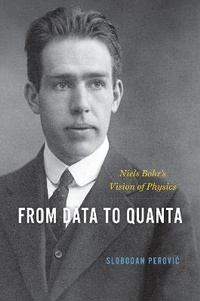
From Data to Quanta
Niels Bohr's Vision of Physics
Published on 1. October 2021
Book
Hardback
240 pages
978-0-226-79833-2 (ISBN)
Description
Niels Bohr was a central figure in quantum physics, well known for his work on atomic structure and his contributions to the Copenhagen interpretation of quantum mechanics. In this book, philosopher of science Slobodan Perovic explores the way Bohr practiced and understood physics and analyzes its implications for our understanding of modern science. Perovic develops a novel approach to Bohr's understanding of physics and his method of inquiry, presenting an exploratory symbiosis of historical and philosophical analysis that uncovers the key aspects of Bohr's philosophical vision of physics within a given historical context.
To better understand the methods that produced Bohr's breakthrough results in quantum phenomena, Perovic clarifies the nature of Bohr's engagement with the experimental side of physics and lays out the basic distinctions and concepts that characterize his approach. Rich and insightful, Perovic's take on the early history of quantum mechanics and its methodological ramifications sheds vital new light on one of the key figures of modern physics.
To better understand the methods that produced Bohr's breakthrough results in quantum phenomena, Perovic clarifies the nature of Bohr's engagement with the experimental side of physics and lays out the basic distinctions and concepts that characterize his approach. Rich and insightful, Perovic's take on the early history of quantum mechanics and its methodological ramifications sheds vital new light on one of the key figures of modern physics.
Reviews / Votes
"Perovic offers a novel and refreshingly unorthodox interpretation of Bohr's seminal contributions to quantum physics and their philosophical implications. Adopting a method of historically sensitive analysis, he argues convincingly that the great Dane came to his overarching hypotheses, including the complementarity principle, by inductive reasoning inherently based on experiments. He skillfully defends Bohr against the charges that his epistemological and methodological views were amateurish armchair philosophy. Perovic's book on Bohr's vision is recommendable from a scientific, historical, and philosophical perspective."--Helge Kragh, Niels Bohr Institute, University of CopenhagenMore details
Language
English
Place of publication
Chicago
United States
Publishing group
The University of Chicago Press
Product notice
sewn/stitched
Cloth over boards
Dimensions
Height: 229 mm
Width: 152 mm
ISBN-13
978-0-226-79833-2 (9780226798332)
Copyright in bibliographic data and cover images is held by Nielsen Book Services Limited or by the publishers or by their respective licensors: all rights reserved.
Schweitzer Classification
Other editions
Additional editions
E-Book
10/2021
1st Edition
University of Chicago Press
€55.49
Available for download
Person
Slobodan Perovic is professor of the history and philosophy of science at the University of Belgrade. His work has been featured in the Stanford Encyclopedia of Philosophy, Studies in History and Philosophy of Modern Physics, Foundations of Science, and Synthese, among others.
Content
Introduction
Part 1: Preliminaries
2 From Laboratory to Theory
3 From Classical Experiments to Quantum Theory
Part 2: Bohr's Vision in Practice: the Old Quantum Theory
4 Spectral Lines, Quantum States, and a Master Model of the Atom
5 The Correspondence Principle as an Intermediary Hypothesis
6 Reception
7 The Scientific Moderator
Part 3: Toward Quantum Mechanics
8 Quantum Corpuscles, Quantum Waves, and the Experiments
9 The Uncertainty Principle as an Intermediary Hypothesis
10 Metaphysical Principles and Heuristic Rules
11 New Formalisms and Bohr's Atom
12 Complementarity Established and Applied
Part 4: Aftermath
13 Bohr and the "Copenhagen Orthodoxy"
14 Bohr's Response to the Einstein-Podolsky-Rosen Argument
15 The Mature Bohr and the Rise of Slick Theory and Theoreticians
Acknowledgments
Bibliography
Index
Part 1: Preliminaries
2 From Laboratory to Theory
3 From Classical Experiments to Quantum Theory
Part 2: Bohr's Vision in Practice: the Old Quantum Theory
4 Spectral Lines, Quantum States, and a Master Model of the Atom
5 The Correspondence Principle as an Intermediary Hypothesis
6 Reception
7 The Scientific Moderator
Part 3: Toward Quantum Mechanics
8 Quantum Corpuscles, Quantum Waves, and the Experiments
9 The Uncertainty Principle as an Intermediary Hypothesis
10 Metaphysical Principles and Heuristic Rules
11 New Formalisms and Bohr's Atom
12 Complementarity Established and Applied
Part 4: Aftermath
13 Bohr and the "Copenhagen Orthodoxy"
14 Bohr's Response to the Einstein-Podolsky-Rosen Argument
15 The Mature Bohr and the Rise of Slick Theory and Theoreticians
Acknowledgments
Bibliography
Index