

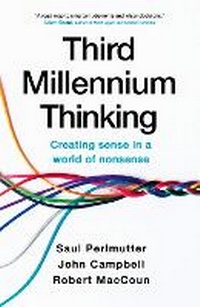
Third Millennium Thinking
Creating Sense in a World of Nonsense
Book
Paperback/Softback
320 pages
978-1-3997-0553-0 (ISBN)
Description
Reviews / Votes
'A model of clear thinking, and a terrific discussion of how to use logic and evidence to solve the hardest problems. This might just be the cure for what ails us.' Cass R. Sunstein, Robert Walmsley University Professor, Harvard University, and author of Decisions About Decisions 'If our species is to stagger through another millennium, we need to get better at thinking about how we think-and conducting high-stakes debates more intelligently. This book lays out, with superb clarity, the path forward.' Philip E. Tetlock, author of Superforecasting 'A physicist, a philosopher, and a psychologist walk into a book, and mix an inviting cocktail about how to think through big problems and make effective decisions in a Third Millennium age of overwhelming, complex, and contradictory information. A must read for anyone who needs to make expert judgments without being experts themselves.' David Dunning, Professor of Psychology at the University of Michigan and discoverer of the Dunning-Kruger EffectMore details
Language
English
Place of publication
United Kingdom
Publishing group
Hodder & Stoughton
Target group
College/higher education
Professional and scholarly
Product notice
Paperback (UK-B)
Dimensions
Height: 198 mm
Width: 129 mm
ISBN-13
978-1-3997-0553-0 (9781399705530)
Copyright in bibliographic data and cover images is held by Nielsen Book Services Limited or by the publishers or by their respective licensors: all rights reserved.
Schweitzer Classification
Persons
Saul Perlmutter is a 2011 Nobel Laureate, sharing the prize in Physics for the discovery of the accelerating expansion of the universe. He is professor of physics at the University of
California, Berkeley, and a senior scientist at Lawrence Berkeley National Laboratory. He is also the leader of the International Supernova Cosmology Project, director of the Berkeley Institute for Data Science, and executive director of the Berkeley Center for Cosmological Physics.
Robert MacCoun is a social psychologist and public policy analyst who is currently James and Patricia Kowal Professor of Law at Stanford University and a Senior Fellow at the Freeman Spogli Institute for International Studies. His previous book with Peter Reuter, Drug War Heresies: Learning from Other Vices, Times, and Places is considered a landmark scholarly analysis of the drug legalization debate. His publications and expert testimony on military unit cohesion were influential in the 1993 and 2010 policy debates about allowing gay and lesbian people to serve openly in the US military. John Campbell is Willis S. and Marion Slusser Professor of Philosophy at the University of California, Berkeley. He has held Guggenheim and NEH Fellowships and served as President of the European Society for Philosophy and Psychology. Campbell is the author of Past, Space and Self (1994), Reference and Consciousness (2002), Berkeley's Puzzle, co-authored with Quassim Cassam (2012) and Causation in Psychology (2020).
California, Berkeley, and a senior scientist at Lawrence Berkeley National Laboratory. He is also the leader of the International Supernova Cosmology Project, director of the Berkeley Institute for Data Science, and executive director of the Berkeley Center for Cosmological Physics.
Robert MacCoun is a social psychologist and public policy analyst who is currently James and Patricia Kowal Professor of Law at Stanford University and a Senior Fellow at the Freeman Spogli Institute for International Studies. His previous book with Peter Reuter, Drug War Heresies: Learning from Other Vices, Times, and Places is considered a landmark scholarly analysis of the drug legalization debate. His publications and expert testimony on military unit cohesion were influential in the 1993 and 2010 policy debates about allowing gay and lesbian people to serve openly in the US military. John Campbell is Willis S. and Marion Slusser Professor of Philosophy at the University of California, Berkeley. He has held Guggenheim and NEH Fellowships and served as President of the European Society for Philosophy and Psychology. Campbell is the author of Past, Space and Self (1994), Reference and Consciousness (2002), Berkeley's Puzzle, co-authored with Quassim Cassam (2012) and Causation in Psychology (2020).