

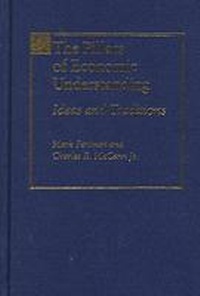
The Pillars of Economic Understanding
Ideas and Traditions
Will be published approx. on 22. October 1998
Book
Hardback
680 pages
978-0-472-10907-4 (ISBN)
Description
This is a new interpretation of the historical development of our understanding of the workings of the economy. Mark Perlman and Charles R. McCann's important work illuminates the foundations of economic inquiry during the past three hundred years. Writing from the standpoint of the impact of cultural pluralism on economic thinking, their purpose is to show how modern economic thinking is shaped by a small number of cultural legacies that explain both how economic questions are asked but also how they are formulated. This history of economic thought is thus distinguished by the attention that it gives to the philosophical ideas that are, as the authors say, the cultural legacies upon which the structure of economics is built.
What are some of these legacies? The authors consider the principal writings of British, French, German, Austrian, and American economists, mainly from the seventeenth century onwards. Underlying these writings are questions posed by Hobbes, Francis Bacon, Descartes, Bentham, Cournot, Walras, Pareto, and such Americans as Bates Clark, Wesley Mitchell, and Commons. An example of the authors' attention to philosophical issues is their discussion of the way much of early economics was written in opposition to Hobbes's belief in the primacy of force. Locke's belief in the God-man relationship seen in unalienable rights and the right of private property are only two of the answers. Other questions relate to the faith in the primacy of Cartesian logic and the need to establish a just society with some controls over the unequal division of the product.
This is a major contribution to the history of economic thought and an important source for all with an interest in the deep issues posed by the study and modeling of the economy.
"[A] book that will provide new perspectives on the history of economics . . . ." --Craufurd D. Goodwin, Duke University
Mark Perlman is Professor of Economics, Emeritus, University of Pittsburgh. Charles R. McCann, Jr., is an independent scholar.
What are some of these legacies? The authors consider the principal writings of British, French, German, Austrian, and American economists, mainly from the seventeenth century onwards. Underlying these writings are questions posed by Hobbes, Francis Bacon, Descartes, Bentham, Cournot, Walras, Pareto, and such Americans as Bates Clark, Wesley Mitchell, and Commons. An example of the authors' attention to philosophical issues is their discussion of the way much of early economics was written in opposition to Hobbes's belief in the primacy of force. Locke's belief in the God-man relationship seen in unalienable rights and the right of private property are only two of the answers. Other questions relate to the faith in the primacy of Cartesian logic and the need to establish a just society with some controls over the unequal division of the product.
This is a major contribution to the history of economic thought and an important source for all with an interest in the deep issues posed by the study and modeling of the economy.
"[A] book that will provide new perspectives on the history of economics . . . ." --Craufurd D. Goodwin, Duke University
Mark Perlman is Professor of Economics, Emeritus, University of Pittsburgh. Charles R. McCann, Jr., is an independent scholar.
Reviews / Votes
This is a major contribution to the history of economic thought and an important source for all with an interest in the deep issues posed by the study and modeling of the economy. "[A] book that will provide new perspectives on the history of economics . . . ." --Craufurd D. Goodwin, Duke UniversityMore details
Language
English
Place of publication
Ann Arbor
United States
Target group
Professional and scholarly
Illustrations
3 figures
Dimensions
Height: 229 mm
Width: 152 mm
ISBN-13
978-0-472-10907-4 (9780472109074)
Copyright in bibliographic data and cover images is held by Nielsen Book Services Limited or by the publishers or by their respective licensors: all rights reserved.
Schweitzer Classification
Persons
Mark Perlman is Professor of Economics, Emeritus, University of Pittsburgh.
Charles R. McCann, Jr. is an independent scholar.
Charles R. McCann, Jr. is an independent scholar.