

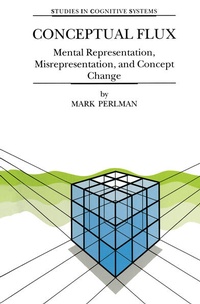
Conceptual Flux
Mental Representation, Misrepresentation, and Concept Change
Published on 7. December 2010
Book
Paperback/Softback
XXIV, 438 pages
978-90-481-5415-9 (ISBN)
Description
How can one think about a thing, think something false about it, and still be thinking about that thing at all? If a concept is applied to something outside its meaning, how are we to say it does not mean that thing as well? The problem of misrepresentation is one of the central issues in contemporary philosophy of mind. Here, Mark Perlman criticizes the way all contemporary theories of mental representation seek to account for misrepresentation, concluding that it cannot be explained naturistically. Specifically, Perlman evaluates and criticizes the theories of mental content proposed by Fodor, Dretske, Millikan, Block, Harman and others, as well as examining verificationist approaches to meaning of Quine, Davidson and Stich.
The book goes much further than criticism, however: Perlman formulates a naturalistic theory of representation that reluctantly accepts the unfortunate conclusion that there is no misrepresentation. He adds a pragmatic theory of content, which explains apparent misrepresentation as concept change. Mental representations can be good or bad in specific contexts and for specific purposes, but their correctness is not a matter of truth and falsity. The pragmatic approach to mental content has implications for epistemology, theories of truth, metaphysics, psychology, and AI (specifically connectionist networks).
Readership: One of the most thorough examinations of mental representation and meaning holism available, this book should be read by everyone interested in the mind and how ideas can have meaning. It crosses boundaries from philosophy into psychology, linguistics, AI and cognitive science.
The book goes much further than criticism, however: Perlman formulates a naturalistic theory of representation that reluctantly accepts the unfortunate conclusion that there is no misrepresentation. He adds a pragmatic theory of content, which explains apparent misrepresentation as concept change. Mental representations can be good or bad in specific contexts and for specific purposes, but their correctness is not a matter of truth and falsity. The pragmatic approach to mental content has implications for epistemology, theories of truth, metaphysics, psychology, and AI (specifically connectionist networks).
Readership: One of the most thorough examinations of mental representation and meaning holism available, this book should be read by everyone interested in the mind and how ideas can have meaning. It crosses boundaries from philosophy into psychology, linguistics, AI and cognitive science.
More details
Series
Edition
Softcover reprint of hardcover 1st ed. 2000
Language
English
Place of publication
Dordrecht
Netherlands
Target group
Professional and scholarly
Research
Illustrations
XXIV, 438 p.
Dimensions
Height: 235 mm
Width: 155 mm
Thickness: 25 mm
Weight
698 gr
ISBN-13
978-90-481-5415-9 (9789048154159)
DOI
10.1007/978-94-015-9462-2
Schweitzer Classification
Other editions
Additional editions
E-Book
04/2013
Springer
€149.79
Available for download
Book
02/2000
Kluwer Academic Publishers
€160.49
Shipment within 15-20 days
Content
1. Groundwork and Overview of the Project.- 2. Verifications and Failure to Allow for Error and Misrepresentation.- 3. Cognitive Science and the Failure to Allow for Error and Misrepresentation.- 4. Content without Misrepresentation: A Pragmatic Theory.- 5: Objections and Replies.- 6: Analyticity, Compositionality, and Meaning Holism.- 7: Varieties of Meaning Holism.- 8: Implications of Strict Conceptual Role Theory.- 9: Methodological Objections, Nihilism, and (Re)Appraisal.- References.- Index of Names.- Index of Subjects.- About the Author.