

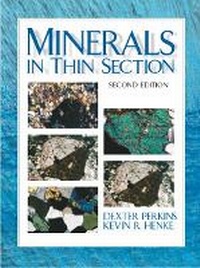
Minerals in Thin Section
2nd Edition
Published on 11. September 2003
Book
Spiral bound
176 pages
978-0-13-142015-1 (ISBN)
Description
For courses in Optical Mineralogy, Mineralogy, Crystallography, Petrology, and Petrography; and for routine petrographic work in the lab.
This clear and concise text assists students as they look at thin sections. It focuses on the practical, need-to-know information absolutely necessary for work in the laboratory.
This clear and concise text assists students as they look at thin sections. It focuses on the practical, need-to-know information absolutely necessary for work in the laboratory.
More details
Other editions
Previous edition
Dexter Perkins | Kevin R. Henke
Minerals in Thin Sections
Book
07/1999
Pearson
€37.13
Article exhausted; check for reprint
Persons
Dr. Dexter Perkins received his Ph.D. from the University of Michigan in 1979. He has published over 80 papers and three books. He has had research appointments at the University of Chicago and the Universite Blaise Pascal and has been a regular faculty member in the Department of Geology and Geological Engineering at the University of North Dakota for more than 20 years. His current research is focused on mineral equilibria and science education reform.
Kevin R. Henke received his Ph.D. in geology from the University of North Dakota in 1997. He has had research and postdoctoral appointments at Oak Ridge National Laboratory, in the Chemistry Department at North Dakota State University, and in the Chemistry Department at the University of Kentucky. He has also taught in the Department of Geological Sciences at the University of Kentucky. Currently, he is researching the chemistry and environmental impacts of mercury and other heavy metals as an employee of the Center for Applied Energy Research at the University of Kentucky, Lexington.
Kevin R. Henke received his Ph.D. in geology from the University of North Dakota in 1997. He has had research and postdoctoral appointments at Oak Ridge National Laboratory, in the Chemistry Department at North Dakota State University, and in the Chemistry Department at the University of Kentucky. He has also taught in the Department of Geological Sciences at the University of Kentucky. Currently, he is researching the chemistry and environmental impacts of mercury and other heavy metals as an employee of the Center for Applied Energy Research at the University of Kentucky, Lexington.
Content
I. THEORETICAL CONSIDERATIONS.
What Is Light?
Polarization of Light and the Polarizing Microscope.
The Velocity of Light in Crystals and the Refractive Index.
Interaction of Light and Crystals.
Other Mineral Characteristics in Thin Sections.
II. IDENTIFYING MINERALS IN THIN SECTION.
Detailed Mineral Description.
Appendix A: Common Opaque Minerals.
Appendix B: Isotropic Minerals Ordered by Refractive Index.
Appendix C: Uniaxial Minerals Sorted by Optic Sign and Ordered by Refractive Index.
Appendix D: Biaxial Minerals Sorted by Optic Sign and Ordered by Refractive Index.
Appendix E: Minerals Ordered by Interference Colors and Sorted by Optic System and Optic Sign.
Appendix F: Alphabetical List of Minerals and Mineral Properties.
Color Photographs.
Mineral Index.
What Is Light?
Polarization of Light and the Polarizing Microscope.
The Velocity of Light in Crystals and the Refractive Index.
Interaction of Light and Crystals.
Other Mineral Characteristics in Thin Sections.
II. IDENTIFYING MINERALS IN THIN SECTION.
Detailed Mineral Description.
Appendix A: Common Opaque Minerals.
Appendix B: Isotropic Minerals Ordered by Refractive Index.
Appendix C: Uniaxial Minerals Sorted by Optic Sign and Ordered by Refractive Index.
Appendix D: Biaxial Minerals Sorted by Optic Sign and Ordered by Refractive Index.
Appendix E: Minerals Ordered by Interference Colors and Sorted by Optic System and Optic Sign.
Appendix F: Alphabetical List of Minerals and Mineral Properties.
Color Photographs.
Mineral Index.