

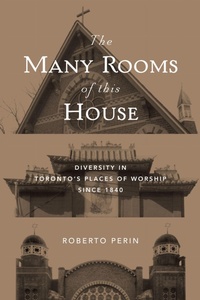
The Many Rooms of This House
Diversity in Toronto's Places of Worship Since 1840
Published on 26. April 2017
Book
Paperback/Softback
440 pages
978-1-4875-2017-5 (ISBN)
Description
Places of worship are the true building blocks of communities where people of various genders, age, and class interact with each other on a regular basis. These places are also rallying points for immigrants, helping them make the transition to a new, and often hostile environment.
The Many Rooms of this House is a story about the rise and decline of religion in Toronto over the past 160 years. Unlike other studies that concentrate on specific denominations, or ecclesiastical politics, Roberto Perin's ecumenical approach focuses on the physical places of worship and the local clergy and congregants that gather there. Perin's timely and nuanced analysis reveals how the growing wealth of the city stimulated congregations to compete with one another over the size, style, materials, and decoration of their places of worship. However, the rise of individualism has negatively affected these same congregations leading to multiple church closings, communal breakdown, and redevelopments. Perin's fascinating work is a lens to understanding how this once overwhelmingly Protestant city became a symbol of diversity.
The Many Rooms of this House is a story about the rise and decline of religion in Toronto over the past 160 years. Unlike other studies that concentrate on specific denominations, or ecclesiastical politics, Roberto Perin's ecumenical approach focuses on the physical places of worship and the local clergy and congregants that gather there. Perin's timely and nuanced analysis reveals how the growing wealth of the city stimulated congregations to compete with one another over the size, style, materials, and decoration of their places of worship. However, the rise of individualism has negatively affected these same congregations leading to multiple church closings, communal breakdown, and redevelopments. Perin's fascinating work is a lens to understanding how this once overwhelmingly Protestant city became a symbol of diversity.
Reviews / Votes
'Historians and social scientists interested in the evolution of Canadian society, cities, urban geography, religious diversity, and multiculturalism will gain much from reading this important, well-written, and meticulously researched book.'- David Seljack (Canadian Historical Review vol 99:01:2018)
More details
Language
English
Place of publication
Toronto
Canada
Target group
College/higher education
Professional and scholarly
Product notice
Paperback (trade)
Illustrations
7 b&w maps, 14 b&w tables
Dimensions
Height: 226 mm
Width: 152 mm
Thickness: 25 mm
Weight
635 gr
ISBN-13
978-1-4875-2017-5 (9781487520175)
Copyright in bibliographic data and cover images is held by Nielsen Book Services Limited or by the publishers or by their respective licensors: all rights reserved.
Schweitzer Classification
Person
Roberto Perin is a professor in the Department of History at Glendon College, York University.
Content
Tables
List of Illustrations
Introduction
Chapter 1: Consolidating Protestantism
Chapter 2: An Era of Exuberance, 1880-1920
Chapter 3: Fulsome Fellowship, 1880-1920
Chapter 4: Ecclesiastical Musical Chairs, 1920-1960
Chapter 5: The Empire of Full-Orbed Christianity, 1920-1960
Chapter 6: To Every Thing Turn! Turn! Turn! There is a Season, 1960-2000
Chapter 7: Fellowship in the Time of the Shopping Centre
Conclusion: Ex Uno Plures?
Appendix: West End Places of Worship 1840-2000
Bibliography
Index
List of Illustrations
Introduction
Chapter 1: Consolidating Protestantism
Chapter 2: An Era of Exuberance, 1880-1920
Chapter 3: Fulsome Fellowship, 1880-1920
Chapter 4: Ecclesiastical Musical Chairs, 1920-1960
Chapter 5: The Empire of Full-Orbed Christianity, 1920-1960
Chapter 6: To Every Thing Turn! Turn! Turn! There is a Season, 1960-2000
Chapter 7: Fellowship in the Time of the Shopping Centre
Conclusion: Ex Uno Plures?
Appendix: West End Places of Worship 1840-2000
Bibliography
Index