

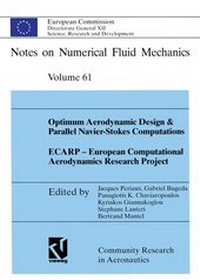
Optimum Aerodynamic Design & Parallel Navier-Stokes Computations ECARP - European Computational Aerodynamics Research Project
ECARP- European Computational Aerodynamics Research Project
Published on 27. March 1998
Book
Hardback
X, 467 pages
978-3-528-06961-2 (ISBN)
Description
This book is one of three volumes entitled "ECARP-European Computational Aerodynamics Research Project", which was supported by the European Union in the Aeronautics Area of the Industrial and Materials Technology Programme.
This volume contains optimization techniques for a number of inviscid and viscous problems like drag reduction, inverse, multipoint, wing-pylon-nacelle and riblets (Part A); and methodologies for solving the Navier Stokes equations on parallel architectures for compressible viscous flows in two and three dimensions (Part B).
The main objective of this book is to disseminate information about cost effective methodologies for practical design problems and parallel CFD to be used by computer scientists and multidisciplinary engineers.
This volume contains optimization techniques for a number of inviscid and viscous problems like drag reduction, inverse, multipoint, wing-pylon-nacelle and riblets (Part A); and methodologies for solving the Navier Stokes equations on parallel architectures for compressible viscous flows in two and three dimensions (Part B).
The main objective of this book is to disseminate information about cost effective methodologies for practical design problems and parallel CFD to be used by computer scientists and multidisciplinary engineers.
More details
Series
Edition
1998
Language
English
Place of publication
Wiesbaden
Germany
Publishing group
Vieweg & Teubner
Target group
Research
Product notice
sewn/stitched
Illustrations
201
201 s/w Abbildungen
Bibliography; 201 Illustrations, black and white
Dimensions
Height: 22.9 cm
Width: 16.2 cm
Weight
819 gr
ISBN-13
978-3-528-06961-2 (9783528069612)
DOI
10.1007/978-3-322-90193-4
Schweitzer Classification
Other editions
Additional editions
Jacques Periaux | Gabriel Bugeda | Kyriakos Giannakoglou
Optimum Aerodynamic Design & Parallel Navier-Stokes Computations ECARP - European Computational Aerodynamics Research Project
Book
06/2012
Vieweg+Teubner Verlag
€106.99
Shipment within 10-15 days
Persons
Content
A: Numerical Optimization in Aerodynamic Design.- I. Introduction.- II. Definition of the Problems for the Analysis.- 1. Definition of test cases.- 2. ECARP data base: access rules and storage formats.- 3. ECARP data base: visualization tools.- III. Contributions to the Resolution of the Data Workshop Test Cases.- 1. On the optimization of a wing-pylon-nacelle configuration.- 2. Optimization of transonic airfoils and wings.- 2.1 Optimization of transonic airfoils.- 2.2 Optimization of transonic wings.- 3. Airfoil optimization using viscous/inviscid coupling code.- 4. Optimization of the wing-pylon-nacelle testcase TE5 by HISSS-D, a panel method-based design tool.- 5. Design of a wing-pylon-nacelle configuration.- 6. Dassault contribution to the optimum design ECARP project.- 7. Geometry optimization of airfoils by multi-point design.- 8. Riblet optimization.- 9. Aerodynamic design of a M6 wing of transonic wing using unstructured meshes.- 10. Part I. Single and two-point airfoil design using Euler and Navier-Stokes equations.- 10. Part II. Application of genetic algorithms to the design of airfoil pressure distributions.- 11. Design and optimization aspects of 2-D and quasi 3-D configurations using an inverse Euler solver.- 12. Optimum aerodynamic shape design including mesh adaptivitiy.- IV. Synthesis of Test Cases.- V. Conclusion and Perspectives.- B: Navier Stokes Solution on MPP Computers.- I. Introduction.- II. Definition of the Problems for the Analysis.- III. Contribution to the Resolution of the Data Workshop Test Cases.- 1. Flow computation for a NACA0012 with the parallel Navier-Stokes Solver CGNS.- 2. Massively parallel computers for Navier-Stokes solutions on unstructured meshes.- 3. Parallel computations on an IBM SP2 and SGI cluster.- 3.1 Parallel computations on an IBM SP2 and an SGI cluster for the NACA0012 airfoil.- 3.2 Parallel computations on an IBM SP2 for the MW6 wing.- 4. Contributions from INRIA to the test cases.- 4.1 TP1 test case.- 4.2 TP2 test case.- 5. Viscous flow computations using structured and unstructured grids on the Intel-Paragon.- 6. Development of finite element algorithms for compressible viscous flows for parallel SIMD machines.- 7. Implementation of Navier-Stokes solvers on parallel computers.- 8. Navier Stokes simulations on MIMD computers using the EURANU Scode.- IV. Synthesis of Test Cases.- V. Conclusion and Perspectives.- Acknowledgements.- Annex: List of Partners and Addresses.