

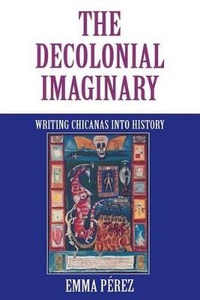
The Decolonial Imaginary
Writing Chicanas into History
Published on 22. September 1999
Book
Hardback
208 pages
978-0-253-33504-3 (ISBN)
Description
Emma Perez discusses the historical methodology which has created Chicano history. Then borrowing from theorists and philosophers of history, Michel Foucault, Juan Gomez-Quinones, Homi Bhabha, Gayatri Chakravorty Spivak, and Hayden White as well as cultural feminist critics Gloria Anzaldu(accute)a, Teresa de Lauretis, Antonia Castaneda, Deena Gonzalez, Chela Sandoval, the author argues that the Chicano historical narrative has often omitted gender. She poses a theory which rejects the coloniser's methodological assumptions and examines new tools for uncovering the hidden voices of Chicanas who have been relegated to silence.Within that silence, she uncovers what she describes as 'third space feminism'. By traversing political borders and disciplinary boundaries, the text moves from geographic spaces in the Yucatan to California and Texas in and around the Mexican Revolution of 1910. Perez examines Yucatan's socialist revolution, the international revolutionary movement El Partido Liberal Mexicano, and the Club Femenino Chapultepec.In these case studies 'new voices' come into existence to shape knowledge about Chicanas, constructing identities and feminisms which cross borders and boundaries.
The last chapter critiques the tale of La Malinche, the translator and alleged lover to Cortes'; a recent film, "Silent Tongue," the story of an Indian woman; Delgadeio, the object of desire in a popular corrido; and Selina, the slain Tex-Mex popular singer who practiced her own cultural feminism in sexualized performances. The historical case studies and contemporary cultural phenomena employ the concept of decolonial imaginary and demonstrate its usefulness as a tool to rewrite Chicana history.
The last chapter critiques the tale of La Malinche, the translator and alleged lover to Cortes'; a recent film, "Silent Tongue," the story of an Indian woman; Delgadeio, the object of desire in a popular corrido; and Selina, the slain Tex-Mex popular singer who practiced her own cultural feminism in sexualized performances. The historical case studies and contemporary cultural phenomena employ the concept of decolonial imaginary and demonstrate its usefulness as a tool to rewrite Chicana history.
More details
Series
Language
English
Place of publication
Bloomington, IN
United States
Target group
Professional and scholarly
Illustrations
1 bibliog., 1 index
Dimensions
Height: 235 mm
Width: 156 mm
Weight
340 gr
ISBN-13
978-0-253-33504-3 (9780253335043)
Copyright in bibliographic data and cover images is held by Nielsen Book Services Limited or by the publishers or by their respective licensors: all rights reserved.
Schweitzer Classification