

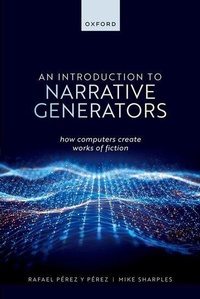
An Introduction to Narrative Generators
How Computers Create Works of Fiction
Published on 15. July 2023
Book
Hardback
224 pages
978-0-19-887660-1 (ISBN)
Description
This book describes how computer programs can generate narratives and how studies of computational narrative can illuminate how humans tell stories.
Combining an introduction to relevant concepts related to automatic storytelling with accessible descriptions of well-known computer programs that illustrate how such concepts are employed, the book is aimed at an interdisciplinary audience and assumes little or no background in computer science.
The book introduces the most relevant techniques employed over the last 60 years for the development of computer models for narrative generation, including narrative templates, problem-solving, planning, author engagement and reflection, and statistical methods such as deep neural networks, ending with an examination of the societal implications of the development of automatic narrative generator systems.
Combining an introduction to relevant concepts related to automatic storytelling with accessible descriptions of well-known computer programs that illustrate how such concepts are employed, the book is aimed at an interdisciplinary audience and assumes little or no background in computer science.
The book introduces the most relevant techniques employed over the last 60 years for the development of computer models for narrative generation, including narrative templates, problem-solving, planning, author engagement and reflection, and statistical methods such as deep neural networks, ending with an examination of the societal implications of the development of automatic narrative generator systems.
Reviews / Votes
The book is well structured and progresses from describing relatively simple and accessible models using templates much like online forms that are such a familiar part of everyday online life. * David Longman, Teacher, learner, enthusiast. Independent Academic. *More details
Language
English
Place of publication
Oxford
United Kingdom
Target group
College/higher education
Dimensions
Height: 242 mm
Width: 161 mm
Thickness: 18 mm
Weight
508 gr
ISBN-13
978-0-19-887660-1 (9780198876601)
Copyright in bibliographic data and cover images is held by Nielsen Book Services Limited or by the publishers or by their respective licensors: all rights reserved.
Schweitzer Classification
Other editions
Additional editions

Rafael Perez y Perez | Mike Sharples
An Introduction to Narrative Generators
How Computers Create Works of Fiction
Book
07/2023
Oxford University Press
€48.00
Shipment within 15-20 days
Rafael Pérez Y Pérez | Mike Sharples
An Introduction to Narrative Generators
How Computers Create Works of Fiction
E-Book
06/2023
1st Edition
OUP eBook
€33.99
Available for download
Persons
Rafael Perez y Perez is a Professor at the Universidad Autonoma Metropolitana at Cuajimalpa, Mexico City. He gained a PhD in Artificial Intelligence from the University of Sussex. He specializes in computational creativity, particularly in models for narrative generation. From 2014 to 2019 he was the chair of the Association for Computational Creativity (computationalcreativity.net), which organises the annual International Conference on Computational Creativity (ICCC). His works include Story machines: how computers have become creative writers, MEXICA: 20 Years - 20 Stories, Creatividad Computacional, and several papers about AI and computational creativity.
Mike Sharples is Emeritus Professor of Educational Technology at The Open University. He gained a PhD in Cognition, Computers and Creative Writing from the Department of Artificial Intelligence, University of Edinburgh. He is co-author of Story Machines: How Computers Have Become Creative Writers and author of How We Write: Writing as Creative Design. His other works include Computers and Thought: A Practical Introduction to Artificial Intelligence, plus over 300 books and papers on artificial intelligence, computers and writing, and educational technology.
Mike Sharples is Emeritus Professor of Educational Technology at The Open University. He gained a PhD in Cognition, Computers and Creative Writing from the Department of Artificial Intelligence, University of Edinburgh. He is co-author of Story Machines: How Computers Have Become Creative Writers and author of How We Write: Writing as Creative Design. His other works include Computers and Thought: A Practical Introduction to Artificial Intelligence, plus over 300 books and papers on artificial intelligence, computers and writing, and educational technology.
Content
1: The power to narrate 2: Narrative templates 3: Narrative generation from the character's perspective: problem solving 4: A methodology to design a narrative generator based on problem-solving 5: Generating a narrative step by step 6: Narrative generation from the author's perspective: planning 7: Representing the author's experience in planning 8: Weaving texts with patterns: the power of repetition 9: Inspired by the brain: a single neuron 10: Inspired by the brain: deep neural networks 11: MEXICA 12: Endless ways to use computers to study narrative generation (part 1) 13: Endless ways to use computers to study narrative generation (part 2) 14: The story we always wanted to tell you