

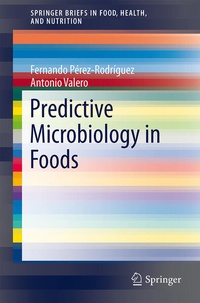
Predictive Microbiology in Foods
Published on 11. December 2012
Book
Paperback/Softback
VI, 128 pages
978-1-4614-5519-6 (ISBN)
Description
Predictive microbiology is a recent area within food microbiology, which studies the responses of microorganisms in foods to environmental factors (e.g., temperature, pH) through mathematical functions. These functions enable scientists to predict the behavior of pathogens and spoilage microorganisms under different combinations of factors. The main goal of predictive models in food science is to assure both food safety and food quality. Predictive models in foods have developed significantly in the last 20 years due to the emergence of powerful computational resources and sophisticated statistical packages. This book presents the concepts, models, most significant advances, and future trends in predictive microbiology. It will discuss the history and basic concepts of predictive microbiology. The most frequently used models will be explained, and the most significant software and databases (e.g., Combase, Sym'Previus) will be reviewed. Quantitative Risk Assessment, which uses predictive modeling to account for the transmission of foodborne pathogens across the food chain, will also be covered.
More details
Series
Edition
2013 ed.
Language
English
Place of publication
New York
United States
Target group
Professional and scholarly
Professional/practitioner
Illustrations
10 s/w Abbildungen, 11 farbige Abbildungen
VI, 128 p. 21 illus., 11 illus. in color.
Dimensions
Height: 235 mm
Width: 155 mm
Thickness: 8 mm
Weight
219 gr
ISBN-13
978-1-4614-5519-6 (9781461455196)
DOI
10.1007/978-1-4614-5520-2
Schweitzer Classification
Other editions
Additional editions
Fernando Perez-Rodriguez | Antonio Valero
Predictive Microbiology in Foods
E-Book
12/2012
1st Edition
Springer
€58.84
Available for download
Content
1. Predictive Microbiology in Foods.- 2. Experimental Design and Data Generation.- 3. Predictive Models: Foundation, Types and Development.- 4. Other Models and Modeling Approaches.- 5. Software and Data Bases: Use and Application.- 6. Application of Predictive Models in Quantitative Risk Assessment and Risk Management.- 7. Future Trends and Perspectives.