

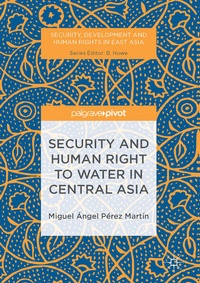
Security and Human Right to Water in Central Asia
Published on 14. March 2017
Book
Hardback
XI, 181 pages
978-1-137-54004-1 (ISBN)
Description
This book examines the impact and implications of the declaration of human right to water and sanitation access for human security in Central Asia. It analyzes the current risks and threats arising from mismanagement of water resources in Central Asia through the different dimensions of human security: environmental, economic, social, and political. Identifying the main actors involved in water conflict in the region, the author pays particular attention to the multilateral security organizations operating in the region, OSCE, NATO, SCO, and CSTO, and discusses whether their security policies have been effective in addressing these conflicts.
More details
Series
Edition
1st ed. 2017
Language
English
Place of publication
New York
United States
Publishing group
Palgrave Macmillan
Target group
Professional and scholarly
Illustrations
3 s/w Abbildungen
XI, 181 p. 3 illus.
Dimensions
Height: 216 mm
Width: 153 mm
Thickness: 16 mm
Weight
373 gr
ISBN-13
978-1-137-54004-1 (9781137540041)
DOI
10.1057/978-1-137-54005-8
Schweitzer Classification
Other editions
Additional editions
Miguel Ángel Pérez Martín
Security and Human Right to Water in Central Asia
E-Book
03/2017
Palgrave Pivot
€58.84
Available for download
Person
Miguel Ángel Pérez Martín
, PhD, is teacher and researcher at the Institute of Development and Cooperation, Complutense University of Madrid, Spain and coordinator of the Observatory of Human Right to Water. He is a specialist in water resources and Eurasian studies and has conducted research in Iran, the UK, Germany, and Kazakhstan.
Content
1. Introduction .- 2. A water history of Central Asia .- 3. Environmental security, water resources and international security organizations .- 4. Economic security and water resources and security organizations .- 5. Political security, water resources and security organizations in the Amu-Darya .- 6. Conclusions.