

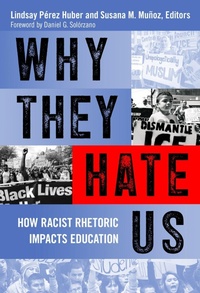
Why They Hate Us
How Racist Rhetoric Impacts Education
Will be published approx. on 5. March 2021
Book
Paperback/Softback
240 pages
978-0-8077-6498-5 (ISBN)
Description
This book examines how racist political rhetoric has created damaging and dangerous conditions for Students of Color in schools and higher education institutions throughout the United States. The authors show how the election of the 45th president has resulted in a defining moment in U.S. history where racist discourses, reinforced by ideologies of white supremacy, have affected the educational experiences of our most vulnerable students. This volume situates the rhetoric of the Trump presidency within a broader historical narrative and provides recommendations for those who seek to advocate for anti-racism and social justice. As we enter the uncharted waters of a global pandemic and national racial reckoning, this will be invaluable reading for scholars, educators, and administrators who want to be part of the solution. Book Features:
Uses Donald Trump's presidency as a case study to show how and why racist rhetoric can be used to mobilize large numbers of U.S. voters.
Examines how the current administration has changed perspectives on contemporary racism that will have a lasting impact throughout the K-16 educational system.
Demonstrates how the current discourses around race and immigration are resulting in increased racism and violence in schools and universities.
Provides strategies for how anti-racist social justice efforts in education will need to shift to respond to the new landscape.
Uses Donald Trump's presidency as a case study to show how and why racist rhetoric can be used to mobilize large numbers of U.S. voters.
Examines how the current administration has changed perspectives on contemporary racism that will have a lasting impact throughout the K-16 educational system.
Demonstrates how the current discourses around race and immigration are resulting in increased racism and violence in schools and universities.
Provides strategies for how anti-racist social justice efforts in education will need to shift to respond to the new landscape.
More details
Language
English
Place of publication
New York
United States
Target group
Professional and scholarly
Product notice
Paperback (trade)
Unsewn / adhesive bound
Dimensions
Height: 229 mm
Width: 156 mm
Thickness: 13 mm
Weight
522 gr
ISBN-13
978-0-8077-6498-5 (9780807764985)
Copyright in bibliographic data and cover images is held by Nielsen Book Services Limited or by the publishers or by their respective licensors: all rights reserved.
Schweitzer Classification
Persons
Lindsay Perez Huber is an associate professor in the Social and Cultural Analysis of Education master's program in the College of Education at California State University, Long Beach. Susana M. Munoz is an associate professor, program coordinator of the Higher Education Leadership Program, and co-director of CSU initiatives for the Race and Intersectional Studies for Educational Equity Center in the School of Education at Colorado State University.
Content
Contents
Foreword?Daniel G. Solorzano?vii
Acknowledgments?xv
Introduction: Racist Rhetoric in the United States: A Brief History, From the "Southern Strategy" to "Make America Great Again"?1
Lindsay Perez Huber
1.?Historical and Contemporary Articulations of White Supremacist, Anti-Immigrant, and Racist Rhetoric?27
Susana M. Munoz
2.?Not "A Good Example for Children": Racist Speech in America's High Schools in the Age of Trump?49
John Rogers and Michael Ishimoto
3.?Praxis of Resilience and Resistance: "We Can STOP Donald Trump" and Other Messages From Immigrant Children?71
Silvia Rodriguez Vega
4.?"You Can't Learn If You Don't Feel Safe": Educators Working With Undocumented High School Students?93
Carolina Valdivia, Marisol Clark-Ibanez, Josefina Espino, and Carolina Lopez
5.?Xenophobia at the U.S.-Mexico Border: The Impacts of Anti-Latina/o/x and Anti-Immigrant Discourse on Transfronterista Community College Students?120
Tanya J. Gaxiola Serrano
6.?Racist Nativist Microaggressions in the Trump Era: Experiences of DACA and Undocumented Latinx College Students?140
Valerie A. Gomez, Darsella Vigil, Lindsay Perez Huber, and Susana M. Munoz
7.?"I Am Not Your Victim": Intersectional Religious Marginalization and Resistance Among Black Muslim Immigrant and Refugee College Students?162
Naruro Hassan, Saskias Casanova, and Keon M. McGuire
Conclusion: The Racism Pandemic?187
Lindsay Perez Huber and Susana M. Munoz
About the Contributors?206
Index?212
Foreword?Daniel G. Solorzano?vii
Acknowledgments?xv
Introduction: Racist Rhetoric in the United States: A Brief History, From the "Southern Strategy" to "Make America Great Again"?1
Lindsay Perez Huber
1.?Historical and Contemporary Articulations of White Supremacist, Anti-Immigrant, and Racist Rhetoric?27
Susana M. Munoz
2.?Not "A Good Example for Children": Racist Speech in America's High Schools in the Age of Trump?49
John Rogers and Michael Ishimoto
3.?Praxis of Resilience and Resistance: "We Can STOP Donald Trump" and Other Messages From Immigrant Children?71
Silvia Rodriguez Vega
4.?"You Can't Learn If You Don't Feel Safe": Educators Working With Undocumented High School Students?93
Carolina Valdivia, Marisol Clark-Ibanez, Josefina Espino, and Carolina Lopez
5.?Xenophobia at the U.S.-Mexico Border: The Impacts of Anti-Latina/o/x and Anti-Immigrant Discourse on Transfronterista Community College Students?120
Tanya J. Gaxiola Serrano
6.?Racist Nativist Microaggressions in the Trump Era: Experiences of DACA and Undocumented Latinx College Students?140
Valerie A. Gomez, Darsella Vigil, Lindsay Perez Huber, and Susana M. Munoz
7.?"I Am Not Your Victim": Intersectional Religious Marginalization and Resistance Among Black Muslim Immigrant and Refugee College Students?162
Naruro Hassan, Saskias Casanova, and Keon M. McGuire
Conclusion: The Racism Pandemic?187
Lindsay Perez Huber and Susana M. Munoz
About the Contributors?206
Index?212