

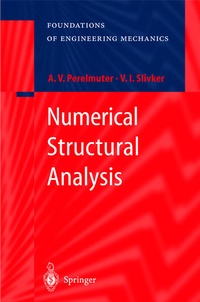
Numerical Structural Analysis
Methods, Models and Pitfalls
Published on 23. April 2003
Book
Hardback
XIX, 501 pages
978-3-540-00628-2 (ISBN)
Description
To our sons, Mike, Andrew, Alex, who did not inherit their fathers' level of interest in applied mechanics, but who became sophisticated in software development and in this regard surpassed their parents. A.P., V.S. Hard times came, the god5 got angry. Children do not behave themselves and everybody wishes to write a book. Ancient Babylonian inscription X Preface Preface to the English Edition The book you are reading is a translation from Russian into English. Within a pretty short term this book saw two editions in Russian. The authors received in spiring responses from readers that both stimulated our continuing and improving this work and made sure it would not be in vain of us to try to multiply our readers by covering the English-speaking engineering community. When we prepared the present edition, we took into account interests of the Western readers, so we had to make some changes to our text published earlier. These changes include the following aspects. First, we excluded a lot of references and discussions regarding Russian engi neering codes. It seems to us those are of no real interest for Western engineers oriented at Eurocode or national construction design regulations.
More details
Series
Edition
2003 ed.
Language
English
Place of publication
Berlin
Germany
Publishing group
Springer Berlin
Target group
Professional and scholarly
Research
Illustrations
258 s/w Abbildungen
XIX, 501 p. 258 illus.
Dimensions
Height: 241 mm
Width: 160 mm
Thickness: 33 mm
Weight
951 gr
ISBN-13
978-3-540-00628-2 (9783540006282)
DOI
10.1007/978-3-540-36500-6
Schweitzer Classification
Other editions
Additional editions
Book
03/2012
Springer
€213.99
Shipment within 7-9 days
Content
Object of Analysis and Problem of Modelling.- Building a Design Model.- Basic Relationships for Discrete Systems.- Finite Element Models.- Mistakes and Pitfalls, Special Techniques to Build Finite Element Models.- Estimating and Interpreting Results.- Uncertainty of Parameters.- A Review of some Problem Classes.- Buckling Problems and Related Issues.- Problems of Dynamics.- A Word Instead of a Conclusion.