

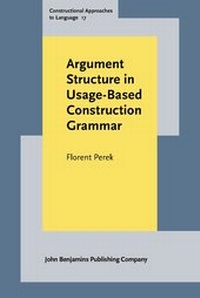
Argument Structure in Usage-Based Construction Grammar
Experimental and corpus-based perspectives
Published on 23. April 2015
Book
Hardback
246 pages
978-90-272-0439-4 (ISBN)
Description
The argument structure of verbs, defined as the part of grammar that deals with how participants in verbal events are expressed in clauses, is a classical topic in linguistics that has received considerable attention in the literature. This book investigates argument structure in English from a usage-based perspective, taking the view that the cognitive representation of grammar is shaped by language use, and that crucial aspects of grammatical organization are tied to the frequency with which words and syntactic constructions are used. On the basis of several case studies combining quantitative corpus studies and psycholinguistic experiments, it is shown how a usage-based approach sheds new light on a number of issues in argument realization and offers frequency-based explanations for its organizing principles at three levels of generality: verbs, constructions, and argument structure alternations.
More details
Series
Language
English
Place of publication
Amsterdam
Netherlands
Target group
Professional and scholarly
Illustrations
+ index
Weight
595 gr
ISBN-13
978-90-272-0439-4 (9789027204394)
Copyright in bibliographic data and cover images is held by Nielsen Book Services Limited or by the publishers or by their respective licensors: all rights reserved.
Schweitzer Classification
Other editions
Additional editions
Florent Perek
Argument Structure in Usage-Based Construction Grammar
Experimental and corpus-based perspectives
E-Book
04/2015
1st Edition
John Benjamins Publishing Company
€118.99
Available for download
Person
Content
1. Acknowledgments; 2. Chapter 1. Introduction; 3. Part I. Verbs; 4. Chapter 2. Usage-based perspectives on verb valency; 5. Chapter 3. Empirical evidence for usage-based valency; 6. Part II. Constructions; 7. Chapter 4. The usage basis of constructional meaning; 8. Chapter 5. The importance of local generalizations; 9. Part III. Alternations; 10. Chapter 6. Alternations as units of linguistic knowledge; 11. Chapter 7. The usage basis of alternation based productivity; 12. Conclusion; 13. Chapter 8. Summary and evaluation; 14. References; 15. Appendix; 16. Constructions index; 17. Name index; 18. Subject index