

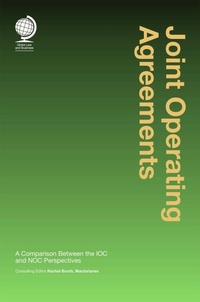
Joint Operating Agreements
A Comparison Between the IOC and NOC Perspectives
1st Edition
Published on 1. July 2015
Book
Hardback
205 pages
978-1-909416-30-7 (ISBN)
Description
Historically, oil and gas upstream activities were largely open to foreign investment. However, nationalisation in recent decades has concentrated the vast majority of natural resources in the hands of national oil companies (NOCs). Therefore, independent oil companies (IOCs) are increasingly likely to deal with NOCs as a partner.
The joint operating agreement (JOA) was intended as a private document that regulates relationships between private investors. Recent developments under several local laws require the participation of NOCs at some stage of the JOA. In addition, many NOCs are now operating internationally, such as Statoil, Gazprom and CNPC. JOAs will thus be affected, as public or semi-public entities are more likely to be party to a document which was originally constructed for private investors.
This major work analyses the critical concerns and challenges that IOCs and NOCs face in this new type of consortium, and will ultimately suggest alternative solutions to find common ground between these parties. The book is divided into three chapters, which respectively deal with the conduct of operations, the financial issues relating to the consortium and the boilerplates of the agreement. Each chapter will include analysis from the perspectives of four different types of company - large IOCs, large NOCs, young IOCs and young NOCs. This approach will provide a detailed picture of the JOA from the point of view of all players in the oil and gas industry, from small to large companies and private to public entities.
The book serves as an invaluable guide for IOCs, independents, NOCs, consultants, legal advisers and consultants who need to understand the implications of having an NOC as a party to a JOA.
The joint operating agreement (JOA) was intended as a private document that regulates relationships between private investors. Recent developments under several local laws require the participation of NOCs at some stage of the JOA. In addition, many NOCs are now operating internationally, such as Statoil, Gazprom and CNPC. JOAs will thus be affected, as public or semi-public entities are more likely to be party to a document which was originally constructed for private investors.
This major work analyses the critical concerns and challenges that IOCs and NOCs face in this new type of consortium, and will ultimately suggest alternative solutions to find common ground between these parties. The book is divided into three chapters, which respectively deal with the conduct of operations, the financial issues relating to the consortium and the boilerplates of the agreement. Each chapter will include analysis from the perspectives of four different types of company - large IOCs, large NOCs, young IOCs and young NOCs. This approach will provide a detailed picture of the JOA from the point of view of all players in the oil and gas industry, from small to large companies and private to public entities.
The book serves as an invaluable guide for IOCs, independents, NOCs, consultants, legal advisers and consultants who need to understand the implications of having an NOC as a party to a JOA.
Reviews / Votes
This book addresses one of the major challenges stemming from the proliferation of national oil companies, (NOCs) that have emerged as a result of nationalisation. -- Phillip Taylor * Richmond Green Chambers *More details
Language
English
Place of publication
London
United Kingdom
Target group
Professional and scholarly
Product notice
sewn/stitched
Cloth over boards
Dimensions
Height: 240 mm
Width: 163 mm
Thickness: 24 mm
Weight
640 gr
ISBN-13
978-1-909416-30-7 (9781909416307)
Copyright in bibliographic data and cover images is held by Nielsen Book Services Limited or by the publishers or by their respective licensors: all rights reserved.
Schweitzer Classification
Other editions
New editions
Eduardo G. Pereira | Anna Ovcharova | Reg Fowler
Joint Operating Agreements
A Comparison Between the IOC and NOC Perspectives, Second Edition
E-Book
02/2022
2nd Edition
Globe Law and Business
€260.99
Available for download
Eduardo G. Pereira | Anna Ovcharova | Reg Fowler
Joint Operating Agreements
A Comparison Between the IOC and NOC Perspectives, Second Edition
Book
02/2022
2nd Edition
Globe Law and Business Ltd
€244.50
Shipment within 3-4 weeks
Persons
By Eduardo Pereira - Edited by Anna Ovcharova
Content
Introduction
Chapter one:
Conduct of operations 7
1 Scope 10
Eduardo G Pereira
2 Working interest 14
Eduardo G Pereira
3 Liability 18
Eduardo G Pereira
4 Operatorship, removal and replacement 34
Eduardo G Pereira
5 Information 56
Eduardo G Pereira
6 Operating committee (Opcom) 60
Eduardo G Pereira
7 Award of contracts 83
Eduardo G Pereira
8 Exclusive operations 103
Eduardo G Pereira
9 Secondment, project team and staffing 146
Anna Ovcharova
10 Local content 155
Anna Ovcharova
11 Health, safety and environment 158
Anna Ovcharova
12 Disposition of production 162
Anna Ovcharova
13 Relinquishment, surrender and withdrawal 172
Anna Ovcharova
Chapter two:
Funding & Accounting 181
1 Work programme and budget 181
Eduardo G Pereira
2 Authorisation for expenditure 197
Eduardo G Pereira
3 Insurance 221
Eduardo G Pereira
4 Decommissioning 224
Eduardo G Pereira
5 Default 228
Eduardo G Pereira
6 Cash calls 247
Anna Ovcharova
7 Cost recovery 253
Anna Ovcharova
8 Overheads 258
Anna Ovcharova
9 Accounting 266
Anna Ovcharova
10 Commingling of funds 272
Anna Ovcharova
11 Tax 276
Eduardo G Pereira
Chapter three:
Boiler plates 279
1 Governing law 279
Eduardo G Pereira
2 Dispute resolution 281
Eduardo G Pereira
3 Termination 289
Anna Ovcharova
4 Force Majeure (chance occurrence) 290
Anna Ovcharova
5 Assignment 293
Anna Ovcharova
6 Intellectual property rights 296
Anna Ovcharova
About the authors 299
Chapter one:
Conduct of operations 7
1 Scope 10
Eduardo G Pereira
2 Working interest 14
Eduardo G Pereira
3 Liability 18
Eduardo G Pereira
4 Operatorship, removal and replacement 34
Eduardo G Pereira
5 Information 56
Eduardo G Pereira
6 Operating committee (Opcom) 60
Eduardo G Pereira
7 Award of contracts 83
Eduardo G Pereira
8 Exclusive operations 103
Eduardo G Pereira
9 Secondment, project team and staffing 146
Anna Ovcharova
10 Local content 155
Anna Ovcharova
11 Health, safety and environment 158
Anna Ovcharova
12 Disposition of production 162
Anna Ovcharova
13 Relinquishment, surrender and withdrawal 172
Anna Ovcharova
Chapter two:
Funding & Accounting 181
1 Work programme and budget 181
Eduardo G Pereira
2 Authorisation for expenditure 197
Eduardo G Pereira
3 Insurance 221
Eduardo G Pereira
4 Decommissioning 224
Eduardo G Pereira
5 Default 228
Eduardo G Pereira
6 Cash calls 247
Anna Ovcharova
7 Cost recovery 253
Anna Ovcharova
8 Overheads 258
Anna Ovcharova
9 Accounting 266
Anna Ovcharova
10 Commingling of funds 272
Anna Ovcharova
11 Tax 276
Eduardo G Pereira
Chapter three:
Boiler plates 279
1 Governing law 279
Eduardo G Pereira
2 Dispute resolution 281
Eduardo G Pereira
3 Termination 289
Anna Ovcharova
4 Force Majeure (chance occurrence) 290
Anna Ovcharova
5 Assignment 293
Anna Ovcharova
6 Intellectual property rights 296
Anna Ovcharova
About the authors 299