

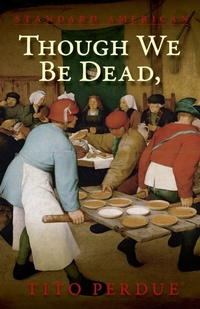
Though We Be Dead, Yet Our Day Will Come
Published on 15. July 2020
Book
Paperback/Softback
104 pages
978-1-940933-79-5 (ISBN)
Description
Tito Perdue’s Though We Be Dead, Yet Our Day Shall Come is a novella about the advancement of American civilization as revealed by the sixtieth high school reunion of the Class of 1956 from a small Alabama town. The narrator sardonically catalogs the "progress" of his classmates in terms of divorces, abortions, addictions, suicides, arrests, and sex change operations, which progressive thinkers tend to regard as negligible epiphenomena of long-overdue revolutionary advances in social justice and self-actualization. This is a book for those who are not quite ready to celebrate the end of history just yet.
More details
Language
English
Product notice
Paperback (trade)
Unsewn / adhesive bound
Illustrations
Illustrations
Dimensions
Height: 216 mm
Width: 140 mm
Thickness: 7 mm
Weight
143 gr
ISBN-13
978-1-940933-79-5 (9781940933795)
Copyright in bibliographic data and cover images is held by Nielsen Book Services Limited or by the publishers or by their respective licensors: all rights reserved.
Schweitzer Classification
Person
Tito Perdue was born in 1938 in Chile, the son of an electrical engineer from Alabama. The family returned to Alabama in 1941, where Tito graduated from the Indian Springs School, a private academy near Birmingham, in 1956. He then attended Antioch College in Ohio for a year, before being expelled for cohabitating with a female student, Judy Clark. In 1957, they were married, and remain so today. He graduated from the University of Texas in 1961, and spent some time working in New York City, an experience which garnered him his life-long hatred of urban life. After holding positions at various university libraries, Tito has devoted himself full-time to writing since 1983. He is the author of twenty-three novels, which have been praised in The New York Times, The Los Angeles Reader, The New England Review of Books, Chronicles: A Magazine of American Culture, The Quarterly Review, The Occidental Observer, and at Counter-Currents. In 2015, he received the H. P. Lovecraft Prize for Literature.