

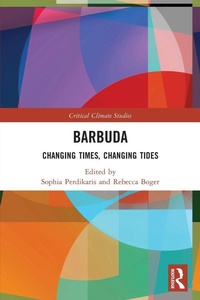
Barbuda
Changing Times, Changing Tides
1st Edition
Published on 26. August 2024
Book
Paperback/Softback
180 pages
978-1-032-39014-7 (ISBN)
Description
This volume explores a range of themes including impacts of climate change, resilience, sustainability, indigeneity, cultural genocide, disaster capitalism, preservation of biodiversity, and environmental degradation. Focusing on the island of Barbuda in the West Indies, it shares critical insights into how climate change is reshaping our world. The book examines how climate has changed in the Caribbean over different spatial and temporal scales and how varying natural and anthropogenic factors have shaped Barbuda's climatic and cultural history. It highlights projections of 21st-century climate change for the Caribbean region and its likely impacts on Barbuda's coastal ecosystems, potable groundwater resources, and heritage. With essays by researchers from the United States, Canada, Caribbean, and Europe, this volume straddles a range of disciplines such as archaeology, anthropology, paleoclimatology, environmental sciences, science education, and Traditional Ecological Knowledge (TEK).
Drawing on interdisciplinary and transdisciplinary approaches that explore the intersection of natural and social systems over the longue duree, the volume will be of interest to scholars, researchers, and students of ethnography, social anthropology, climate action, development studies, public policy, and climate change.
Drawing on interdisciplinary and transdisciplinary approaches that explore the intersection of natural and social systems over the longue duree, the volume will be of interest to scholars, researchers, and students of ethnography, social anthropology, climate action, development studies, public policy, and climate change.
More details
Series
Language
English
Place of publication
London
United Kingdom
Publishing group
Taylor & Francis Ltd
Target group
College/higher education
Professional and scholarly
Academic and Postgraduate
Illustrations
39 s/w Abbildungen, 15 s/w Photographien bzw. Rasterbilder, 24 s/w Zeichnungen, 9 s/w Tabellen
9 Tables, black and white; 24 Line drawings, black and white; 15 Halftones, black and white; 39 Illustrations, black and white
Dimensions
Height: 234 mm
Width: 156 mm
Thickness: 10 mm
Weight
286 gr
ISBN-13
978-1-032-39014-7 (9781032390147)
Copyright in bibliographic data and cover images is held by Nielsen Book Services Limited or by the publishers or by their respective licensors: all rights reserved.
Schweitzer Classification
Other editions
Additional editions
Book
12/2022
1st Edition
Routledge India
€185.70
Shipment within 10-20 days
E-Book
12/2022
1st Edition
Routledge India
€55.49
Available for download
E-Book
12/2022
1st Edition
Routledge India
€55.49
Available for download
Persons
Sophia Perdikaris is Director of Global Integrative Studies (the home of Anthropology, Geography, and Global Studies) and Happold Professor of Anthropology at the University of Nebraska-Lincoln, USA. Her area is environmental archaeology with a specialty in animal bones from archaeological sites. She is interested in people-environment interactions through time and the response of both to big climatic events.
Rebecca Boger is Professor at Brooklyn College, City University of New York (CUNY), USA, and has a background in geospatial technologies, environmental science, and science education. Her research in Barbuda examines socio-ecological resilience, sustainability, environmental/climate change modeling, and community-based mapping.
Rebecca Boger is Professor at Brooklyn College, City University of New York (CUNY), USA, and has a background in geospatial technologies, environmental science, and science education. Her research in Barbuda examines socio-ecological resilience, sustainability, environmental/climate change modeling, and community-based mapping.
Content
Introduction 1. A long-term perspective of climate change in the Caribbean and its impacts on the island of Barbuda 2. Water use and availability on Barbuda from the colonial times to the present: An intersection of natural and social systems 3. Developing agency and resilience in the face of climate change: Ways of knowing, feeling, and practicing through art and science 4. Fallow deer: The unprotected biocultural heritage of Barbuda 5. From the far ground to the near ground: Barbuda's shifting agricultural practices 6. Written with lightning: Filming Barbuda before the storm 7. Disaster capitalism: Who has a right to control their future?