

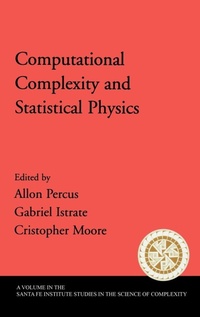
Computational Complexity and Statistical Physics
Published on 15. December 2005
Book
Hardback
384 pages
978-0-19-517737-4 (ISBN)
Description
Computer science and physics have been closely linked since the birth of modern computing. In recent years, an interdisciplinary area has blossomed at the junction of these fields, connecting insights from statistical physics with basic computational challenges. Researchers have successfully applied techniques from the study of phase transitions to analyze NP-complete problems such as satisfiability and graph coloring. This is leading to a new understanding of the structure of these problems, and of how algorithms perform on them.
Computational Complexity and Statistical Physics will serve as a standard reference and pedagogical aid to statistical physics methods in computer science, with a particular focus on phase transitions in combinatorial problems. Addressed to a broad range of readers, the book includes substantial background material along with current research by leading computer scientists, mathematicians, and physicists. It will prepare students and researchers from all of these fields to contribute to this exciting area.
Computational Complexity and Statistical Physics will serve as a standard reference and pedagogical aid to statistical physics methods in computer science, with a particular focus on phase transitions in combinatorial problems. Addressed to a broad range of readers, the book includes substantial background material along with current research by leading computer scientists, mathematicians, and physicists. It will prepare students and researchers from all of these fields to contribute to this exciting area.
Reviews / Votes
"This volume provides a comprehensive overview of an exciting new research area at the interface between statistical physics and computer science. It is an excellent exposition, featuring state-of-the-art contributions by renowned researchers in the field. The book will serve as a useful reference for years to come." Bart Selman, Cornell UniversityMore details
Series
Language
English
Place of publication
New York
United States
Target group
Professional and scholarly
Illustrations
84 halftones & line illus.
Dimensions
Height: 240 mm
Width: 161 mm
Thickness: 25 mm
Weight
740 gr
ISBN-13
978-0-19-517737-4 (9780195177374)
Copyright in bibliographic data and cover images is held by Nielsen Book Services Limited or by the publishers or by their respective licensors: all rights reserved.
Schweitzer Classification
Other editions
Additional editions
Allon Percus | Gabriel Istrate | Cristopher Moore
Computational Complexity and Statistical Physics
Book
03/2006
Oxford University Press Inc
€76.00
Shipment within 15-20 days
Allon Percus | Gabriel Istrate | Cristopher Moore
Computational Complexity and Statistical Physics
E-Book
02/2006
1st Edition
OUP eBook
€47.49
Available for download
Persons
Allon Percus is Associate Director of the Institute for Pure and Applied Mathematics at UCLA, and a scientist at Los Alamos National Laboratory. He received his Ph.D. in Theoretical Physics from the University of Paris, Orsay, in 1997. His research has combined statistical physics, discrete mathematics, and computer science, focusing primarily on local search algorithms in combinatorial optimization. He has organized numerous conferences and workshops on combinatorics, phase transitions, and algorithmic complexity.
Gabriel Istrate is a scientist at Los Alamos National Laboratory, in the Basic and Applied Simulation Science group. He received his Ph.D. in Computer Science from the University of Rochester in 1999. His primary research interests are in combinatorial, game theoretic, and probabilistic aspects of complex systems. His work in the area of phase transitions has focused on the interplay between threshold properties and computational complexity.
Cristopher Moore is an Associate Professor at the University of New Mexico, and holds a joint appointment in the Computer Science and Physics departments. He received his Ph.D. in Physics from Cornell University in 1991. He has published 80 papers at the interface between these two fields, on topics ranging from statistical physics and phase transitions to quantum algorithms and mapping the internet.
Gabriel Istrate is a scientist at Los Alamos National Laboratory, in the Basic and Applied Simulation Science group. He received his Ph.D. in Computer Science from the University of Rochester in 1999. His primary research interests are in combinatorial, game theoretic, and probabilistic aspects of complex systems. His work in the area of phase transitions has focused on the interplay between threshold properties and computational complexity.
Cristopher Moore is an Associate Professor at the University of New Mexico, and holds a joint appointment in the Computer Science and Physics departments. He received his Ph.D. in Physics from Cornell University in 1991. He has published 80 papers at the interface between these two fields, on topics ranging from statistical physics and phase transitions to quantum algorithms and mapping the internet.
Content
Preface ; Part 1: Fundamentals ; 1. Introduction: Where Statistical Physics Meets Computation ; 2. Threshold Phenomena and Influence: Perspectives from Mathematics, Computer Science, and Economics ; Part 2: Statistical Physics and Algorithms ; 3. Analyzing Search Algorithms with Physical Methods ; 4. Constraint Satisfaction by Survey Propagation ; 5. The Easiest Hard Problem: Number Partitioning ; 6. Ground States, Energy Landscape and Low-Temperature Dynamics of plus/minus Spin Glasses ; Part 3: Identifying the Threshold ; 7. The Satisfiability Threshold Conjecture: Techniques Behind Upper Bound Improvements ; 8. Proving Conditional Randomness Using the Principle of Deferred Decisions ; 9. The Phase Transition in the Random HornSAT Problem ; Part 4: Extensions and Applications ; 10. Phase Transitions for Quantum Search Algorithms ; 11. Scalability, Random Surfaces and Synchronized Computing Networks ; 12. Combinatorics of Genotype-Phenotype Maps: An RNA Case Study ; 13. Towards a Predictive Computational Complexity Theory for Periodically Specified Problems: A Survey ; Bibliography ; Index