

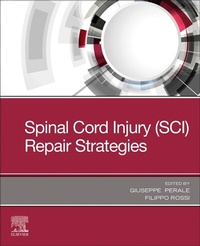
Spinal Cord Injury (SCI) Repair Strategies
Published on 29. October 2019
Book
Paperback/Softback
346 pages
978-0-08-102807-0 (ISBN)
Description
Spinal Cord Injury (SCI) Repair Strategies provides researchers the latest information on potential regenerative approaches to spinal cord injury, specifically focusing on therapeutic approaches that target regeneration, including cell therapies, controlled drug delivery systems, and biomaterials. Dr. Giuseppe Perale and Dr. Filippo Rossi lead a team of authoritative authors in academia and industry in this innovative reference on the field of regenerative medicine and tissue engineering. This book presents all the information readers need to understand the current and potential array of techniques, materials, applications and their benefits for spinal cord repair.
More details
Language
English
Place of publication
London
United Kingdom
Publishing group
Elsevier Health Sciences
Target group
Professional and scholarly
Primary: Researchers in regenerative medicine, tissue engineering and neuroscience
Secondary:<b> </b>Researchers in Biomaterials and Biomedical Engineering
Dimensions
Height: 235 mm
Width: 191 mm
Weight
720 gr
ISBN-13
978-0-08-102807-0 (9780081028070)
Copyright in bibliographic data and cover images is held by Nielsen Book Services Limited or by the publishers or by their respective licensors: all rights reserved.
Schweitzer Classification
Other editions
Additional editions
Giuseppe Perale | Filippo Rossi
Spinal Cord Injury (SCI) Repair Strategies
E-Book
10/2019
Elsevier
€205.00
Available for download
Persons
Giuseppe Perale is currently Professor of Regenerative Medicine at the Faculty of Biomedical Sciences of the University of Southern Switzerland (USI) in Lugano, Switzerland, and visiting Professor at the Ludwig Boltzmann Institute for Experimental and Clinical Traumatology in Vienna, Austria Filippo Rossi is Associate Professor in Applied Physical Chemistry at the Department of Chemistry, Materials and Chemical Engineering "Giulio Natta? at Politecnico di Milano, Italy. His research focused on innovative polymer materials for nanomedicine, drug delivery, biosensors, and tissue engineering, both experimental and modeling techniques.
Editor
Professor of Regenerative Medicine, Faculty of Biomedical Sciences, University of Southern Switzerland (USI), Switzerland; Visiting Professor, Ludwig Boltzmann Institute for Experimental and Clinical Traumatology, Vienna, Austria
Associate Professor, Applied Physical Chemistry, Department of Chemistry, Materials and Chemical Engineering "Giulio Natta? of Politecnico di Milano in Milan, Italy
Content
1. Introduction to spinal cord injury as clinical pathology
2. Spinal cord injury: role of neurophysiology
3. Conventional treatments and surgical margins of maneuvering for spinal cord injury management
4. MRI as an imaging tool for in vivo noninvasive morphological and (partially) functional examination of injured spinal cord
5. Spinal cord injury: ethical issues
6. Elements of material science and polymeric biomaterials
7. Soft and rigid scaffolds for spinal cord injury regeneration
8. Nanomaterials for spinal cord injury (SCI) regeneration
9. Cell therapies for spinal cord injury regeneration
10. Functional properties of progenitor-like cells in the spinal cord: implications for self-repair
11. Paracrine effects for spinal cord injury regeneration
12. Pharmacological therapies and factors delivery for spinal cord injury regeneration
13. Reliability on animal models
14. Fundamentals and application of modeling in support of spinal cord injury repair strategies
2. Spinal cord injury: role of neurophysiology
3. Conventional treatments and surgical margins of maneuvering for spinal cord injury management
4. MRI as an imaging tool for in vivo noninvasive morphological and (partially) functional examination of injured spinal cord
5. Spinal cord injury: ethical issues
6. Elements of material science and polymeric biomaterials
7. Soft and rigid scaffolds for spinal cord injury regeneration
8. Nanomaterials for spinal cord injury (SCI) regeneration
9. Cell therapies for spinal cord injury regeneration
10. Functional properties of progenitor-like cells in the spinal cord: implications for self-repair
11. Paracrine effects for spinal cord injury regeneration
12. Pharmacological therapies and factors delivery for spinal cord injury regeneration
13. Reliability on animal models
14. Fundamentals and application of modeling in support of spinal cord injury repair strategies