

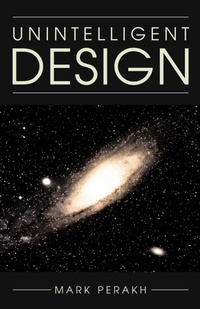
Unintelligent Design
Published on 1. December 2003
Book
Hardback
459 pages
978-1-59102-084-4 (ISBN)
Description
Physicist Mark Perakh critically reviews recent trends toward harmonizing religion and science. From intelligent design theories to arguments allegedly proving the compatibility of biblical stories with scientific data and "Bible codes" containing secret messages, Perakh shows that, however sophisticated in appearance, all such approaches are little more than tailoring evidence to fit the desired theory.
Beginning with the design theorists, Perakh provides a detailed critique of the publications of William Dembski, Michael Behe, and Phillip Johnson. In each case he clearly demonstrates lack of substantiation, internal contradictions, and multiple fallacies that mar their works.
In Part Two he critiques the "mental acrobatics" of various Christian and Jewish writers whose works attempt to prove such unlikely propositions as: the inerrancy of the Bible, the harmony of the Torah and science, the duration of the six days of creation, and deriving a theory of nonrandom evolution from the Talmud.
Part Three describes how genuine science is conducted, what the laws of science actually mean to practicing scientists, and what distinguishes real science from pseudoscience.
In conclusion, Perakh discusses the rise and fall of the so-called Bible code as an example of how well-marketed pseudoscience can successfully cloak itself in the mantle of science.
For everyone interested in separating scientific facts from the hype of trendy theories about science, this book is must reading.
Beginning with the design theorists, Perakh provides a detailed critique of the publications of William Dembski, Michael Behe, and Phillip Johnson. In each case he clearly demonstrates lack of substantiation, internal contradictions, and multiple fallacies that mar their works.
In Part Two he critiques the "mental acrobatics" of various Christian and Jewish writers whose works attempt to prove such unlikely propositions as: the inerrancy of the Bible, the harmony of the Torah and science, the duration of the six days of creation, and deriving a theory of nonrandom evolution from the Talmud.
Part Three describes how genuine science is conducted, what the laws of science actually mean to practicing scientists, and what distinguishes real science from pseudoscience.
In conclusion, Perakh discusses the rise and fall of the so-called Bible code as an example of how well-marketed pseudoscience can successfully cloak itself in the mantle of science.
For everyone interested in separating scientific facts from the hype of trendy theories about science, this book is must reading.
More details
Language
English
Place of publication
United States
Product notice
sewn/stitched
Cloth over boards
Dimensions
Height: 238 mm
Width: 164 mm
Thickness: 40 mm
Weight
833 gr
ISBN-13
978-1-59102-084-4 (9781591020844)
Copyright in bibliographic data and cover images is held by Nielsen Book Services Limited or by the publishers or by their respective licensors: all rights reserved.
Schweitzer Classification
Person
By Mark Perakh