

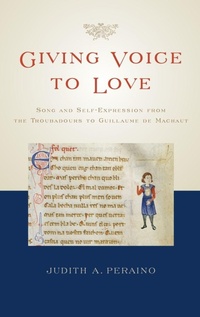
Giving Voice to Love
Song and Self-Expression from the Troubadours to Guillaume de Machaut
Published on 15. December 2011
Book
Hardback
384 pages
978-0-19-975724-4 (ISBN)
Description
Grafting musicology and literary studies together in an unprecedented manner, Giving Voice to Love: Song and Self Expression from the Troubadours to Guillaume de Machaut investigates the "courtly love" songs of the twelfth to late fourteenth centuries and explores the paradoxical relationship of music and self expression in the Middle Ages. While these love songs often conceive and express the autonomous subject - the lyric "I" represented by a single line of melody - they also engage highly conventional musical and poetic language. This paradox was understood by the poets and became the basis for irony, parody and intertextual referencing, which instilled the lyrics with a characteristic self-consciousness that reflected the unstable conditions for self-expression.
Author Judith Peraino illustrates that similar operations are at work in the musical settings. Examining moments where voice, melody, rhythm, form, and genre come dramatically to the fore and seem to comment on music itself, Giving Voice to Love strives not only to hear self-expression in these love songs, but to understand how musical elements give voice to the complex issues of self and subjectivity encoded in medieval love.
Through its approach to the exploration of "courtly love" songs, Giving Voice to Love serves as a model for methodological integration and provides musicologists, literary scholars and medieval historians with a common analytical ground.
Author Judith Peraino illustrates that similar operations are at work in the musical settings. Examining moments where voice, melody, rhythm, form, and genre come dramatically to the fore and seem to comment on music itself, Giving Voice to Love strives not only to hear self-expression in these love songs, but to understand how musical elements give voice to the complex issues of self and subjectivity encoded in medieval love.
Through its approach to the exploration of "courtly love" songs, Giving Voice to Love serves as a model for methodological integration and provides musicologists, literary scholars and medieval historians with a common analytical ground.
Reviews / Votes
Giving Voice to Love, then, itself presents a plurality of voices - postmodern, traditionalist, overt, and covert - making this book by Judith A. Peraino a valuable contribution to the study of medieval song, as well as to debates on the future direction(s) of medieval musicology. * Henry Hope, Music and Letters * Giving voice to love is a complex book, offering a valuable contribution to a part of musicology ripe for theorization along precisely the line that Peraino pursues.. deeply thought provoking. * Elizabeth Eva Leach, Early Music *More details
Language
English
Place of publication
New York
United States
Target group
College/higher education
Dimensions
Height: 240 mm
Width: 161 mm
Thickness: 26 mm
Weight
790 gr
ISBN-13
978-0-19-975724-4 (9780199757244)
Copyright in bibliographic data and cover images is held by Nielsen Book Services Limited or by the publishers or by their respective licensors: all rights reserved.
Schweitzer Classification
Other editions
Additional editions
Judith A. Peraino
Giving Voice to Love
Song and Self-Expression from the Troubadours to Guillaume de Machaut
E-Book
11/2011
1st Edition
OUP eBook
€36.99
Available for download
Person
Judith A. Peraino is Professor of Music at Cornell University. Her publications include articles on medieval secular songs and motets, the rock artists PJ Harvey and Blondie, and Henry Purcell's opera Dido and Aeneas. She is the author of the book Listening to the Sirens: Musical Technologies of Queer Identity from Homer to Hedwig (2006). Peraino is also a faculty member of the Medieval Studies Program and the Feminist, Gender, and Sexuality Studies Program.
Content
Table of Contents ; About the Companion Website ; List of Figures ; List of Tables ; Abbreviations ; Map of Medieval France ; Introduction: Love, Self, and Song ; Chapter One: The Turn of the Voice ; Chapter Two: Delinquent Descorts and Medieval Lateness ; Chapter Three: Changing the Subject of the Chanson d'amour ; Chapter Four: The Hybrid Voice of Monophonic Motets ; Chapter Five: Machaut's Turn to Monophony ; Conclusion: Medieval Expressionism ; Bibliography ; Index of Songs and Motets ; Index