

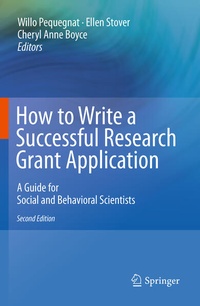
How to Write a Successful Research Grant Application
A Guide for Social and Behavioral Scientists
2nd Edition
Published on 13. October 2010
Book
Paperback/Softback
XXXI, 300 pages
978-1-4419-1453-8 (ISBN)
Description
Over the last fifty years behavioral and medical research has been generously supported by the federal government, private foundations, and other philanthropic organizations contributing to the development of a vibrant public health system both in the United States and worldwide. However, these funds are dwindling and to stay competitive, investigators must understand the funding environment and know how to translate their hypotheses into research grant applications that reviewers evaluate as having scientific merit.
The Second Edition of 'How to Write a Successful Research Grant Application' is the only book of its kind written by federal research investigators which provides technical assistance for researchers applying for biobehavioral and psychosocial research funding and can give them an edge in this competitive environment. The book provides invaluable tips on all aspects of the art of grantsmanship, including: how to determine research opportunities and priorities, how to develop the different elements of an application, how to negotiate the electronic submission and review processes, and how to disseminate the findings. Charts, visual aids, Web links, an extensive real-world example of a research proposal with budget, and a "So You Were Awarded Your Grant-Now What?" chapter show prospective applicants how to:
- Formulate a testworthy-and interesting-hypothesis.
- Select the appropriate research mechanism.
- Avoid common pitfalls in proposal writing.
- Develop an adequate control group.
- Conduct a rigorous qualitative inquiry.
- Develop a budget justification of costs.
- Develop a human subjects of animal welfare plan.
- Write a data analytic plan.
- Design a quality control/assurance program.
- Read between the lines of a summary of the review of your application.
Although its focus is on Public Health Service funding, 'How to Write a Successful Research Grant' is equally useful for all research proposals, including graduate studentspreparing a thesis or dissertation proposal. Service providers in community-based organizations and public health agencies will also find this a useful resource in preparing a proposal to compete for grant funds from state and community resources, non-government organizations, and foundations.
More details
Edition
2nd ed. 2011
Language
English
Place of publication
New York
United States
Target group
Professional and scholarly
Research
Edition type
Revised edition
Product notice
Paperback (trade)
Unsewn / adhesive bound
Illustrations
XXXI, 300 p.
Dimensions
Height: 233 mm
Width: 156 mm
Thickness: 25 mm
Weight
614 gr
ISBN-13
978-1-4419-1453-8 (9781441914538)
DOI
10.1007/978-1-4419-1454-5
Schweitzer Classification
Other editions
Additional editions
Willo Pequegnat | Ellen Stover | Cheryl Anne Boyce
How to Write a Successful Research Grant Application
A Guide for Social and Behavioral Scientists
E-Book
11/2010
2nd Edition
Springer
€128.39
Available for download
Previous edition
Willo Pequegnat | Ellen Stover
How to Write a Successful Research Grant Application
A Guide for Social and Behavioral Scientists
Book
09/1995
1st Edition
Plenum Publishing Co.,N.Y.
€85.59
Article exhausted; check for reprint
Persons
Willo Pequegnat is Associate Director of the International AIDS Prevention Research in the NIMH Center for Mental Health Research on AIDS at the National Institutes of Health (NIH).
Ellen Stover is Director of the Division of AIDS and Health and Behavior Research at the National Institute of Mental Health.
Cheryl Boyce is Associate Director for Pediatric Research Training and Career Development and Chief, Child Abuse and Neglect Program at the National Institute of Mental Health.
Content
Part I: Grantsmanship and the Grant Review and Management Process.- Research Priorities and Emerging Issues.- Children, Women and Ethnic Minorities In Research.- Grantsmanship.- Program Announcements and Requests For Research Applications.- Selecting the Appropriate Research Mechanism.- Selecting Issues and Hypothesis for a Research Study.- Electronic Submission of Grant Proposal.- The Review Process.- Common Mistakes in Developing a Grant.- Interpreting Your Summary Statement.- The Award Process.- Managing a Grant.- Part II: Developing Sections of Your Research Application.- Developing a Theoretical Framework and Rationale for a Research Proposal.- How Do You Formulate a Testable Hypothesis?.- Qualitative Inquiry.- Using Technology and the Internet in Research.- Designing an Intervention Study.- Designing an Adequate Control Group.- Designing a Training Grant Application (Fs, Ks, Ts, R36s).- Assessment.- IRBs and Human Subjects Issues (DSMBs).- Conflict of Interest and Disclosure.- Community Based Collaborations.- Animal Welfare and Behavior.- Integrating Biological and Genetic Components.- Biographic Sketches of Senior/Key Persons.- Developing the Data Analytic Plan.- Developing a Budget and Financial Justification.- Quality Control/Quality Assurance Program.- SBIR/STTP.- Part III: Disseminating Your Research.- Public Access for Publications.- Disseminating Findings to Communities.- Data Sharing.- Appendix A: Funded Research Proposal (including data analytic plan and budget justification). - Appendix B: Charts, Timelines, and Other Visual Aids.- Appendix C: Links to More Information (Federal, State and Other).