

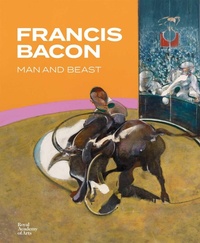
Francis Bacon
Man and Beast
Published on 8. February 2021
Book
Hardback
160 pages
978-1-912520-55-8 (ISBN)
Description
Francis Bacon is considered one of the most important painters of the 20thcentury. A major exhibition of his paintings at the Royal Academy of Arts, planned for 2020 but postponed because of the pandemic, explores the role of animals in his work - not least the human animal.
Having often painted dogs and horses, in 1969 Bacon first depicted bullfights. In this powerful series of works, the interaction between man and beast is dangerous and cruel, but also disturbingly intimate. Both are contorted in their anguished struggle, and the erotic lurks not far away: 'Bullfighting is like boxing,' Bacon once said. 'A marvellous aperitif to sex.' Twenty-two years later, a lone bull was to be the subject of his final painting.
In this fascinating publication - a significant addition to the literature on Bacon - expert authors discuss Bacon's approach to animals and identify his varied sources of inspiration, which included wildlife photography and the motion studies of Eadweard Muybridge. They contend that, by considering animals in states of vulnerability, anger and unease, Bacon was able to lay bare the role of instinctual behaviour in the human condition.
Images below, left to right:
Francis Bacon (1909-1992), Fragment of a Crucifixion, 1950. Oil and cotton wool on canvas, 140 x 108.5 cm. Stedelijk van Abbemuseum, Eindhoven. Photo Hugo Maertens
Francis Bacon (1909-1992), Study for Portrait (with Two Owls), 1963. Oil on canvas, 198.1 x 144.8 cm. Private collection. Photo Prudence Cuming Associates Ltd
Francis Bacon (1909-1992), Man with Dog, 1953. Oil on canvas, 152 x 117 cm. Albright-Knox Art Gallery, Buffalo, New York. Gift of Seymour H. Knox Jr, 1955, inv. K1955:3. Photo Prudence Cuming Associates Ltd
All images (c) The Estate of Francis Bacon. All rights reserved, DACS/Artimage 2020.
Having often painted dogs and horses, in 1969 Bacon first depicted bullfights. In this powerful series of works, the interaction between man and beast is dangerous and cruel, but also disturbingly intimate. Both are contorted in their anguished struggle, and the erotic lurks not far away: 'Bullfighting is like boxing,' Bacon once said. 'A marvellous aperitif to sex.' Twenty-two years later, a lone bull was to be the subject of his final painting.
In this fascinating publication - a significant addition to the literature on Bacon - expert authors discuss Bacon's approach to animals and identify his varied sources of inspiration, which included wildlife photography and the motion studies of Eadweard Muybridge. They contend that, by considering animals in states of vulnerability, anger and unease, Bacon was able to lay bare the role of instinctual behaviour in the human condition.
Images below, left to right:
Francis Bacon (1909-1992), Fragment of a Crucifixion, 1950. Oil and cotton wool on canvas, 140 x 108.5 cm. Stedelijk van Abbemuseum, Eindhoven. Photo Hugo Maertens
Francis Bacon (1909-1992), Study for Portrait (with Two Owls), 1963. Oil on canvas, 198.1 x 144.8 cm. Private collection. Photo Prudence Cuming Associates Ltd
Francis Bacon (1909-1992), Man with Dog, 1953. Oil on canvas, 152 x 117 cm. Albright-Knox Art Gallery, Buffalo, New York. Gift of Seymour H. Knox Jr, 1955, inv. K1955:3. Photo Prudence Cuming Associates Ltd
All images (c) The Estate of Francis Bacon. All rights reserved, DACS/Artimage 2020.
More details
Language
English
Place of publication
London
United Kingdom
Illustrations
160 Illustrations, color
Dimensions
Height: 290 mm
Width: 239 mm
Thickness: 20 mm
Weight
1084 gr
ISBN-13
978-1-912520-55-8 (9781912520558)
Copyright in bibliographic data and cover images is held by Nielsen Book Services Limited or by the publishers or by their respective licensors: all rights reserved.
Schweitzer Classification