

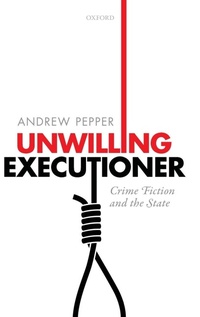
Unwilling Executioner
Crime Fiction and the State
Published on 7. April 2016
Book
Hardback
288 pages
978-0-19-871618-1 (ISBN)
Description
What gives crime fiction its distinctive shape and form? What makes it such a compelling vehicle of social and political critique? Unwilling Executioner argues that the answer lies in the emerging genre's complex and intimate relationship with the bureaucratic state and modern capitalism, and the contradictions that ensue once the state assumes control of the criminal justice system. This study offers a dramatic new interpretation of the genre's emergence
and evolution over a three hundred year period and as a genuinely transnational phenomenon. From its roots in the tales of criminality circulated widely in Paris and London in the early eighteenth century, this book examines the extraordinary richness, diversity and complexity of the genre's subsequent
thematizations of crime and policing-moving from France and Britain and from continental Europe and the United States to other parts of the globe. In doing so it offers new ways of reading established crime novelists like Gaboriau, Doyle, Hammett, and Simenon, beyond their national contexts and an impulse to characterize their work as either straightforwardly 'radical' or 'conservative'. It also argues for the centrality of writers like Defoe, Gay, Godwin, Vidocq, Morrison, and more recently
Manchette, Himes, and Sjöwall and Wahlöö to a project where crime and policing are rooted, and shown to be rooted, in the social and economic conditions of their time. These are all deeply political writers even if their novels exhibit no interest in directly promoting political causes or parties. The
result is an agile, layered, and far-reaching account of the crime story's ambivalent relationship to the justice system and its move to complicate our understanding of what crime is and how society is policed and for whose benefit.
and evolution over a three hundred year period and as a genuinely transnational phenomenon. From its roots in the tales of criminality circulated widely in Paris and London in the early eighteenth century, this book examines the extraordinary richness, diversity and complexity of the genre's subsequent
thematizations of crime and policing-moving from France and Britain and from continental Europe and the United States to other parts of the globe. In doing so it offers new ways of reading established crime novelists like Gaboriau, Doyle, Hammett, and Simenon, beyond their national contexts and an impulse to characterize their work as either straightforwardly 'radical' or 'conservative'. It also argues for the centrality of writers like Defoe, Gay, Godwin, Vidocq, Morrison, and more recently
Manchette, Himes, and Sjöwall and Wahlöö to a project where crime and policing are rooted, and shown to be rooted, in the social and economic conditions of their time. These are all deeply political writers even if their novels exhibit no interest in directly promoting political causes or parties. The
result is an agile, layered, and far-reaching account of the crime story's ambivalent relationship to the justice system and its move to complicate our understanding of what crime is and how society is policed and for whose benefit.
Reviews / Votes
Pepper offers nothing less than a long history of the crime novel as world literature, its roots in England but its branches universal. * Len Gutkin, Times Literary Supplement *More details
Other editions
Additional editions

Book
08/2019
Oxford University Press
€44.00
Shipment within 15-20 days

E-Book
04/2016
1st Edition
OUP eBook
€17.49
Available for download
Person
Andrew Pepper is Senior Lecturer in English and American literature at Queen's University Belfast. He has written extensively about crime fiction over a twenty year period and is the author of The Contemporary American Crime Novel: Race, Ethnicity, Gender, Class (Edinburgh University Press, 2000) and co-editor, with David Schmid, of Globalization and the State in Contemporary Crime Fiction (Palgrave, 2016). He is also the author of five detective
novels set in nineteenth-century Britain and Ireland, all published by Weidenfeld & Nicolson, including The Last Days of Newgate (2006), The Detective Branch (2010) and Bloody Winter (2011).
novels set in nineteenth-century Britain and Ireland, all published by Weidenfeld & Nicolson, including The Last Days of Newgate (2006), The Detective Branch (2010) and Bloody Winter (2011).
Content
Preface ; Introduction: Crime Fiction as Unwilling Executioner ; 1. 'A life of horrid and inimitable wickedness': Crime, Law and Punishment in Early Eighteenth-Century London and Paris ; 2. 'Let us attack injustice at its source': Crime Literature in an Era of Revolution and Reform ; 3. 'A mysterious power whose hand is everywhere': Imagining the State and Codifying the Law in the Mid-Nineteenth Century ; 4. Crime, Business, and Liberty at the Turn of the Century: the Individual, the State and the Emergence of Modern Capitalism ; 5. 'No Good for Business': States of Crime in the 1920s and 1930s ; 6. 'On the Barricades': Crime Fiction and Commitment in an Era of Radical Politics ; 7. 1. From Sovereignty to Neoliberalism: Crime Fiction in the Contemporary World ; Conclusion ; Select Bibliography