

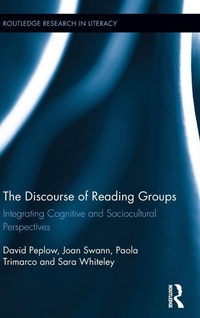
The Discourse of Reading Groups
Integrating Cognitive and Sociocultural Perspectives
1st Edition
Published on 3. December 2015
Book
Hardback
214 pages
978-0-415-72969-7 (ISBN)
Description
Of interest in their own terms as a significant cultural practice, reading groups also provide a window on the everyday interpretation of literary texts. While reading is often considered a solitary process, reading groups constitute a form of social reading, where interpretations are produced and displayed in discourse. The Discourse of Reading Groups is a study of such joint conceptual activity, and how this is necessarily embedded in interpersonal activity and the production of reader identities. Uniquely in this context it draws on, and seeks to integrate, ideas from both cognitive and social linguistics.
The book will be of interest to scholars in literacy studies as well as cultural and literary studies, the history of reading, applied linguistics and sociolinguistics, digital technologies and educational research.
The book will be of interest to scholars in literacy studies as well as cultural and literary studies, the history of reading, applied linguistics and sociolinguistics, digital technologies and educational research.
More details
Series
Language
English
Place of publication
London
United Kingdom
Publishing group
Taylor & Francis Ltd
Target group
College/higher education
Illustrations
4 s/w Zeichnungen, 5 s/w Tabellen
5 Tables, black and white; 4 Line drawings, black and white
Dimensions
Height: 235 mm
Width: 157 mm
Thickness: 16 mm
Weight
468 gr
ISBN-13
978-0-415-72969-7 (9780415729697)
Copyright in bibliographic data and cover images is held by Nielsen Book Services Limited or by the publishers or by their respective licensors: all rights reserved.
Schweitzer Classification
Other editions
Additional editions
David Peplow | Joan Swann | Paola Trimarco
The Discourse of Reading Groups
Integrating Cognitive and Sociocultural Perspectives
Book
05/2017
1st Edition
Routledge
€69.60
Shipment within 10-20 days
David Peplow | Joan Swann | Paola Trimarco
The Discourse of Reading Groups
Integrating Cognitive and Sociocultural Perspectives
E-Book
11/2015
Routledge
€63.49
Available for download
David Peplow | Joan Swann | Paola Trimarco
The Discourse of Reading Groups
Integrating Cognitive and Sociocultural Perspectives
E-Book
11/2015
Routledge
€63.49
Available for download
Persons
David Peplow is a Lecturer in English Language at Sheffield Hallam University, UK. His research interests include discourse analysis, stylistics, and health humanities.
Joan Swann is Emeritus Professor of English Language at the Open University, UK. She is a sociolinguist with a particular interest in the analysis of spoken interaction.
Paola Trimarco is an Associate Professor at University of Nizwa, in the Sultanate of Oman. Her specialties are digital communication, literary stylistics and sociolinguistics.
Sara Whiteley is a Lecturer in Language and Literature at The University of Sheffield, UK who specialises in cognitive stylistics and cognitive linguistic discourse analysis.
Joan Swann is Emeritus Professor of English Language at the Open University, UK. She is a sociolinguist with a particular interest in the analysis of spoken interaction.
Paola Trimarco is an Associate Professor at University of Nizwa, in the Sultanate of Oman. Her specialties are digital communication, literary stylistics and sociolinguistics.
Sara Whiteley is a Lecturer in Language and Literature at The University of Sheffield, UK who specialises in cognitive stylistics and cognitive linguistic discourse analysis.
Content
1. Introduction: Reading Groups and the Study of Literary Reading 2. Social Reading and the Cognitive Stylistics of Literary Texts 3. Mimetic Reading and Reader Identities 4. Co-reading and the Contextualisation of Response 5. Reading Groups and Institutional Discourse 6. Reading Online 7. Conclusion: Developing an Integrated Analysis of Reading Group Discourse