

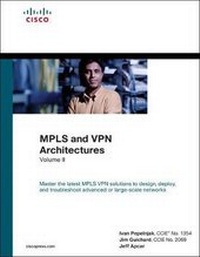
MPLS and VPN Architectures, Volume II (paperback)
Published on 20. October 2014
Book
Paperback/Softback
504 pages
978-1-58714-432-5 (ISBN)
Description
Master the latest MPLS VPN solutions to design, deploy, and troubleshoot advanced or large-scale networks
With MPLS and VPN Architectures, Volume II, you'll learn:
How to integrate various remote access technologies into the backbone providing VPN service to many different types of customers
The new PE-CE routing options as well as other advanced features, including per-VPN Network Address Translation (PE-NAT)
How VRFs can be extended into a customer site to provide separation inside the customer network
The latest MPLS VPN security features and designs aimed at protecting the MPLS VPN backbone
How to carry customer multicast traffic inside a VPN
The latest inter-carrier enhancements to allow for easier and more scalable deployment of inter-carrier MPLS VPN services
Advanced troubleshooting techniques including router outputs to ensure high availability
MPLS and VPN Architectures, Volume II, builds on the best-selling MPLS and VPN Architectures, Volume I (1-58705-002-1), from Cisco Press. Extending into more advanced topics and deployment architectures, Volume II provides readers with the necessary tools they need to deploy and maintain a secure, highly available VPN.
MPLS and VPN Architectures, Volume II, begins with a brief refresher of the MPLS VPN Architecture. Part II describes advanced MPLS VPN connectivity including the integration of service provider access technologies (dial, DSL, cable, Ethernet) and a variety of routing protocols (IS-IS, EIGRP, and OSPF), arming the reader with the knowledge of how to integrate these features into the VPN backbone. Part III details advanced deployment issues including security, outlining the necessary steps the service provider must take to protect the backbone and any attached VPN sites, and also detailing the latest security features to allow more advanced topologies and filtering. This part also covers multi-carrier MPLS VPN deployments. Finally, Part IV provides a methodology for advanced MPLS VPN troubleshooting.
MPLS and VPN Architectures, Volume II, also introduces the latest advances in customer integration, security, and troubleshooting features essential to providing the advanced services based on MPLS VPN technology in a secure and scalable way.
This book is part of the Networking Technology Series from Cisco Press(r), which offers networking professionals valuable information for constructing efficient networks, understanding new technologies, and building successful careers.
With MPLS and VPN Architectures, Volume II, you'll learn:
How to integrate various remote access technologies into the backbone providing VPN service to many different types of customers
The new PE-CE routing options as well as other advanced features, including per-VPN Network Address Translation (PE-NAT)
How VRFs can be extended into a customer site to provide separation inside the customer network
The latest MPLS VPN security features and designs aimed at protecting the MPLS VPN backbone
How to carry customer multicast traffic inside a VPN
The latest inter-carrier enhancements to allow for easier and more scalable deployment of inter-carrier MPLS VPN services
Advanced troubleshooting techniques including router outputs to ensure high availability
MPLS and VPN Architectures, Volume II, builds on the best-selling MPLS and VPN Architectures, Volume I (1-58705-002-1), from Cisco Press. Extending into more advanced topics and deployment architectures, Volume II provides readers with the necessary tools they need to deploy and maintain a secure, highly available VPN.
MPLS and VPN Architectures, Volume II, begins with a brief refresher of the MPLS VPN Architecture. Part II describes advanced MPLS VPN connectivity including the integration of service provider access technologies (dial, DSL, cable, Ethernet) and a variety of routing protocols (IS-IS, EIGRP, and OSPF), arming the reader with the knowledge of how to integrate these features into the VPN backbone. Part III details advanced deployment issues including security, outlining the necessary steps the service provider must take to protect the backbone and any attached VPN sites, and also detailing the latest security features to allow more advanced topologies and filtering. This part also covers multi-carrier MPLS VPN deployments. Finally, Part IV provides a methodology for advanced MPLS VPN troubleshooting.
MPLS and VPN Architectures, Volume II, also introduces the latest advances in customer integration, security, and troubleshooting features essential to providing the advanced services based on MPLS VPN technology in a secure and scalable way.
This book is part of the Networking Technology Series from Cisco Press(r), which offers networking professionals valuable information for constructing efficient networks, understanding new technologies, and building successful careers.
More details
Other editions
Additional editions
Ivan Pepelnjak | Jim Guichard | Jeff Apcar
MPLS and VPN Architectures, Volume II
E-Book
06/2003
1st Edition
Cisco Press
from
€84.39
Available for download

Ivan Pepelnjak | Jim Guichard | Jeff Apcar
MPLS and VPN Architectures, Volume II
MPLS VPN Archi VolII ePub
E-Book
06/2003
1st Edition
Cisco Press
€48.99
Available for download
Persons
Ivan Pepelnjak, CCIE No. 1354, has more than 10 years experience in designing, installing, troubleshooting, and operating large service provider and enterprise WAN and LAN networks and is currently chief technologies advisor at NIL Data Communications. He is the architect of NIL's Service Provider Academy program, one of the architects of the Cisco Systems(r) Service Provider curriculum, and the lead developer of several service provider-focused courses covering MPLS, Border Gateway Protocol (BGP), and IP quality of service. Ivan is one of the Cisco(r) Routing authorities in Europe and is the author of EIGRP Network Design Solutions and co-author of MPLS and VPN Architectures, both published by Cisco Press.
Jim Guichard, CCIE No. 2069, is a technical leader for MPLS and IP backbone technologies at Cisco Systems and is the co-author of the highly successful book MPLS and VPN Architectures, published by Cisco Press. He has extensive experience with designing, migrating, and deploying large-scale IP networks and has assisted many of the largest Cisco customers with the integration of MPLS-related technologies into their networks.
Jeff Apcar is a senior consulting engineer in the Advanced Services group at Cisco Systems and has been working with MPLS technologies for more than three years. Jeff's focus is the Asia-Pacific theatre where he has provided detailed designs and design consulting for nearly every major service provider MPLS rollout in the region.
Jim Guichard, CCIE No. 2069, is a technical leader for MPLS and IP backbone technologies at Cisco Systems and is the co-author of the highly successful book MPLS and VPN Architectures, published by Cisco Press. He has extensive experience with designing, migrating, and deploying large-scale IP networks and has assisted many of the largest Cisco customers with the integration of MPLS-related technologies into their networks.
Jeff Apcar is a senior consulting engineer in the Advanced Services group at Cisco Systems and has been working with MPLS technologies for more than three years. Jeff's focus is the Asia-Pacific theatre where he has provided detailed designs and design consulting for nearly every major service provider MPLS rollout in the region.
Content
Introduction.
I. INTRODUCTION.
1. MPLS VPN Architecture Overview.
MPLS VPN Terminology. Connection-Oriented VPNs. Connectionless VPNs. MPLS-Based VPNs. New MPLS VPN Developments. Summary.
II. ADVANCED PE-CE CONNECTIVITY.
2. Remote Access to an MPLS VPN.
Feature Enhancements for MPLS VPN Remote Access. Overview of Access Protocols and Procedures. Providing Dial-In Access to an MPLS VPN. Providing Dial-Out Access via LSDO. Providing Dial-Out Access Without LSDO (Direct ISDN). Providing Dial Backup for MPLS VPN Access. Providing DSL Access to an MPLS VPN. Providing Cable Access to an MPLS VPN. Advanced Features for MPLS VPN Remote Access. Summary.
3. PE-CE Routing Protocol Enhancements and Advanced Features.
PE-CE Connectivity: OSPF. PE-CE Connectivity: Integrated IS-IS. PE-CE Connectivity: EIGRP. Summary.
4. Virtual Router Connectivity.
Configuring Virtual Routers on CE Routers. Linking the Virtual Router with the MPLS VPN Backbone. VRF Selection Based on Source IP Address. Performing NAT in a Virtual Router Environment. Summary.
III. ADVANCED DEPLOYMENT SCENARIOS.
5. Protecting the MPLS-VPN Backbone.
Inherent Security Capabilities. Neighbor Authentication. CE-to-CE Authentication. Control of Routes That Are Injected into a VRF. PE to CE Circuits. Extranet Access. Internet Access. IPSec over MPLS. Summary.
6. Large-Scale Routing and Multiple Service Provider Connectivity.
Large Scale Routing: Carrier's Carrier Solution Overview. Carrier Backbone Connectivity. Label Distribution Protocols on PE-CE Links. BGP-4 Between PE/CE Routers. Hierarchical VPNs: Carrier's Carrier MPLS VPNs. VPN Connectivity Between Different Service Providers. Summary.
7. Multicast VPN.
Introduction to IP Multicast. Enterprise Multicast in a Service Provider Environment. mVPN Architecture. MDTs. Case Study of mVPN Operation in SuperCom. Summary.
8. IP Version 6 Transport Across an MPLS Backbone.
IPv6 Business Drivers. Deployment of IPv6 in Existing Networks. Quick Introduction to IPv6. In-Depth 6PE Operation and Configuration. Complex 6PE Deployment Scenarios. Summary.
IV. TROUBLESHOOTING.
9. Troubleshooting of MPLS-Based Solutions.
Introduction to Troubleshooting of MPLS-Based Solutions. Troubleshooting the MPLS Backbone. Other Quick Checks. MPLS Control Plane Troubleshooting. MPLS Data Plane Troubleshooting. MPLS VPN Troubleshooting. In-Depth MPLS VPN Troubleshooting. Summary. Index.
I. INTRODUCTION.
1. MPLS VPN Architecture Overview.
MPLS VPN Terminology. Connection-Oriented VPNs. Connectionless VPNs. MPLS-Based VPNs. New MPLS VPN Developments. Summary.
II. ADVANCED PE-CE CONNECTIVITY.
2. Remote Access to an MPLS VPN.
Feature Enhancements for MPLS VPN Remote Access. Overview of Access Protocols and Procedures. Providing Dial-In Access to an MPLS VPN. Providing Dial-Out Access via LSDO. Providing Dial-Out Access Without LSDO (Direct ISDN). Providing Dial Backup for MPLS VPN Access. Providing DSL Access to an MPLS VPN. Providing Cable Access to an MPLS VPN. Advanced Features for MPLS VPN Remote Access. Summary.
3. PE-CE Routing Protocol Enhancements and Advanced Features.
PE-CE Connectivity: OSPF. PE-CE Connectivity: Integrated IS-IS. PE-CE Connectivity: EIGRP. Summary.
4. Virtual Router Connectivity.
Configuring Virtual Routers on CE Routers. Linking the Virtual Router with the MPLS VPN Backbone. VRF Selection Based on Source IP Address. Performing NAT in a Virtual Router Environment. Summary.
III. ADVANCED DEPLOYMENT SCENARIOS.
5. Protecting the MPLS-VPN Backbone.
Inherent Security Capabilities. Neighbor Authentication. CE-to-CE Authentication. Control of Routes That Are Injected into a VRF. PE to CE Circuits. Extranet Access. Internet Access. IPSec over MPLS. Summary.
6. Large-Scale Routing and Multiple Service Provider Connectivity.
Large Scale Routing: Carrier's Carrier Solution Overview. Carrier Backbone Connectivity. Label Distribution Protocols on PE-CE Links. BGP-4 Between PE/CE Routers. Hierarchical VPNs: Carrier's Carrier MPLS VPNs. VPN Connectivity Between Different Service Providers. Summary.
7. Multicast VPN.
Introduction to IP Multicast. Enterprise Multicast in a Service Provider Environment. mVPN Architecture. MDTs. Case Study of mVPN Operation in SuperCom. Summary.
8. IP Version 6 Transport Across an MPLS Backbone.
IPv6 Business Drivers. Deployment of IPv6 in Existing Networks. Quick Introduction to IPv6. In-Depth 6PE Operation and Configuration. Complex 6PE Deployment Scenarios. Summary.
IV. TROUBLESHOOTING.
9. Troubleshooting of MPLS-Based Solutions.
Introduction to Troubleshooting of MPLS-Based Solutions. Troubleshooting the MPLS Backbone. Other Quick Checks. MPLS Control Plane Troubleshooting. MPLS Data Plane Troubleshooting. MPLS VPN Troubleshooting. In-Depth MPLS VPN Troubleshooting. Summary. Index.