

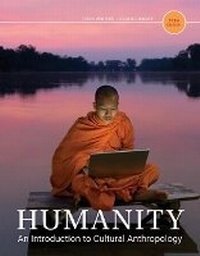
Humanity
An Introduction to Cultural Anthropology
11th Edition
Published on 7. February 2017
Book
Paperback/Softback
480 pages
978-1-337-10969-7 (ISBN)
Description
Using engaging stories and clear writing, HUMANITY: AN INTRODUCTION TO CULTURAL ANTHROPOLOGY, Eleventh Edition, introduces cultural anthropology within a solid framework centered on globalization and culture change. Peoples and Bailey focus on the social and cultural consequences of globalization, emphasizing culture change and world problems. The book's engaging narrative provides new ways of looking at many of the challenges facing the world in this century. As you explore contemporary issues including recent debates on gay marriage, cultural and economic globalization, population growth, hunger, and the survival of indigenous cultures, you will gain a better understanding of the cultural information you need to successfully navigate in today's global economy. The authors emphasize the diversity of humanity and reveal why an appreciation and tolerance of cultural differences is critical in the modern world.
More details
Edition
11th edition
Language
English
Place of publication
Belmont, CA
United States
Publishing group
Cengage Learning, Inc
Target group
College/higher education
Dimensions
Height: 22 mm
Width: 200 mm
Thickness: 254 mm
Weight
880 gr
ISBN-13
978-1-337-10969-7 (9781337109697)
Copyright in bibliographic data and cover images is held by Nielsen Book Services Limited or by the publishers or by their respective licensors: all rights reserved.
Schweitzer Classification
Persons
James Peoples is professor of Sociology/Anthropology and Director of East Asian Studies at Ohio Wesleyan University, where he has been teaching courses in anthropology since 1988. He has also taught in the anthropology departments of the University of California at Davis and the University of Tulsa. His geographic area of specialty is Micronesia, where he studied the impact of American subsidies on the island agricultural and cash economies. His first book, ISLAND IN TRUST (1985), summarized the results of this field research. Since becoming Director of East Asian Studies in 2004, Dr. Peoples has journeyed to Korea and Japan for seminars and workshops. He recently published a chapter, translated into Chinese, in a book used in cultural anthropology courses in the People's Republic of China. He has published most of the results of a comparative analysis of political evolution in Micronesia. Dr. Peoples also has co-authored ESSENTIALS OF CULTURAL ANTHROPOLOGY and INTRODUCTION TO CULTURAL ANTHROPOLOGY. A well-known specialist in Native American cultures, Garrick Bailey has authored numerous scholarly works including A HISTORY OF THE NAVAJOS, with Roberta Bailey (1986), THE OSAGE AND THE INVISIBLE WORLD (1995) and ART OF THE OSAGE, with Daniel Swan (2004). He is currently editor of Volume 2, INDIANS IN CONTEMPORARY SOCIETY, THE HANDBOOK OF NORTH AMERICAN INDIANS. Dr. Bailey received his Ph.D. from the University of Oregon. He also is the co-author of ESSENTIALS OF CULTURAL ANTHROPOLOGY and INTRODUCTION TO CULTURAL ANTHROPOLOGY. He teaches anthropology at the University of Tulsa.
Content
1. The Study of Humanity.
2. Culture.
3. Culture and Language.
4. Cultural Diversity and Globalization.
5. The Development of Anthropological Thought.
6. Methods of Investigation.
7. Culture and Nature: Interacting with the Environment.
8. Exchange in Economic Systems.
9. Marriage and Families.
10. Kinship and Descent.
11. Gender in Comparative Perspective.
12. The Organization of Political Life.
13. Social Inequality and Stratification.
14. Religion and Worldview.
15. Art and the Aesthetic.
16. Ethnicity and Ethnic Conflict.
17. World Problems and the Practice of Anthropology.
2. Culture.
3. Culture and Language.
4. Cultural Diversity and Globalization.
5. The Development of Anthropological Thought.
6. Methods of Investigation.
7. Culture and Nature: Interacting with the Environment.
8. Exchange in Economic Systems.
9. Marriage and Families.
10. Kinship and Descent.
11. Gender in Comparative Perspective.
12. The Organization of Political Life.
13. Social Inequality and Stratification.
14. Religion and Worldview.
15. Art and the Aesthetic.
16. Ethnicity and Ethnic Conflict.
17. World Problems and the Practice of Anthropology.