

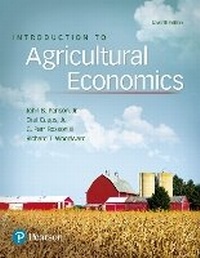
Introduction to Agricultural Economics
7th Edition
Published on 22. March 2017
Book
Hardback
432 pages
978-0-13-460282-0 (ISBN)
Description
For courses in Introduction to Agricultural or Applied Economics
Introduction to Agricultural Economics, 7/e, provides students with a systematic introduction to the basic economic concepts and issues impacting the U.S. food and fiber industry and offers strong coverage of macroeconomic theory and international trade.
Teaching and Learning Experience:
Strong coverage of macroeconomics, the role of government, and international agricultural trade: The coverage of macroeconomics and agricultural programs and policies allows students to further understand the domestic market economy.
Building block approach: Discusses individual consumer and producer decision-making, market equilibrium and economic welfare conditions, government intervention in agriculture, macroeconomic policy, and international trade.
Extensive chapter review: Each chapter contains an extensive list of questions designed to test student comprehension of the material covered.
Introduction to Agricultural Economics, 7/e, provides students with a systematic introduction to the basic economic concepts and issues impacting the U.S. food and fiber industry and offers strong coverage of macroeconomic theory and international trade.
Teaching and Learning Experience:
Strong coverage of macroeconomics, the role of government, and international agricultural trade: The coverage of macroeconomics and agricultural programs and policies allows students to further understand the domestic market economy.
Building block approach: Discusses individual consumer and producer decision-making, market equilibrium and economic welfare conditions, government intervention in agriculture, macroeconomic policy, and international trade.
Extensive chapter review: Each chapter contains an extensive list of questions designed to test student comprehension of the material covered.
More details
Edition
7th edition
Language
English
Place of publication
United States
Publishing group
Pearson Education (US)
Target group
College/higher education
Dimensions
Height: 277 mm
Width: 218 mm
Thickness: 23 mm
Weight
1175 gr
ISBN-13
978-0-13-460282-0 (9780134602820)
Copyright in bibliographic data and cover images is held by Nielsen Book Services Limited or by the publishers or by their respective licensors: all rights reserved.
Schweitzer Classification
Other editions
Previous edition
John Penson | Oral Capps | C. Rosson
Introduction to Agricultural Economics
Book
05/2014
6th Edition
Pearson
€174.54
Article exhausted; check different version
Persons
John B. Penson, Jr., holds the titles of Regents Professor and Stiles Endowed Professor of Agriculture in the Department of Agricultural Economics at Texas A&M University. He is also a senior scientist with the Norman Borlaug Institute for International Agriculture. Penson received a Ph.D. degree in agricultural economics from the University of Illinois. Penson has taught courses in Korea, Japan, Guatemala, Nicaragua, and Ecuador. His research has focused on the macroeconomics of agriculture and portfolio credit risk analysis. He has also conducted research in the Middle East and Eurasia.
Oral Capps, Jr., holds the titles of Executive Professor and Regents Professor in the Department of Agricultural Economics at Texas A&M University. He is a certified business economist and co-director of the Agribusiness, Food and Consumer Economics Research Center at Texas A&M University. He is also holder of the Southwest Dairy Marketing Endowed Chair. He received a Ph.D. in agricultural economics from Virginia Tech. He has received numerous teaching and research awards and is recognized internationally for his research in demand and price analysis.
C. Parr Rosson III is Professor and Department Head of the Agricultural Economics Department at Texas A&M University. He received his Ph.D. in agricultural economics from Texas A&M University. Rosson works in the areas of international trade and international marketing. He currently chairs the Education Committee of the Texas-Cuba Trade Alliance. He served on the Grains, Feed, Oilseeds and Planting Seeds Agricultural Trade Advisory Committee for the U.S. Trade Representative and U.S. Department of Agriculture from 2001 to 2015. He has conducted projects in Latin America, the Middle East, and Asia.
Richard T. Woodward is Professor in the Department of Agricultural Economics at Texas A&M University. His research is in the general area of environmental and resource economics. His recent research projects have focused on the use of transferable permits to address water quality and fishery challenges and problems of choice under uncertainty.
Oral Capps, Jr., holds the titles of Executive Professor and Regents Professor in the Department of Agricultural Economics at Texas A&M University. He is a certified business economist and co-director of the Agribusiness, Food and Consumer Economics Research Center at Texas A&M University. He is also holder of the Southwest Dairy Marketing Endowed Chair. He received a Ph.D. in agricultural economics from Virginia Tech. He has received numerous teaching and research awards and is recognized internationally for his research in demand and price analysis.
C. Parr Rosson III is Professor and Department Head of the Agricultural Economics Department at Texas A&M University. He received his Ph.D. in agricultural economics from Texas A&M University. Rosson works in the areas of international trade and international marketing. He currently chairs the Education Committee of the Texas-Cuba Trade Alliance. He served on the Grains, Feed, Oilseeds and Planting Seeds Agricultural Trade Advisory Committee for the U.S. Trade Representative and U.S. Department of Agriculture from 2001 to 2015. He has conducted projects in Latin America, the Middle East, and Asia.
Richard T. Woodward is Professor in the Department of Agricultural Economics at Texas A&M University. His research is in the general area of environmental and resource economics. His recent research projects have focused on the use of transferable permits to address water quality and fishery challenges and problems of choice under uncertainty.
Content
Part I: Introduction
1. What is Agricultural Economics?
2. The U.S. Food and Fiber Industry
Part II: Understanding Consumer Behavior
3. Theory of Consumer Behavior
4. Consumer Equilibrium and Market Demand
5. Measurement and Interpretation of Elasticities
Part II: Business Behavior and Market Equilibrium
6. Introduction to Production and Resource Use
7. Economics of Input and Product Substitution
8. Market Equilibrium and Product Price: Perfect Competition
9. Market Equilibrium and Product Price: Imperfect Competition
Part IV: Government in the Food and Fiber Industry
10. Natural Resources, the Environment, and Agriculture
11. Government Intervention in Agriculture
Part V: Macroeconomics of Agriculture
12. Product Markets and National Output
13. Macroeconomic Policy Fundamentals
14. Consequences of Business Fluctuations
15. Macroeconomic Policy and Agriculture
Part VI: International Agricultural Trade
16. Agricultural Trade and Exchange Rates
17. Why Nations Trade
18. Agricultural Trade Policy and Preferential Trading Arrangements
Glossary
Index
1. What is Agricultural Economics?
2. The U.S. Food and Fiber Industry
Part II: Understanding Consumer Behavior
3. Theory of Consumer Behavior
4. Consumer Equilibrium and Market Demand
5. Measurement and Interpretation of Elasticities
Part II: Business Behavior and Market Equilibrium
6. Introduction to Production and Resource Use
7. Economics of Input and Product Substitution
8. Market Equilibrium and Product Price: Perfect Competition
9. Market Equilibrium and Product Price: Imperfect Competition
Part IV: Government in the Food and Fiber Industry
10. Natural Resources, the Environment, and Agriculture
11. Government Intervention in Agriculture
Part V: Macroeconomics of Agriculture
12. Product Markets and National Output
13. Macroeconomic Policy Fundamentals
14. Consequences of Business Fluctuations
15. Macroeconomic Policy and Agriculture
Part VI: International Agricultural Trade
16. Agricultural Trade and Exchange Rates
17. Why Nations Trade
18. Agricultural Trade Policy and Preferential Trading Arrangements
Glossary
Index