

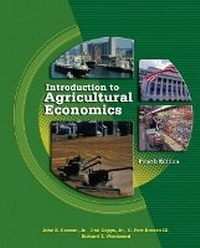
Introduction to Agricultural Economics
4th Edition
Published on 7. July 2005
Book
Hardback
512 pages
978-0-13-117312-5 (ISBN)
Description
Known for its strong coverage of macroeconomic theory and international trade, Introduction to Agricultural Economics provides students with a systematic introduction to the basic economic concepts and issues impacting the U.S. food and fiber industry. Using a building block approach, the authors discuss individual consumer and producer decision-making, market equilibrium and economic welfare conditions, government intervention in agriculture, macroeconomic policy and international trade. This new edition continues to take a broad perspective-providing examples not only from the farm, but also throughout the entire food and fiber industry-and features a new chapter on natural resources, an updated design, and margin notes throughout.
More details
Edition
4th edition
Language
English
Place of publication
United States
Publishing group
Pearson Education (US)
Target group
Professional and scholarly
Dimensions
Height: 261 mm
Width: 209 mm
Thickness: 24 mm
Weight
1134 gr
ISBN-13
978-0-13-117312-5 (9780131173125)
Copyright in bibliographic data and cover images is held by Nielsen Book Services Limited or by the publishers or by their respective licensors: all rights reserved.
Schweitzer Classification
Other editions
New editions
John B. Penson | Oral T. Capps | C. Parr Rosson
Introduction to Agricultural Economics
Book
11/2009
5th Edition
Pearson
€129.98
Article exhausted; check for reprint
Previous edition
John B. Penson | Oral T. Capps | C. Parr Rosson
Introduction to Agricultural Economics
Book
05/2001
3rd Edition
Pearson
€63.13
Article exhausted; check for reprint
Content
I. INTRODUCTION.
1. What Is Agricultural Economics?
2. The U.S. Food and Fiber Industry.
II. UNDERSTANDING CONSUMER BEHAVIOR.
3. Theory of Consumer Behavior.
4. Consumer Equilibrium and Market Demand.
5. Measurement and Interpretation of Elasticities.
III. BUSINESS BEHAVIOR AND MARKET EQUILIBRIUM.
6. Introduction to Production and Resource Use.
7. Economics of Input and Product Substitution.
8. Market Equilibrium and Product Price: Perfect Competition.
9. Market Equilibrium and Product Price: Imperfect Competition.
IV. GOVERNMENT IN THE FOOD AND FIBER INDUSTRY.
10. Natural Resources, the Environment and Agriculture.
11. Government Intervention in Agriculture.
V. MACROECONOMICS OF AGRICULTURE.
12. Product Markets and National Output.
13. Macroeconomic Policy Fundamentals.
14. Consequences of Business Fluctuations.
15. Macroeconomic Policy and Agriculture.
VI. INTERNATIONAL AGRICULTURAL TRADE.
16. Agriculture and International Trade.
17. Exchange Rates and Agricultural Trade.
18. Why Nations Trade.
19. Agricultural Trade Policy and Preferred Trading Arrangements.
Glossary.
Index.
1. What Is Agricultural Economics?
2. The U.S. Food and Fiber Industry.
II. UNDERSTANDING CONSUMER BEHAVIOR.
3. Theory of Consumer Behavior.
4. Consumer Equilibrium and Market Demand.
5. Measurement and Interpretation of Elasticities.
III. BUSINESS BEHAVIOR AND MARKET EQUILIBRIUM.
6. Introduction to Production and Resource Use.
7. Economics of Input and Product Substitution.
8. Market Equilibrium and Product Price: Perfect Competition.
9. Market Equilibrium and Product Price: Imperfect Competition.
IV. GOVERNMENT IN THE FOOD AND FIBER INDUSTRY.
10. Natural Resources, the Environment and Agriculture.
11. Government Intervention in Agriculture.
V. MACROECONOMICS OF AGRICULTURE.
12. Product Markets and National Output.
13. Macroeconomic Policy Fundamentals.
14. Consequences of Business Fluctuations.
15. Macroeconomic Policy and Agriculture.
VI. INTERNATIONAL AGRICULTURAL TRADE.
16. Agriculture and International Trade.
17. Exchange Rates and Agricultural Trade.
18. Why Nations Trade.
19. Agricultural Trade Policy and Preferred Trading Arrangements.
Glossary.
Index.