

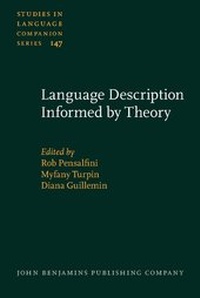
Language Description Informed by Theory
Published on 28. January 2014
Book
Hardback
391 pages
978-90-272-0614-5 (ISBN)
Description
This volume explores how linguistic theories inform the ways in which languages are described. Theories, as representations of linguistic categories, guide the field linguist to look for various phenomena without presupposing their necessary existence and provide the tools to account for various sets of data across different languages. A goal of linguistic description is to represent the full range of language structures for any given language. The chapters in this book cover various sub-disciplines of linguistics including phonetics, phonology, morphology, syntax, semantics, language acquisition, and anthropological linguistics, drawing upon theoretical approaches such as prosodic Phonology, Enhancement theory, Distributed Morphology, Minimalist syntax, Lexical Functional Grammar, and Kinship theory. The languages described in this book include Australian languages (Pama-Nyungan and non-Pama-Nyungan), Romance languages as well as English. This volume will be of interest to researchers in both descriptive and theoretical linguistics.
More details
Series
Language
English
Place of publication
Amsterdam
Netherlands
Target group
Professional and scholarly
Illustrations
+ index
Weight
855 gr
ISBN-13
978-90-272-0614-5 (9789027206145)
Copyright in bibliographic data and cover images is held by Nielsen Book Services Limited or by the publishers or by their respective licensors: all rights reserved.
Schweitzer Classification
Other editions
Additional editions
Rob Pensalfini | Myfany Turpin | Diana Guillemin
Language Description Informed by Theory
E-Book
01/2014
1st Edition
John Benjamins Publishing Company
€123.99
Available for download
Persons
Content
1. Map of Australian languages refferred to in this book; 2. List of contributors; 3. Editors' introduction (by Pensalfini, Rob); 4. Bibliography of Mary Laughren (by Turpin, Myfany); 5. Evaluating the Bilingual Education Program in Warlpiri schools (by Disbray, Samantha); 6. Part 1. Phonology; 7. Phonological aspects of Arandic baby talk (by Turpin, Myfany); 8. Prestopping of nasals and laterals is only partly parallel (by Round, Erich); 9. Part 2. Morphology; 10. Liminal pronoun systems: Evidence from Garrwa (by Mushin, Ilana); 11. Verbs as spatial deixis markers in Jingulu (by Pensalfini, Rob); 12. The reconstruction of inflectional classes in morphology: History, method and Pama-Nyungan (Australian) verbs (by Koch, Harold); 13. Part 3. Syntax; 14. Marking Definiteness or Specificity, not necessarily both: Evidence of a principle of economy from Mauritian Creole (by Guillemin, Diana); 15. Theory and experiment in parametric minimalism: The case of Romance negation (by Longobardi, Giuseppe); 16. Serial verbs in Wambaya (by Nordlinger, Rachel); 17. Nominals as adjuncts or arguments: Further evidence from language mixing (by Meakins, Felicity); 18. Part 4. Semantics; 19. The case of the invisible postman: The current status of the French future tense (by Wales, Lynn); 20. Manner and result: A view from clean (by Levin, Beth); 21. Part 5. Anthropological Linguistics; 22. Shifting relations: Structure and agency in the language of Bininj Gunwok kinship (by Garde, Murray); 23. Language index; 24. Subject index