

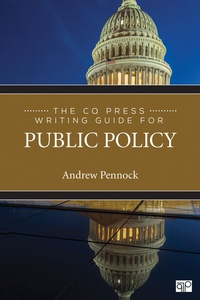
The CQ Press Writing Guide for Public Policy
1st Edition
Published on 25. February 2019
Book
Paperback/Softback
280 pages
978-1-5063-4878-0 (ISBN)
Description
Winner of the 2019 Textbook Excellence Award ("Texty") from the Textbook & Academic Authors Association (TAA)
"At the heart of policy analysis is giving advice about public issues, and the key to persuasive advice is clear and credible communication. In the CQ Press Writing Guide for Public Policy, Andrew Pennock draws on his years of experience as a professor, committee staffer, and policy consultant to impart useful, practical lessons on how to write more effective issue briefs, legislative testimony, memos, policy histories and op/ eds. Pennock provides potent insights into how to create first drafts, how to sharpen prose, how to communicate about complicated tables and figures, and how to write for nontraditional formats such as email and social media. This terrific book presents dozens of concrete tips and step-by-step instructions that should be required reading for all student in public affairs undergraduate and graduate-level programs."
-Eric M. Patashnik, Brown University
The CQ Press Writing Guide for Public Policy is loaded with rich real world examples that help students master the process of translating insightful policy analysis into clear policy recommendations. Known for his conversational writing style, author Andrew Pennock offers step-by-step instructions on how to write for a variety of genres in a style that policy makers expect. Focusing on an audience-centered approach, students first learn how to create and organize an argument based on the unique needs and expectations of policy makers. The book then moves onto the nuts and bolts of how to write for a policy audience, with special consideration of ethics and working with visual and technical material. Finally, the book provides practical guidance on writing in specific policy genres: policy memos, briefs, Op-Eds, press releases, written testimony, social media, and emails.
Key Features:
Basic policy writing tasks help students write sentences, paragraphs and sections that make sense to readers (and to professors!). Students also learn how to create professional quality tables and figures that support their argument as well as how to package these components together effectively to communicate with policy makers.
Six separate chapters for various public policy genres (issue briefs, legislative histories, decision memos, testimony, op-eds, and new media) provide students with an overview of the genre, several examples, and an analysis of each example.
Current examples from across the field of public policy keep students engaged by connecting the concepts to current topics such as public health (the opioid epidemic, Native-American healthcare, lead poisoning), education (early childhood, school governance), criminal justice (sexting laws, ban-the-box), business regulation (AirBnB, renewable energy, drug pricing), security policy (cyber-security, foreign asset control), and social policy (physician assisted suicide).
"At the heart of policy analysis is giving advice about public issues, and the key to persuasive advice is clear and credible communication. In the CQ Press Writing Guide for Public Policy, Andrew Pennock draws on his years of experience as a professor, committee staffer, and policy consultant to impart useful, practical lessons on how to write more effective issue briefs, legislative testimony, memos, policy histories and op/ eds. Pennock provides potent insights into how to create first drafts, how to sharpen prose, how to communicate about complicated tables and figures, and how to write for nontraditional formats such as email and social media. This terrific book presents dozens of concrete tips and step-by-step instructions that should be required reading for all student in public affairs undergraduate and graduate-level programs."
-Eric M. Patashnik, Brown University
The CQ Press Writing Guide for Public Policy is loaded with rich real world examples that help students master the process of translating insightful policy analysis into clear policy recommendations. Known for his conversational writing style, author Andrew Pennock offers step-by-step instructions on how to write for a variety of genres in a style that policy makers expect. Focusing on an audience-centered approach, students first learn how to create and organize an argument based on the unique needs and expectations of policy makers. The book then moves onto the nuts and bolts of how to write for a policy audience, with special consideration of ethics and working with visual and technical material. Finally, the book provides practical guidance on writing in specific policy genres: policy memos, briefs, Op-Eds, press releases, written testimony, social media, and emails.
Key Features:
Basic policy writing tasks help students write sentences, paragraphs and sections that make sense to readers (and to professors!). Students also learn how to create professional quality tables and figures that support their argument as well as how to package these components together effectively to communicate with policy makers.
Six separate chapters for various public policy genres (issue briefs, legislative histories, decision memos, testimony, op-eds, and new media) provide students with an overview of the genre, several examples, and an analysis of each example.
Current examples from across the field of public policy keep students engaged by connecting the concepts to current topics such as public health (the opioid epidemic, Native-American healthcare, lead poisoning), education (early childhood, school governance), criminal justice (sexting laws, ban-the-box), business regulation (AirBnB, renewable energy, drug pricing), security policy (cyber-security, foreign asset control), and social policy (physician assisted suicide).
Reviews / Votes
"At the heart of policy analysis is giving advice about public issues, and the key to persuasive advice is clear and credible communication. In the CQ Press Writing Guide for Public Policy, Andrew Pennock draws on his years of experience as a professor, committee staffer, and policy consultant to impart useful, practical lessons on how to write more effective issue briefs, legislative testimony, memos, policy histories and op-eds. Pennock provides potent insights into how to create first drafts, how to sharpen prose, how to communicate about complicated tables and figures, and how to write for nontraditional formats such as email and social media. This terrific book presents dozens of concrete tips and step-by-step instructions that should be required reading for all student in public affairs undergraduate and graduate-level programs." -- Eric M. Patashnik "Among the many skills of an effective policy analyst, logical thinking expressed in clear writing is the most essential. My guess is that most teachers of policy analysis promote clear writing primarily through editing rather than instruction. This book is an excellent resource for shifting the balance more toward instruction. It combines practical coaching on the mechanics of clear writing with useful guidance on how to do it effectively in the variety of contexts in which analysts offer their advice. Whether in policy analysis, professional development, or workshop courses, public affairs students will benefit from using this book." -- David L. Weimer "No one ever learned to write from a how-to book; we learn to write better by writing (and rewriting with editors', colleagues' and friends' critiques). But learning-by-doing goes faster, and works better, with a good guide like Andrew Pennock's. It's full of useful examples and hands-on exercises, not to mention clear 'rules' and guideposts. I'm going to point my students at this, and try to get my colleagues to do the same." -- Michael O'Hare "When teaching a writing-based public policy course, you previously needed one textbook on the mechanics of the public policy process and a second that guided students how to write. Andrew Pennock's book is unique in that it does both well simultaneously. Each chapter is filled with clear and timely examples that give readers real-world applications of the central theoretical points of the chapter. One nice feature of these examples is that they often demonstrate both effective and ineffective forms of communication. The upshot is that the book gives a reader many templates for structuring their own work. I also particularly liked the exercises that were included at the end of each chapter. This book should be adopted in any course in which a substantial amount of the evaluation is based on students writing policy memos." -- Marc MeredithMore details
Language
English
Place of publication
Washington
United States
Publishing group
SAGE Publications Inc
Target group
College/higher education
Dimensions
Height: 229 mm
Width: 152 mm
Weight
407 gr
ISBN-13
978-1-5063-4878-0 (9781506348780)
Copyright in bibliographic data and cover images is held by Nielsen Book Services Limited or by the publishers or by their respective licensors: all rights reserved.
Schweitzer Classification
Other editions
New editions
Andrew S. Pennock
The CQ Press Writing Guide for Public Policy
Book
07/2023
2nd Edition
CQ Press
€70.83
Shipment within 15-20 days
Person
Andy Pennock is an assistant professor at the Batten School of Leadership and Public Policy at the University of Virginia. He teaches writing in his courses on leadership, policy analysis, political institutions, and Virginia politics and policy. Prior to joining the Batten School, he taught at Brown University where he was the Director of Graduate Studies and the Director of the Applied Social, Economic, & Regulatory Analysis (ASERA) Group which partnered with government institutions, non-profit organizations, and other entities to provide technical expertise, policy analysis, and program evaluation. A seasoned instructor, Professor Pennock won multiple teaching awards during his time at Brown and UNC-Chapel Hill. Before completing his PhD in Political Science at UNC, Professor Pennock was a professional, non-partisan committee staffer at the North Carolina General Assembly. He has continued his applied work through consulting with the Governor of Virginia, the United States Centers for Disease Control, the Rhode Island legislature, local school boards, and Serve Rhode Island, Rhode Island's AmeriCorp home. Professor Pennock's academic research examines public policy in the global economy as well as the scholarship of teaching and learning. His work has been published in Perspectives on Politics, Economics & Politics, and PS: Political Science & Politics. Outside of Batten, he is the father of four small boys who wrestle with him all the time. He and his wife, Charity, love to cook, read, garden, travel, and have good conversations with people whenever they can.
Content
Preface
Acknowledgments
About the Author
PART 1: INTRODUCTION
Chapter 1 Audiences and Audience-Centered Writing in Public Policy
What Is Audience-Centered Writing?
Who Is the Audience in Policy Settings?
The Different Audiences in Policy Settings
What Do These Policy Audiences Need to Know?
Learning the Skills of Audience-Centered Writing
Checklist
Exercises
Bibliography
PART 2: THE SKILLS OF POLICY WRITING
Chapter 2 Generating and Organizing Your Argument
Example: The Problem of Sharing Economy Businesses
Writing Is Thinking, Then Communicating
The Process of Creating a First Draft
Gather Evidence for Your Argument
Documents
People
Revise Your Draft
Conclusion
Checklist
Exercises
Bibliography
Chapter 3 Improving Your Writing: Sentences and Words
How to Identify and Create Good Sentences
Principle 1: Characters Make Good Subjects
Principle 2: Actions Make Good Verbs
Principle 3: Choose Words Wisely
Conclusion
Checklist
Exercises
Answer Key
Bibliography
Chapter 4 Writing Well: Paragraphs and Sections
Cohesion: Do My Sentences Connect Together?
Coherence: Does My Paragraph Make Sense as a Whole?
Editing at a Global Level: Making the Document Make Sense as a Whole
Conclusion
Checklist
Exercises
Bibliography
Chapter 5 Visually Communicating: On Creating and Writing About Tables
Principles for Designing Visuals
Tables
Writing About a Table
Conclusion
Checklist
Tables Checklist
Exercises
Bibliography
Chapter 6 Visually Communicating: On Creating and Writing About Graphs and Other Figures
Elements of a Successful Figure
Graphs
Figures
Conclusion
Exercises
Bibliography
Chapter 7 Pulling It All Together: Creating Professional-Quality Work
Polishing Your Document
Writing Ethically: The Responsibilities of Policy Writing
Conclusion
Checklist
Exercises
Bibliography
PART 3: POLICY GENRES AND THEIR PURPOSES
Chapter 8 The Issue Brief
Distinctive Aspects of Issue Briefs
Example Issue Briefs
Conclusion
Checklist
Exercises
Bibliography
Chapter 9 Policy History
Distinctive Aspects of Policy Histories
How to Organize a Policy History
Example Policy Histories
Conclusion
Checklist
Exercises
Bibliography
Chapter 10 The Decision Memo
Distinctive Aspects of Decision Memos
Example Decision Memos
Conclusion
Checklist
Exercises
Bibliography
Chapter 11 Op-Eds
Distinctive Aspects of Op-Eds
Example Op-Eds
Conclusion: Writing (and Publishing!) Your Own Op-Ed
Checklist
Exercises
Bibliography
Chapter 12 Legislative Testimony and Public Comment: Writing to Persuade the Government
Distinctive Aspects of Testimony and Comment
Legislative Testimony
Public Comment for Regulations
Conclusion
Checklist
Exercises
Bibliography
Chapter 13 Writing for Nontraditional Formats: Email and Social Media
Email
Twitter
Conclusion
Checklist
Exercises
Bibliography
Index
Acknowledgments
About the Author
PART 1: INTRODUCTION
Chapter 1 Audiences and Audience-Centered Writing in Public Policy
What Is Audience-Centered Writing?
Who Is the Audience in Policy Settings?
The Different Audiences in Policy Settings
What Do These Policy Audiences Need to Know?
Learning the Skills of Audience-Centered Writing
Checklist
Exercises
Bibliography
PART 2: THE SKILLS OF POLICY WRITING
Chapter 2 Generating and Organizing Your Argument
Example: The Problem of Sharing Economy Businesses
Writing Is Thinking, Then Communicating
The Process of Creating a First Draft
Gather Evidence for Your Argument
Documents
People
Revise Your Draft
Conclusion
Checklist
Exercises
Bibliography
Chapter 3 Improving Your Writing: Sentences and Words
How to Identify and Create Good Sentences
Principle 1: Characters Make Good Subjects
Principle 2: Actions Make Good Verbs
Principle 3: Choose Words Wisely
Conclusion
Checklist
Exercises
Answer Key
Bibliography
Chapter 4 Writing Well: Paragraphs and Sections
Cohesion: Do My Sentences Connect Together?
Coherence: Does My Paragraph Make Sense as a Whole?
Editing at a Global Level: Making the Document Make Sense as a Whole
Conclusion
Checklist
Exercises
Bibliography
Chapter 5 Visually Communicating: On Creating and Writing About Tables
Principles for Designing Visuals
Tables
Writing About a Table
Conclusion
Checklist
Tables Checklist
Exercises
Bibliography
Chapter 6 Visually Communicating: On Creating and Writing About Graphs and Other Figures
Elements of a Successful Figure
Graphs
Figures
Conclusion
Exercises
Bibliography
Chapter 7 Pulling It All Together: Creating Professional-Quality Work
Polishing Your Document
Writing Ethically: The Responsibilities of Policy Writing
Conclusion
Checklist
Exercises
Bibliography
PART 3: POLICY GENRES AND THEIR PURPOSES
Chapter 8 The Issue Brief
Distinctive Aspects of Issue Briefs
Example Issue Briefs
Conclusion
Checklist
Exercises
Bibliography
Chapter 9 Policy History
Distinctive Aspects of Policy Histories
How to Organize a Policy History
Example Policy Histories
Conclusion
Checklist
Exercises
Bibliography
Chapter 10 The Decision Memo
Distinctive Aspects of Decision Memos
Example Decision Memos
Conclusion
Checklist
Exercises
Bibliography
Chapter 11 Op-Eds
Distinctive Aspects of Op-Eds
Example Op-Eds
Conclusion: Writing (and Publishing!) Your Own Op-Ed
Checklist
Exercises
Bibliography
Chapter 12 Legislative Testimony and Public Comment: Writing to Persuade the Government
Distinctive Aspects of Testimony and Comment
Legislative Testimony
Public Comment for Regulations
Conclusion
Checklist
Exercises
Bibliography
Chapter 13 Writing for Nontraditional Formats: Email and Social Media
Conclusion
Checklist
Exercises
Bibliography
Index