

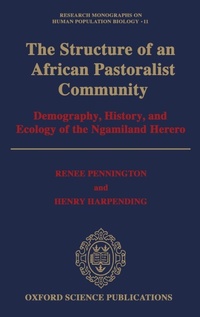
The Structure of an African Pastoralist Community
Demography, History, and Ecology of the Ngamiland Herero
Published on 12. August 1993
Book
Hardback
288 pages
978-0-19-852286-7 (ISBN)
Description
This book is about the ecology and population dynamics of a group of cattle and goat herders in the northern Kalahari Desert ofthe Ngamiland district of Botswana. Although the Herero arrived in this region less than a century ago as destitute refugees, these staunchly traditional Bantu speakers have established themselves as a prominent and prosperous tribe in a pocket of the Kalahari previously occupied almost exclusively by Kung-speaking foragers. Their rise to economic prominence in Botswana has been accompanied by dramatic decreases in mortality and increases in fertility, and a resurgence of tribal ethnicity.
The demographic data were collected through intense ethnographic interviews of over 700 Herero living north-western Botswana. Studies such as this illustrate the trade-offs between large-scale censuses that traditional demographers are comfortable with and small qualitative studies familiar to anthropologists and sociologists. Statistics from large national or regional studies that blur distinctions among genetically, historically, and economically different groups may not reveal much about the processes that generated them because differences within groups are confounded by differences between groups. For example, Herero mortality rates are low by the national standards of Botswana, yet those of their neighbours the Kung Bushmen are relatively high. Neither the difference between the ethnic groups nor their causes is apparent from the census data alone. The methods of study and the use of traditional Herero names allowed the authors to date with confidence the years of birth of informants and the years of vital events of their family members in a part of the world where this information is generally unknown.
The demographic data were collected through intense ethnographic interviews of over 700 Herero living north-western Botswana. Studies such as this illustrate the trade-offs between large-scale censuses that traditional demographers are comfortable with and small qualitative studies familiar to anthropologists and sociologists. Statistics from large national or regional studies that blur distinctions among genetically, historically, and economically different groups may not reveal much about the processes that generated them because differences within groups are confounded by differences between groups. For example, Herero mortality rates are low by the national standards of Botswana, yet those of their neighbours the Kung Bushmen are relatively high. Neither the difference between the ethnic groups nor their causes is apparent from the census data alone. The methods of study and the use of traditional Herero names allowed the authors to date with confidence the years of birth of informants and the years of vital events of their family members in a part of the world where this information is generally unknown.
Reviews / Votes
'They have produced what is almost certainly the most innovative and original volume yet to appear. This is a very good book ... a significant methodological contribution to demography and to our interpretation of African population structures. It is not overpriced, as prices go these days, and well worth buying.'George T. Nurse, Annals of Human Biology, 1994, vol. 21, No. 6 This book ... is one that demographers should take seriously. This work provides an exemplary model of how small data sets can be used to construct life tables, and how population pyramids can reveal traces of the effects of history ... there are major methodological and conceptual lessons to be learned from this book, by demographers and anthropologists alike they propose some intriguing reversals of the conventional chains of causality, thereby stimulating us to think radically about classic problems, such as senescence and birth-spacing. * Monique Borgerhoff Mulder, University of California at Davis, Population Studies, Volumer 49 Part 1 March 1995 *
More details
Series
Language
English
Place of publication
Oxford
United Kingdom
Publishing group
Oxford University Press
Target group
College/higher education
Illustrations
halftones, line drawings, tables
Dimensions
Height: 240 mm
Width: 161 mm
Thickness: 20 mm
Weight
596 gr
ISBN-13
978-0-19-852286-7 (9780198522867)
Copyright in bibliographic data and cover images is held by Nielsen Book Services Limited or by the publishers or by their respective licensors: all rights reserved.
Schweitzer Classification
Persons
Content
Introduction and background ; 1. Field-work and methods ; 2. Infant and childhood mortality ; 3. Mortality after early childhood ; 4. Measures of fertility, past and present ; 5. Causes of fertility transition ; 6. Life history and marriage ; 7. Child fosterage and social parenthood ; 8. Herero and Kung comparative demography ; 9. History and population change