


High Leverage Practices and Students with Extensive Support Needs
A Co-publication with the Council for Exceptional Children
1st Edition
Published on 21. November 2022
Book
Hardback
268 pages
978-1-032-00790-8 (ISBN)
Description
Building on the formative work of High Leverage Practices (HLP) for Inclusive Classrooms, this critical companion explores how HLP can be applied to the education of students with extensive support needs (ESN). Each chapter walks readers through a different HLP, exploring its implications for students with ESN and aligning it with current practice, supports, and terminology. Edited by researchers and teacher educators with decades of experience in serving students with ESN and their teachers, this book is packed with rich examples of and detailed supports for implementing HLPs to ensure every student has access to all aspects of their school community.
More details
Language
English
Place of publication
London
United Kingdom
Publishing group
Taylor & Francis Ltd
Target group
College/higher education
Professional and scholarly
Academic, Postgraduate, Professional, Professional Practice & Development, and Undergraduate Advanced
Illustrations
7 s/w Tabellen, 44 s/w Abbildungen, 44 s/w Zeichnungen
7 Tables, black and white; 44 Line drawings, black and white; 44 Illustrations, black and white
Dimensions
Height: 260 mm
Width: 183 mm
Thickness: 20 mm
Weight
723 gr
ISBN-13
978-1-032-00790-8 (9781032007908)
Copyright in bibliographic data and cover images is held by Nielsen Book Services Limited or by the publishers or by their respective licensors: all rights reserved.
Schweitzer Classification
Other editions
Additional editions
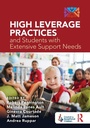
Robert Pennington | Melinda Ault | Ginevra Courtade
High Leverage Practices and Students with Extensive Support Needs
A Co-publication with the Council for Exceptional Children
Book
11/2022
1st Edition
Routledge
€43.20
Shipment within 15-20 days
Robert Pennington | Melinda Ault | Ginevra Courtade
High Leverage Practices and Students with Extensive Support Needs
E-Book
11/2022
1st Edition
Routledge
€39.49
Available for download
Robert Pennington | Melinda Ault | Ginevra Courtade
High Leverage Practices and Students with Extensive Support Needs
E-Book
11/2022
1st Edition
Routledge
€39.49
Available for download
Persons
Robert Pennington is the Lake & Edward J. Snyder, Jr. Distinguished Professor in Special Education at University of North Carolina-Charlotte, USA.
Melinda Jones Ault is a Professor at University of Kentucky, USA.
Ginevra Courtade is a Professor at University of Louisville, USA.
J. Matt Jameson is a Professor at University of Utah, USA.
Andrea Ruppar is an Associate Professor at University of Wisconsin-Madison, USA.
Melinda Jones Ault is a Professor at University of Kentucky, USA.
Ginevra Courtade is a Professor at University of Louisville, USA.
J. Matt Jameson is a Professor at University of Utah, USA.
Andrea Ruppar is an Associate Professor at University of Wisconsin-Madison, USA.
Content
1. Collaborate with Colleagues to Increase Student Success 2. Leading Effective Meetings with Professionals and Families 3. Collaborate with Families to Support Student Learning and Needed Services 4. Using Multiple Sources of Information to Develop a Comprehensive Understanding of a Student's Strengths and Needs 5. Interpreting and Communicating Assessment Information with Stakeholders to Collaboratively Design and Implement Educational Programs 6. Using Student Assessment Data, Analyzing Instructional Packages, and Making Necessary Adjustments that Improve Student Outcomes 7. Consistent, Organized, and Respectful Learning Environment 8. Using Feedback to Improve Student Outcomes 9. Teaching Social Skills 10. Conducting Functional Behavior Assessment to Develop Individualized Behavior Support Plans 11. Identify and Prioritize Long- and Short-term Learning Goals 12. Systematically Design Instruction toward a Specific Learning Goal 13. Adapt Curriculum Tasks and Materials for Specific Learning Goals 14. Teaching Cognitive and Meta Cognitive Strategies to Support Learning and Independence 15. Providing Scaffolded Supports 16. Providing Intensive Instruction and Using Explicit Instruction 17. Using Flexible Grouping 18. Use Strategies to Promote Active Engagement 19. Use Assistive and Instructional Technologies 20. Teach Students to Maintain and Generalize New Learning Across Time and Settings 21. Providing Positive and Corrective Feedback