

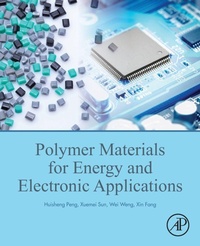
Polymer Materials for Energy and Electronic Applications
Published on 31. August 2016
Book
Paperback/Softback
386 pages
978-0-12-811091-1 (ISBN)
Description
Polymer Materials for Energy and Electronic Applications is among the first books to systematically describe the recent developments in polymer materials and their electronic applications. It covers the synthesis, structures, and properties of polymers, along with their composites. In addition, the book introduces, and describes, four main kinds of electronic devices based on polymers, including energy harvesting devices, energy storage devices, light-emitting devices, and electrically driving sensors.
Stretchable and wearable electronics based on polymers are a particular focus and main achievement of the book that concludes with the future developments and challenges of electronic polymers and devices.
Stretchable and wearable electronics based on polymers are a particular focus and main achievement of the book that concludes with the future developments and challenges of electronic polymers and devices.
More details
Language
English
Place of publication
San Diego
United States
Publishing group
Elsevier Science Publishing Co Inc
Target group
Professional and scholarly
Senior, junior scientists and newcomers from a broad spectrum of fields such as chemistry, physics, biology, materials science, electrical engineering, textile and energy.
Product notice
Paperback (trade)
Dimensions
Height: 235 mm
Width: 191 mm
Thickness: 20 mm
Weight
663 gr
ISBN-13
978-0-12-811091-1 (9780128110911)
Copyright in bibliographic data and cover images is held by Nielsen Book Services Limited or by the publishers or by their respective licensors: all rights reserved.
Schweitzer Classification
Other editions
Additional editions
Huisheng Peng | Xuemei Sun | Wei Weng
Polymer Materials for Energy and Electronic Applications
E-Book
09/2016
Academic Press
€143.00
Available for download
Persons
Huisheng Peng received his BEng in Polymer Materials from Donghua University in China in 1999, MSc in Polymer Science from Fudan University in China in 2003 and PhD in Chemical Engineering from Tulane University in USA in 2006. He worked at Los Alamos National Laboratory from 2006 to 2008. Dr. Peng has been appointed as a Professor at Department of Macromolecular Science at Fudan University since October 2008. He is a pioneer of the fiber-shaped energy harvesting and storage device. Xuemei Sun received her BEng in Polymer Materials and Engineering from East China University of Science and Technology in 2008 and PhD in Macromolecular Chemistry and Physics at Fudan University in 2013. After her postdoctoral research, she joined Fudan University as an Associate Professor in 2015. Her work centers on the responsive polymer/carbon nanotube composite materials. Wei Weng is currently a lecturer at the College of Materials Science and Engineering and State Key Laboratory for Modification of Chemical Fibers and Polymer Materials at Donghua University. He received his BEng in Materials Science and Engineering in 2005 and PhD in Materials Science in 2011, both at Shanghai Jiao Tong University. His research focuses on carbonaceous nanomaterials and high-performance composites mainly for energy storage devices, sensors and aerospace applications. Xin Fang is currently a PhD student in University of Cambridge (UK). He gained his master's degree from Fudan University (China). In his master's projects, Xin focused on developing and translating carbon nanomaterials into applicable electrodes in wearable energy devices including dye-sensitized solar cells, lithium sulphur batteries and supercapacitors. Xin is now working at artificial photosynthesis in his doctoral study.
Author
Professor, Department of Macromolecular Science, Fudan University, Shanghai, China
Associate Professor, Fudan University
Lecturer, College of Materials Science and Engineering and State Key Laboratory for Modification of Chemical Fibers and Polymer Materials, Donghua University
PhD student, University of Cambridge (UK)
Content
1: Introduction
2: Synthesis and Design of Conjugated Polymers for Organic Electronics
3: Structure and Property of Electronic Polymers
4: Electronic Polymer Composite
5: Energy Harvesting Based on Polymer
6: Energy Storage Devices Based on Polymers
7: Light Emitting Based on Polymer
8: Electrically Driving Sensors Based on Polymer
9: Flexible Electronic Devices Based on Polymers
10: Summary and Perspective
2: Synthesis and Design of Conjugated Polymers for Organic Electronics
3: Structure and Property of Electronic Polymers
4: Electronic Polymer Composite
5: Energy Harvesting Based on Polymer
6: Energy Storage Devices Based on Polymers
7: Light Emitting Based on Polymer
8: Electrically Driving Sensors Based on Polymer
9: Flexible Electronic Devices Based on Polymers
10: Summary and Perspective