

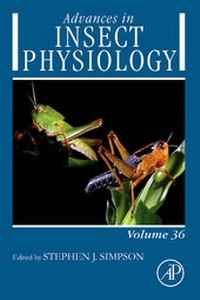
Advances in Insect Physiology: Volume 36
Locust Phase Polyphenism: An Update
Published on 23. September 2009
Book
Hardback
285 pages
978-0-12-374828-7 (ISBN)
Description
Advances in Insect Physiology publishes volumes containing important, comprehensive and in-depth reviews on all aspects of insect physiology. It is an essential reference source for invertebrate physiologists and neurobiologists, entomologists, zoologists and insect biochemists. First published in 1963, the serial is now edited by Steven Simpson and Jerome Casas to provide an international perspective. This volume is a thematic volume focusing on locust phase polyphenism.
More details
Series
Language
English
Place of publication
San Diego
United States
Publishing group
Elsevier Science Publishing Co Inc
Target group
Professional and scholarly
Entomologists, zoologists, insect biochemists, insect physiologists
Dimensions
Height: 229 mm
Width: 152 mm
Weight
600 gr
ISBN-13
978-0-12-374828-7 (9780123748287)
Copyright in bibliographic data and cover images is held by Nielsen Book Services Limited or by the publishers or by their respective licensors: all rights reserved.
Schweitzer Classification
Other editions
Additional editions
E-Book
05/2014
Academic Press
€131.00
Available for download
Persons
Content
1. Introduction
2. Insect polyphenism
3. Density-dependent phase polyphenism
4. Locust phase characteristics
5. Morphology
6. Anatomy
7. Colouration and pigments
8. Reproduction
9. Endocrinology
10. Biochemistry and Molecular Biology
11. Behaviour
12. Volatiles and volatile phermones
13. Cuticular substances and contact phermones
14. Factors that induce gregarious phase characteristics
15. Factors that induce solitarious phase characteristics
16. Transmission of phase from parents to progeny
17. Ecology and ecophysiology
18. Concluding remarks
2. Insect polyphenism
3. Density-dependent phase polyphenism
4. Locust phase characteristics
5. Morphology
6. Anatomy
7. Colouration and pigments
8. Reproduction
9. Endocrinology
10. Biochemistry and Molecular Biology
11. Behaviour
12. Volatiles and volatile phermones
13. Cuticular substances and contact phermones
14. Factors that induce gregarious phase characteristics
15. Factors that induce solitarious phase characteristics
16. Transmission of phase from parents to progeny
17. Ecology and ecophysiology
18. Concluding remarks