

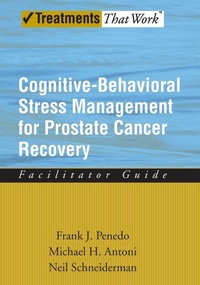
Cognitive-Behavioral Stress Management for Prostate Cancer Recovery
Facilitator Guide
Published on 20. March 2008
Book
Paperback/Softback
224 pages
978-0-19-533697-9 (ISBN)
Description
Men treated for localized prostate cancer have an excellent medical prognosis, but may have difficulty in readjusting to life after surgery as a result of treatment related side effects. Changes in physical functioning and ongoing PSA monitoring due to the possibility of recurrence may bring added stress. Effective stress management is a key factor in increasing quality of life in this population and may play a role in maintaining overall health.
Cognitive Behavioral Stess Management (CBSM) and relaxation training consitute the two components of this comprehensive program. Each session provides participants with stress management skills, including cognitive restructuring, coping strategies, and social support. Participants practice a variety of relaxation methods, such as progressive muscle relaxation, imagery, and meditation. Relevant issues for men having had prostate cancer, such as sexuality and communication, are also addressed.
This guide is designed to be used in conjunction with the corresponding workbook, which includes in-session exercises, monitoring forms, and homework assignments. Group meetings combined with home practice facilitate the application of effective stress management and relaxation techniques to the everyday lives of participants. Together, the guide and workbook include all the material and information needed to successfully implement this program.
Cognitive Behavioral Stess Management (CBSM) and relaxation training consitute the two components of this comprehensive program. Each session provides participants with stress management skills, including cognitive restructuring, coping strategies, and social support. Participants practice a variety of relaxation methods, such as progressive muscle relaxation, imagery, and meditation. Relevant issues for men having had prostate cancer, such as sexuality and communication, are also addressed.
This guide is designed to be used in conjunction with the corresponding workbook, which includes in-session exercises, monitoring forms, and homework assignments. Group meetings combined with home practice facilitate the application of effective stress management and relaxation techniques to the everyday lives of participants. Together, the guide and workbook include all the material and information needed to successfully implement this program.
Reviews / Votes
These two companion books provide a paradigm for manuals of treatments in health psychology...they set the standard for future publications of this kind. * PsycCritiques *More details
Series
Language
English
Place of publication
New York
United States
Target group
Professional and scholarly
Dimensions
Height: 254 mm
Width: 178 mm
Thickness: 12 mm
Weight
431 gr
ISBN-13
978-0-19-533697-9 (9780195336979)
Copyright in bibliographic data and cover images is held by Nielsen Book Services Limited or by the publishers or by their respective licensors: all rights reserved.
Schweitzer Classification
Other editions
Additional editions
Frank J. Penedo | Michael H. Antoni | Neil Schneiderman
Cognitive-Behavioral Stress Management for Prostate Cancer Recovery Facilitator Guide
E-Book
03/2008
1st Edition
OUP eBook
€40.99
Available for download
Frank J. Penedo | Michael H. Antoni | Neil Schneiderman
Cognitive-Behavioral Stress Management for Prostate Cancer Recovery Facilitator Guide
Facilitator Guide
E-Book
03/2008
1st Edition
OUP eBook
€40.99
Available for download
Persons
Frank J. Penedo, Ph.D., is a clinical health psychologist and associate professor at the University of Miami, Department of Psychology, and the University of Miami Sylvester Comprehensive Cancer Center (SCCC), Division of Biobehavioral Oncology and Cancer Epidemiology. He is also a member of Geriatrics Research Education and Clinical Center (GRECC) at the Miami VAMC and the University of Miami Center on Aging.
Michael H. Antoni, Ph.D., is Professor of Psychology and Psychiatry and Behavioral Sciences at the University of Miami and Program Leader at the Sylvester Comprehensive Cancer Center, and has been a licensed psychologist in the State of Florida since 1987. Dr. Antoni leads the Biobehavioral Oncology, Epidemiology, Prevention and Control research program, which includes over 20 faculty from the departments of Psychology, Psychiatry, Epidemiology, Medicine, and
Microbiology/Immunology working together on transdisciplinary research projects. Dr. Antoni also serves on the graduate faculty in both the Clinical Health Psychology doctoral program and the Cancer Biology doctoral program at the
University of Miami.
Neil Schneiderman, Ph.D., is James L. Knight Professor of Health Psychology, Psychiatry and Behavioral Sciences, and Medicine at the University of Miami. He is Director of the University's Behavioral Medicine Research Center and Director of the Division of Health Psychology in the Department of Psychology. Dr. Schneiderman is the Director of both an NIH Program Project and a Research Training Grant from the National Heart Lung and Blood Institute on biobehavioral bases of cardiovascular
disease risk and management. He is also Principal Investigator of the NIH Multi-Center Hispanic Community Health Study as well as an NIMH Research Training Grant on psychoneuroimmunology and HIV/AIDS.
Michael H. Antoni, Ph.D., is Professor of Psychology and Psychiatry and Behavioral Sciences at the University of Miami and Program Leader at the Sylvester Comprehensive Cancer Center, and has been a licensed psychologist in the State of Florida since 1987. Dr. Antoni leads the Biobehavioral Oncology, Epidemiology, Prevention and Control research program, which includes over 20 faculty from the departments of Psychology, Psychiatry, Epidemiology, Medicine, and
Microbiology/Immunology working together on transdisciplinary research projects. Dr. Antoni also serves on the graduate faculty in both the Clinical Health Psychology doctoral program and the Cancer Biology doctoral program at the
University of Miami.
Neil Schneiderman, Ph.D., is James L. Knight Professor of Health Psychology, Psychiatry and Behavioral Sciences, and Medicine at the University of Miami. He is Director of the University's Behavioral Medicine Research Center and Director of the Division of Health Psychology in the Department of Psychology. Dr. Schneiderman is the Director of both an NIH Program Project and a Research Training Grant from the National Heart Lung and Blood Institute on biobehavioral bases of cardiovascular
disease risk and management. He is also Principal Investigator of the NIH Multi-Center Hispanic Community Health Study as well as an NIMH Research Training Grant on psychoneuroimmunology and HIV/AIDS.
Author
Clinical Health Psychologist and Associate ProfessorClinical Health Psychologist and Associate Professor, University of Miami, Miami, Florida, USA
Professor of Psychology, Psychiatry and Behavioral SciencesProfessor of Psychology, Psychiatry and Behavioral Sciences, University of Miami, Miami, Florida, USA
James L. Knight Professor of Health Psychology, Psychiatry, and Behavioral SciencesJames L. Knight Professor of Health Psychology, Psychiatry, and Behavioral Sciences, University of Miami, Miami, Florida, USA
Content
1. Introductory Information for Facilitators ; 2. Logistics of the Cognitive-Behavioral Stress Management Intervention Program ; 3. Session 1: Introduction to the Program / Stress Awareness and Physical Responses / 8-Muscle-Group Progressive Muscle Relaxation ; 4. Session 2: Diaphragmatic Breathing and 4-Muscle-Group Progressive Muscle Relaxation / Stress Awareness and the Appraisal Process ; 5. Session 3: Deep Breathing and Counting with Passive Progressive Muscle Relaxation / Sex and Sexuality After Prostate Cancer Treatment and Automatic Thoughts ; 6. Session 4: Special Place Imagery / Cognitive Distortions ; 7. Session 5: Relaxation for Healing and Well-Being / Cognitive Restructuring ; 8. Session 6: Autogenic Training ; 9. Session 7: Autogenics with Visual Imagery and Positive Self-Suggestions / Coping II ; 10. Session 8: Mentra Meditation / Anger Management ; 11. Session 9: Minfulness Meditation / Assertive Communication ; 12. Session 10: Group Favourite Relaxation Exercise / Social Support and Program Wrap-Up ; Session Evaluation Sheets ; Fidelity Checklists ; References ; About the Authors