

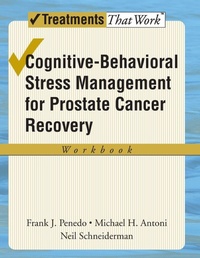
Cognitive-Behavioral Stress Management for Prostate Cancer Recovery: Workbook
Workbook
Published on 20. March 2008
Book
Paperback/Softback
160 pages
978-0-19-533698-6 (ISBN)
Description
After surgery for localized prostate cancer, you may find that treatment related side effects may lead to some difficulty readjusting to everyday life. You may notice an increase in your stress levels or experience problems in your relationships. Even though you may be physically healthy, you may need to work on improving your quality of life. Effective stress management may also help maintain your overall health.
In this group program, you will learn skills to effectively manage your stress. These skills can be used to cope with stressful situations related to having had prostate cancer or with any other situation that may cause stress. You will address issues such as dealing with physical changes or communicating with your partner. Each group meeting also includes training in a relaxation method in order to help you reduce tension and stress. By the end of the program, you will have a variety of techniques to choose from.
This workbook comes complete with homework exercises and monitoring forms to help you apply your new stress management skills. It also includes instructions for relaxation practice that will remain useful long after you've completed the program. Used in conjunction with the group program described in the corresponding facilitator guide, this workbook will help you better your life.
In this group program, you will learn skills to effectively manage your stress. These skills can be used to cope with stressful situations related to having had prostate cancer or with any other situation that may cause stress. You will address issues such as dealing with physical changes or communicating with your partner. Each group meeting also includes training in a relaxation method in order to help you reduce tension and stress. By the end of the program, you will have a variety of techniques to choose from.
This workbook comes complete with homework exercises and monitoring forms to help you apply your new stress management skills. It also includes instructions for relaxation practice that will remain useful long after you've completed the program. Used in conjunction with the group program described in the corresponding facilitator guide, this workbook will help you better your life.
Reviews / Votes
These two companion books provide a paradigm for manuals of treatments in health psychology...they set the standard for future publications of this kind. * PsycCritiques *More details
Series
Language
English
Place of publication
New York
United States
Target group
Professional and scholarly
Illustrations
10 black and white line illustrations
Dimensions
Height: 280 mm
Width: 216 mm
Thickness: 10 mm
Weight
426 gr
ISBN-13
978-0-19-533698-6 (9780195336986)
Copyright in bibliographic data and cover images is held by Nielsen Book Services Limited or by the publishers or by their respective licensors: all rights reserved.
Schweitzer Classification
Other editions
Additional editions
Frank J. Penedo | Michael H. Antoni | Neil Schneiderman
Cognitive-Behavioral Stress Management for Prostate Cancer Recovery Workbook
Workbook
E-Book
03/2008
1st Edition
OUP eBook
€29.99
Available for download
Frank J. Penedo | Michael H. Antoni | Neil Schneiderman
Cognitive-Behavioral Stress Management for Prostate Cancer Recovery Workbook
E-Book
03/2008
1st Edition
OUP eBook
€29.99
Available for download
Persons
Frank J. Penedo, Ph.D., is a clinical health psychologist and associate professor at the University of Miami, Department of Psychology, and the University of Miami Sylvester Comprehensive Cancer Center (SCCC), Division of Biobehavioral Oncology and Cancer Epidemiology. He is also a member of Geriatrics Research Education and Clinical Center (GRECC) at the Miami VAMC and the University of Miami Center on Aging.
Michael H. Antoni, Ph.D., is Professor of Psychology and Psychiatry and Behavioral Sciences at the University of Miami and Program Leader at the Sylvester Comprehensive Cancer Center, and has been a licensed psychologist in the State of Florida since 1987. Dr. Antoni leads the Biobehavioral Oncology, Epidemiology, Prevention and Control research program, which includes over 20 faculty from the departments of Psychology, Psychiatry, Epidemiology, Medicine, and
Microbiology/Immunology working together on transdisciplinary research projects. Dr. Antoni also serves on the graduate faculty in both the Clinical Health Psychology doctoral program and the Cancer Biology doctoral program at the
University of Miami.
Neil Schneiderman, Ph.D., is James L. Knight Professor of Health Psychology, Psychiatry and Behavioral Sciences, and Medicine at the University of Miami. He is Director of the University's Behavioral Medicine Research Center and Director of the Division of Health Psychology in the Department of Psychology. Dr. Schneiderman is the Director of both an NIH Program Project and a Research Training Grant from the National Heart Lung and Blood Institute on biobehavioral bases of
cardiovascular disease risk and management. He is also Principal Investigator of the NIH Multi-Center Hispanic Community Health Study as well as an NIMH Research Training Grant on psychoneuroimmunology and HIV/AIDS.
Michael H. Antoni, Ph.D., is Professor of Psychology and Psychiatry and Behavioral Sciences at the University of Miami and Program Leader at the Sylvester Comprehensive Cancer Center, and has been a licensed psychologist in the State of Florida since 1987. Dr. Antoni leads the Biobehavioral Oncology, Epidemiology, Prevention and Control research program, which includes over 20 faculty from the departments of Psychology, Psychiatry, Epidemiology, Medicine, and
Microbiology/Immunology working together on transdisciplinary research projects. Dr. Antoni also serves on the graduate faculty in both the Clinical Health Psychology doctoral program and the Cancer Biology doctoral program at the
University of Miami.
Neil Schneiderman, Ph.D., is James L. Knight Professor of Health Psychology, Psychiatry and Behavioral Sciences, and Medicine at the University of Miami. He is Director of the University's Behavioral Medicine Research Center and Director of the Division of Health Psychology in the Department of Psychology. Dr. Schneiderman is the Director of both an NIH Program Project and a Research Training Grant from the National Heart Lung and Blood Institute on biobehavioral bases of
cardiovascular disease risk and management. He is also Principal Investigator of the NIH Multi-Center Hispanic Community Health Study as well as an NIMH Research Training Grant on psychoneuroimmunology and HIV/AIDS.
Author
Clinical Health Psychologist and Associate ProfessorClinical Health Psychologist and Associate Professor, University of Miami, Miami, Florida, USA
Professor of Psychology, Psychiatry, and Behavioral SciencesProfessor of Psychology, Psychiatry, and Behavioral Sciences, University of Miami, Miami, Florida, USA
James L. Knight Professor of Health Psychology, Psychiatry, and Behavioral SciencesJames L. Knight Professor of Health Psychology, Psychiatry, and Behavioral Sciences, University of Miami, Miami, Florida, USA
Content
Overview of the Program ; 1. Introduction to the Program / Stress Awareness and Physical Responses / 8-Muscle-Group Progressive Muscle Relaxation ; 2. Stress Awareness and the Appraisal Process / Diaphragmatic Breathing and 4-Muscle-Group Progressive Muscle Relaxation ; 3. Sex and Sexuality After Prostate Cancer Treatment and Automatic Thoughts / Deep Breathing and Counting with Passive Progressive Muscle Relaxation ; 4. Cognitive Distortions / Special Place Imagery ; 5. Cognitive Restructuring / Relaxation for Healing and Well-Being ; 6. Coping I / Autogenic Training ; 7. Coping II / Autogenics with Visual Imagery and Postive Self-Suggestions ; 8. Anger Management / Mantra Meditation ; 9. Assertive Communication / Mindfulness Meditation ; 10. Social Support and Program Wrap-Up ; Additional Monitoring Worksheets