

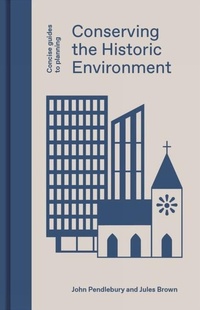
Conserving the Historic Environment
Published on 28. June 2021
Book
Hardback
160 pages
978-1-84822-299-1 (ISBN)
Description
Why do we decide that parts of our built environment are worth the special attention that heritage designation brings? How can the character of conservation areas and other historic places continue to evolve to provide new housing, release their economic potential and enhance communities? What are the principles to understand when judging the impact of new development or alterations to our significant heritage assets? And what about the future of conservation? In seeking to answer such questions, this book provides a grounding for planners and other related professionals in the key concepts associated with conservation and how to apply them in practice.
It begins by setting out the values and principles that underpin the current conservation-planning systems, explaining their historic context and evolution and critically examining these systems and possible counter approaches. Illustrated by a wide range of examples of historic and modern buildings, conservation areas, world heritage sites, parks and gardens, it then focuses upon decision-making and the management of change. It discusses how the conservation of the historic environment has become increasingly linked to other social and economic policy objectives before identifying key lessons and implications for future policy development and planning practice.
It begins by setting out the values and principles that underpin the current conservation-planning systems, explaining their historic context and evolution and critically examining these systems and possible counter approaches. Illustrated by a wide range of examples of historic and modern buildings, conservation areas, world heritage sites, parks and gardens, it then focuses upon decision-making and the management of change. It discusses how the conservation of the historic environment has become increasingly linked to other social and economic policy objectives before identifying key lessons and implications for future policy development and planning practice.
Reviews / Votes
'a valuable starting reference for non-specialist planners, other related professions, students and any member of the public who might be trying to grasp an understanding of decision-making, or indeed toinfluence the (sometimes seemingly illogical) decisions and recommendations made by heritage professionals.' - Context magazine (from the Institute of Historic Building Conservation)
More details
Series
Language
English
Place of publication
London
United Kingdom
Illustrations
Illustrations; 50 Illustrations, black and white
Dimensions
Height: 135 mm
Width: 208 mm
Thickness: 19 mm
Weight
372 gr
ISBN-13
978-1-84822-299-1 (9781848222991)
Copyright in bibliographic data and cover images is held by Nielsen Book Services Limited or by the publishers or by their respective licensors: all rights reserved.
Schweitzer Classification
Other editions
Additional editions
John Pendlebury | Jules Brown
Conserving the Historic Environment
E-Book
06/2021
Lund Humphries Publishers Ltd
€48.99
Available for download
Persons
John Pendlebury
is Professor of Urban Conservation at the Global Urban Research Unit, Newcastle
University. Prior to entering academia, he had ten years' practice experience
as a town planner and urban conservationist.
Jules Brown is
chair of the Institute of Historic Building Conservation, North Branch, and a
conservation and planning manager at the North of England Civic Trust.
is Professor of Urban Conservation at the Global Urban Research Unit, Newcastle
University. Prior to entering academia, he had ten years' practice experience
as a town planner and urban conservationist.
Jules Brown is
chair of the Institute of Historic Building Conservation, North Branch, and a
conservation and planning manager at the North of England Civic Trust.
Content
1. Introduction; 2. Theories; 3. Principles of research, analysis and management; 4. Managing change: buildings; 5. Managing change: areas; 6. Conserving non-traditional environments: the heritage of modernity; 7. Conservation and impact; 8. Conservation and the Future