

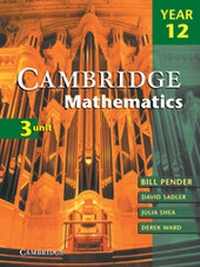
Cambridge 3 Unit Mathematics Year 12
Published on 12. October 2000
Book
Mixed media product
520 pages
978-0-521-65865-2 (ISBN)
Description
Cambridge Mathematics 3 Unit Year 12 spans the full range of NSW 3 Unit Mathematics students' abilities. In each exercise, the book provides a large number and a great variety of questions that are carefully graded and range from quite easy to very demanding. The book provides links to other topics and requirements for explanation in the style of recent HSC papers and is designed to expand and develop the wide range of student abilities through extensive and aptly graded exercises. There is a large number of fully worked examples and theory is logically developed and clearly explained. Chapters are systematically divided into manageable sections which consist of a substantial exercise preceded by theory and worked examples. The exercises are divided into three groups: foundation, development, and extension.
More details
Series
Language
English
Place of publication
Cambridge
United Kingdom
Target group
Primary & secondary/elementary & high school
Interest Age: From 14 to 16 years
Product notice
Paperback (trade)
Illustrations
Worked examples or Exercises
Dimensions
Height: 281 mm
Width: 211 mm
Thickness: 19 mm
Weight
1060 gr
ISBN-13
978-0-521-65865-2 (9780521658652)
Copyright in bibliographic data and cover images is held by Nielsen Book Services Limited or by the publishers or by their respective licensors: all rights reserved.
Schweitzer Classification
Other editions
New editions
William Pender | David Saddler | Julia Shea
Cambridge 3 Unit Mathematics Year 12 Enhanced Version
Book
04/2011
2nd Edition
Cambridge University Press
€47.75
Article not available
Content
Preface; How to use this book; About the authors; Chapter one - The inverse trigonometric function: 1A. Restricting the domain, 1B. Defining the inverse trigonometric functions, 1C. Graphs involving inverse trigonometric functions, 1D. Differentiation, 1E. Integration, 1F. General solutions of trigonometric equations; Chapter two - Further trigonometry: 2A. Trigonometric identities, 2B. The t-formulae, 2C. Applications of trigonometric identities, 2D. Trigonometric equations, 2E. The sum of sine and cosine functions, 2F. Extension - Products to sums and sums to products, 2G. Three-dimensional trigonometry, 2H. Further three-dimensional trigonometry; Chapter three - Motion: 3A. Average velocity and speed, 3B. Velocity and acceleration as derivatives, 3C. Integrating with respect to time, 3D. Simple harmonic motion - the time equations, 3E. Motion using functions of displacement, 3F. Simple harmonic motion - the differential equation, 3G. Projectile motion - the time equations, 3H. Projectile motion - the equation of path; Chapter four - Polynomial functions: 4A. The language of polynomials, 4B. Graphs of polynomial functions, 4C. Division of polynomials, 4D. The remainder and factor theorems, 4E. Consequences of the factor theorem, 4F. The zeroes and the coefficients, 4G. Geometry using polynomial techniques; Chapter five - The binomial theorem: 5A. The Pascal triangle, 5B. Further work with the Pascal triangle, 5C. Factorial notation, 5D. The binomial theorem, 5E. Greatest coefficient and greatest term, 5F. Identities on the binomial coefficients; Chapter six - Further calculus: 6A. Differentiation of the six trigonometric functions, 6B. Integration using the six trigonometric functions, 6C. Integration by substitution, 6D. Further integration by substitution, 6E. Approximate solutions and Newton's method, 6F. Inequalities and limits revisited; Chapter seven - Rates and finance: 7A. Applications of APs and GPs, 7B. Simple and compound interest, 7C. Investing money by regular instalments, 7D. Paying off a loan, 7E. Rates of change - differentiating, 7F. Rates of change - Integrating, 7G. Natural growth and decay, 7H. Modified natural growth and decay; Chapter eight - Euclidean geometry: 8A. Points, lines, parallels and angles, 8B. Angles in triangles and polygons, 8C. Congruence and special triangles, 8D. Trapezia and parallelograms, 8E. Rhombuses, rectangles and squares, 8F. Areas of plane figures, 8G. Pythagoras' theorem and its converse, 8H. Similarity, 8I. Intercepts on transversals; Chapter nine - Circle geometry: 9A. Circles, chords and arcs, 9B. Angles at the centre and circumference, 9C. Angles on the same and opposite arcs, 9D. Concyclic points, 9E. Tangents and radii, 9F. The alternate segment theorem, 9G. Similarity and circles; Chapter ten - Probability and counting: 10A. Probability and sample spaces, 10B. Probability and venn diagrams, 10C. Multi-stage experiments, 10D. Probability tree diagrams, 10E. Counting ordered selections, 10F. Counting with identical elements and cases, 10G. Counting unordered selections, 10H. Using counting in probability, 10I. Arrangements in a circle, 10J. Binomial probability; Answers to exercises; Index.