

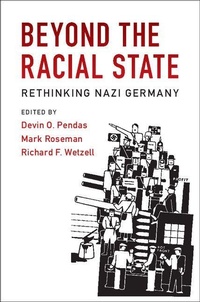
Beyond the Racial State
Rethinking Nazi Germany
Published on 16. November 2017
Book
Paperback/Softback
542 pages
978-1-316-61699-4 (ISBN)
Description
The 'racial state' has become a familiar shorthand for the Third Reich, encapsulating its raison d'etre, ambitions, and the underlying logic of its genocidal violence. The Nazi racial state's agenda is generally understood as a fundamental reshaping of society based on a new hierarchy of racial value. However, this volume argues that it is time to reappraise what race really meant under Nazism, and to question and complicate its relationship to the Nazis' agenda, actions, and appeal. Based on a wealth of new research, the contributors show that racial knowledge and racial discourse in Nazi Germany were far more contradictory and disparate than we have come to assume. They shed new light on the ways that racial policy worked and was understood, and consider race's function, content, and power in relation to society and nation, and above all, in relation to the extraordinary violence unleashed by the Nazis.
More details
Series
Language
English
Place of publication
Cambridge
United Kingdom
Target group
Professional and scholarly
College/higher education
Product notice
Paperback (trade)
Dimensions
Height: 229 mm
Width: 152 mm
Thickness: 32 mm
Weight
876 gr
ISBN-13
978-1-316-61699-4 (9781316616994)
Copyright in bibliographic data and cover images is held by Nielsen Book Services Limited or by the publishers or by their respective licensors: all rights reserved.
Schweitzer Classification
Other editions
Additional editions
Book
11/2017
Cambridge University Press
€129.50
Shipment within 15-20 days
Persons
Devin O. Pendas is Associate Professor of History at Boston College. He received his B.A. from Carleton College and his M.A. and Ph.D. from the University of Chicago. His research focuses on the history of Holocaust trials after World War II and the history of international law and mass violence. His publications include The Frankfurt Auschwitz Trial, 1963-1965: Genocide, History, and the Limits of the Law (Cambridge, 2006) and Political Trials in History and Theory (co-edited, Cambridge, 2017). Mark Roseman is Pat M Glazer Chair in Jewish Studies and Professor in History at Indiana University. Trained at Cambridge and Warwick Universities in the UK, he has taught in the UK and the USA. His books include The Past in Hiding (2000), The Villa, the Lake, the Meeting. The Wannsee Conference and the Final Solution (2002), and Jewish Responses to Persecution 1933-1946, Volume 1 (with Juergen Matthaeus, 2010). Richard F. Wetzell is a Research Fellow at the German Historical Institute in Washington DC. Trained at Swarthmore College, Columbia University and Stanford University, he was a Postdoctoral Fellow at Harvard and has taught at the University of Maryland, Georgetown University, and the Catholic University of America. His research focuses on the intersection of law, science, and politics in modern Germany. His publications include Inventing the Criminal: A History of German Criminology, 1880-1945 (2000), Engineering Society (co-edited, 2012), and Crime and Criminal Justice in Modern Germany (2014).
Content
Introduction; Part I. Comparative and Historical Perspectives: 1. Racial discourse, Nazi violence, and the limits of the racial state model Mark Roseman; 2. The murder of European Jewry: Nazi genocide in continental perspective Donald Bloxham; 3. Meanings of race and biopolitics in historical perspective Pascal Grosse; 4. Racial states in comparative perspective Devin O. Pendas; Part II. Race, Science, and Nazi Biopolitics: 5. Eugenics and racial science in Nazi Germany: was there a genesis of the 'final solution' from the spirit of science? Richard F. Wetzell; 6. Race science, race mysticism, and the racial state Dan Stone; 7. Ideology's logic: the evolution of racial thought in Germany from the voelkisch movement to the Third Reich Christian Geulen; 8. Nazi medical crimes, eugenics, and the limits of the racial state paradigm Herwig Czech; Part III. Anti-Semitism beyond Race: 9. 'The axis around which national socialist ideology turns': state bureaucracy, the Reich Ministry of the Interior and racial policy in the first years of the Third Reich Juergen Matthaeus; 10. Neither Aryan nor Semite: reflections on the meanings of race in Nazi Germany Richard Steigmann-Gall; 11. Racializing historiography: Anti-Jewish scholarship in the Third Reich Dirk Rupnow; Part IV. Race and Society: 12. Volksgemeinschaft: a controversy Michael Wildt; 13. Mothers, whores, or sentimental dupes? Emotion and race in historiographical debates about women in the Third Reich Annette F. Timm; 14. Nationalist mobilization: foreign diplomats' views on the Third Reich, 1933-1945 Frank Bajohr; 15. Race and humor in Nazi Germany Martina Kessel; 16. Legitimacy through war? Nicholas Stargardt; Part V. Race War? Germans and Non-Germans in Wartime: 17. Negotiating voelkisch and racial identities: the Deutsche Volksliste in annexed Poland Gerhard Wolf; 18. Sex, race, volksgemeinschaft: German soldiers' sexual encounters with local women and men during the war and the occupation in the Soviet Union, 1941-1945 Regina Muehlhaeuser; 19. The disintegration of the racial basis of the concentration camp system Stefan Hoerdler.